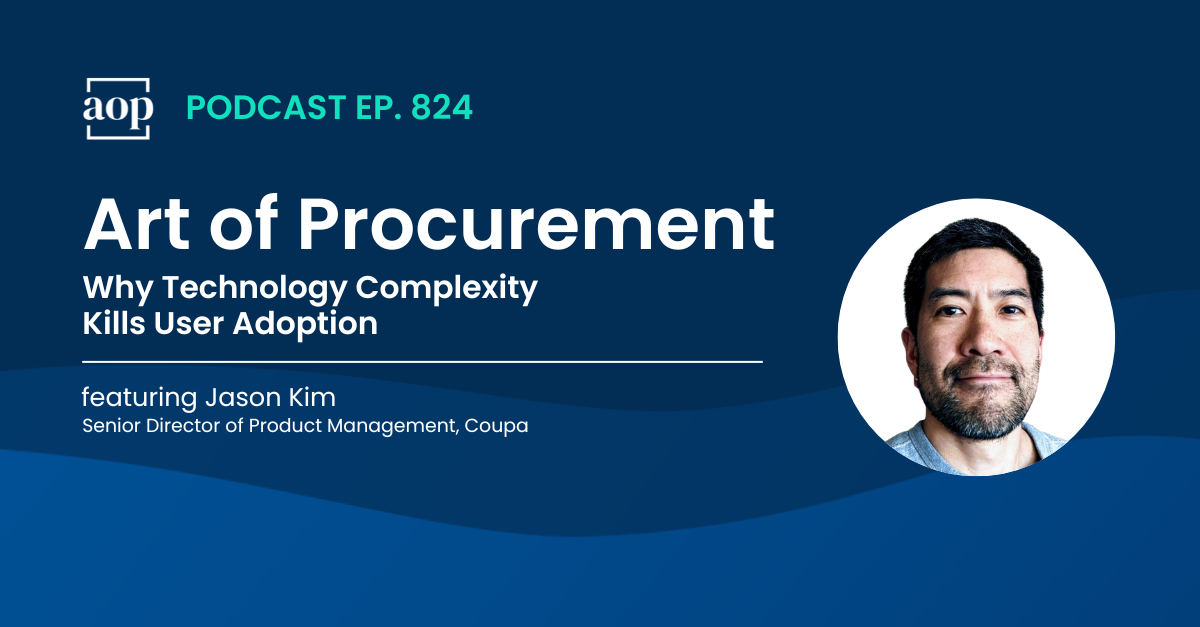
"I think we have hit a tipping point where procurement has become a pretty complicated practice. There's so many options and choices and optimizations with concepts that are just so alien to the typical user." - Jason Kim, Senior Director of Product Management, Coupa
Technology adoption is one of the biggest challenges facing many procurement organizations. While enterprise platforms offer sophisticated capabilities, many struggle with the fundamental challenge of making these tools accessible to both power users and occasional requesters.
Jason Kim, Senior Director of Product Management at Coupa, has extensive experience in procurement technology usability and the evolving landscape of enterprise software integration.
Based on his work on intake and orchestration, Jason provides valuable insights into designing procurement experiences that drive adoption rather than circumvention.
Here, in Jason's own words, are some stand-out moments from our recent conversation on the Art of Procurement podcast:
The Attention Window Challenge
"The ultimate goal is when [users] start interacting with the system, you know that you have your attention for a shorter period of time. And the goal would be in that short period of time, navigate them to where they are and gather the information from that in one fell swoop."
Successful procurement platforms must recognize that casual users have limited patience and attention spans. Optimizing for speed and efficiency in these brief interactions becomes critical for maintaining engagement and process compliance.
The Human Orchestration Problem
"Those practices where things were centralized, in essence, that person who was in that central organization, they were the intake. They were the orchestration."
Traditional procurement models relied on human intermediaries to manage complexity and workflow routing. Modern technology enables organizations to automate this effort while maintaining the personalized service that users expect and require.
The Cognitive Overhead Challenge
"The beauty of a well-designed inbound system is that it takes away that cognitive overhead, the need for you to read a manual, to understand when to do this versus that."
Successful procurement platforms eliminate the learning curve that prevents adoption. When users must study processes rather than simply complete transactions, organizations lose both compliance and user satisfaction.
Meeting Users Where They Are
"As more companies are deploying generative AI to their employee base or Claude or Grok, as that becomes more central to the flow of work, we as enterprise software providers need to be cognizant of that being a new user experience, a new user interface that we need to optimize around."
The future of procurement technology lies in integration with users' existing workflows rather than forcing context switches. This approach reduces friction and increases the likelihood of process adherence.
The Power of Transparency
"Even if you're an infrequent user and you've submitted something, you actually want to know all the different stages that request is going through... seeing it as part of the delivery gives you a better sense and understanding and truly a deeper appreciation of what the procurement function is."
Contrary to conventional wisdom about simplification, users value visibility into procurement processes. This transparency builds understanding and appreciation rather than creating confusion or overwhelm.
The Strategic Impact of Usability
"If I can't necessarily trust them to help me get my headset, how am I going to trust them to work on these really strategic things? Those ripple effects are real."
Poor user experience in simple procurement tasks directly undermines procurement's strategic credibility. Organizations that struggle with basic usability face challenges in gaining stakeholder trust for higher-value initiatives.