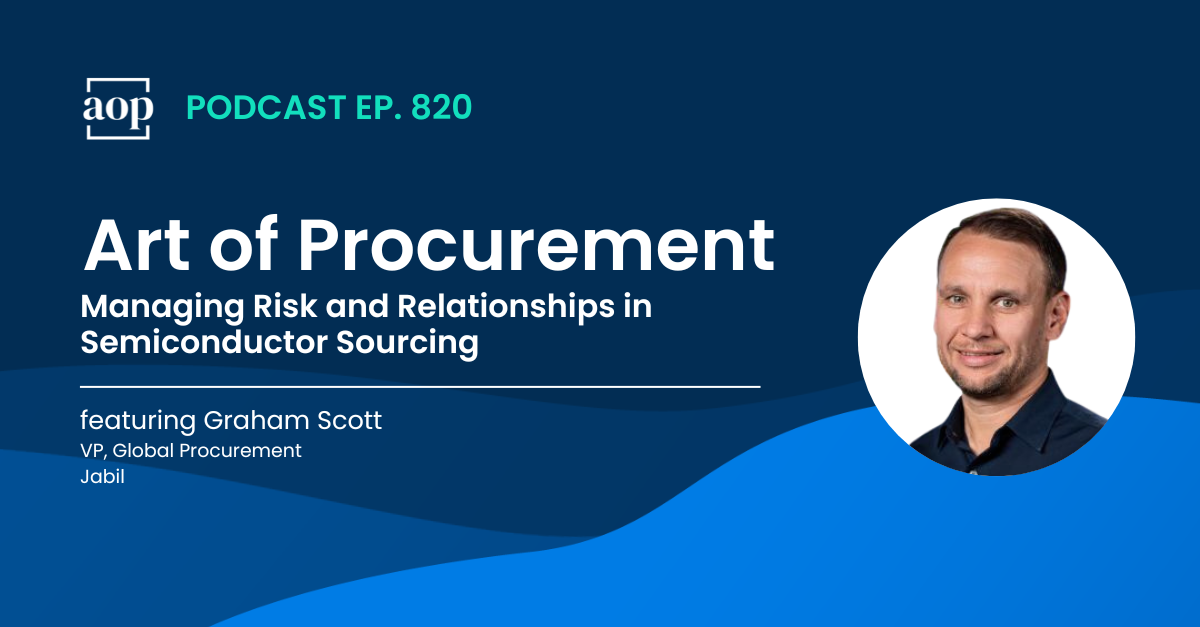
“It’s not going to take much to push us back into a shortage market where demand would exceed supply.” - Graham Scott, Vice President, Global Procurement at Jabil
The semiconductor market remains one of the most volatile supply ecosystems on the planet. After the wild ride of the pandemic, procurement leaders are weighing new opportunities against a backlog of lessons learned. Demand bubbles, shifting global investment, and stubborn inventory challenges make this a space where agility is mandatory and where yesterday's strategies may not be enough for tomorrow's disruptions.
I recently spoke with Graham Scott, Vive President of Global Procurement at Jabil, who gave me a rare, unvarnished look at the reality behind the headlines. Graham talks about known risks and new trends hitting the semiconductor landscape, and he lays out what CPOs need to be watching now.
Here, in Graham’s own words, are some stand-out moments from our conversation:
Demand Volatility Creates a Precarious Market
“We ended up in a bit of a bubble, I think...there's still a ton of inventory that's sitting around the industry, you know, whether that's with an OEM, with an EMS partner, with a distributor or with the manufacturer themselves of parts that probably aren't required anymore...book to bill ratios are pretty high at the moment, capacity utilization's low, lead times are short.”
According to Graham, procurement teams should plan for renewed supply disruption, even as stocks appear healthy. A small uptick in demand could quickly create a scramble.
What makes this especially dangerous is the false sense of security that surplus inventory can create. If that inventory doesn't match actual demand, organizations may be blindsided by shortages in critical components just as production ramps back up.
AI Drives New Capacity (But Old Risks Remain)
"AI is probably the one sector that's mentioned more by our supply base now than any other...we're seeing some of the tier one manufacturers now basically end the life product that was the shining light of maybe five, six years ago. So very quick to end the life of that product and really focus on the memory products that are required by the hyperscalers."
The race to support AI infrastructure means rapid product transitions and little patience for legacy needs. Buyers must keep pace with changing supplier roadmaps and advocate for investment in a full range of components.
Without constant supplier engagement, organizations risk finding that long-standing parts essential to their products are suddenly unavailable, forcing expensive redesigns or delays as AI-driven priorities dominate manufacturing capacity.
Geopolitics and Tariffs Slow Major Investment
"Suppliers are starting to understand that they need to be more transparent with their customers. Semiconductor suppliers in particular have been very slow in providing country of origin information, truly helping us understand the nodes in their manufacturing network....There's definitely been more transparency from the suppliers to help us understand that. So for sure, tariffs are impacting it...I'm not sure that any companies are making significant investment decisions until things settle out."
Strategic agility remains vital as global manufacturing pivots slowly (or not at all) in response to uncertain trade policies.
The ongoing ambiguity around tariffs discourages long-term capital investment, leaving procurement teams operating in a limbo where supply sources can shift overnight based on policy changes rather than market fundamentals, requiring constant contingency planning.
Optionality Becomes Standard Practice
"We really need to be way more agile, have the ability to have multi-source components... If you want to be specific about which assembly line you want your parts to come off of and which fab you want them to come out of, we can do that. It’s going to be a premium..."
CPOs should budget for the true costs of risk mitigation. Multi-sourcing, dual manufacturing sites, and flexibility all come at a price, but may be cheaper than shortages when shocks occur.
Organizations that fail to build this optionality into their sourcing strategies risk being entirely dependent on single points of failure – whether that's one supplier, one region, or even one factory – leaving them highly vulnerable when inevitable disruptions arise.
The Power of Relationship-Based Procurement
"We invested in supplier relationship management to ensure that we can talk to suppliers at an executive level about their longer-term plans...we're talking to suppliers about how we behave and how we're going to talk to people, we're going to treat people with respect."
Deep collaboration and trust with suppliers are key to accessing the data and support needed to navigate ongoing market turbulence.
By cultivating supplier relationships that extend beyond transactional negotiations, procurement can unlock critical early signals (such as upcoming technology shifts, capacity constraints, or geopolitical exposures) that would otherwise be invisible until they become full-blown crises.


.png)