
4 min read
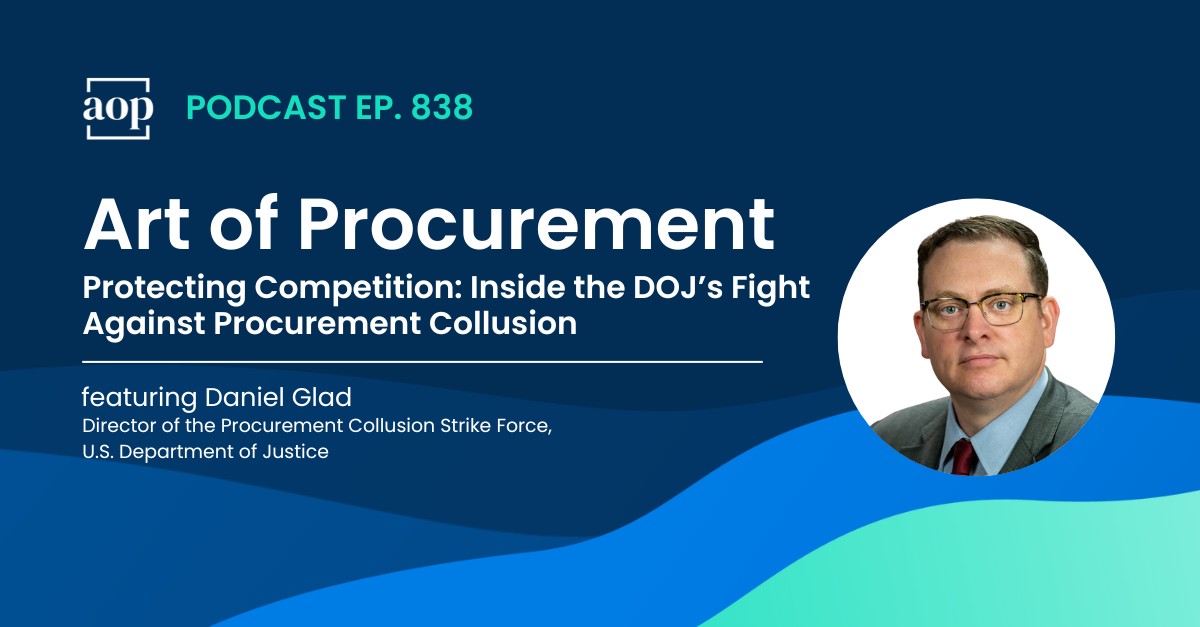
Protecting Competition: Inside the DOJ’s Fight Against Procurement Collusion
Philip Ideson : October 26, 2025
“Fraudulent conduct robs the government – at all levels, local, state, or federal – of the benefit of competition. Competition is free and open; it is the Magna Carta of the American economic system, and robbing the government of that benefit is inherently wrongful."- Daniel Glad
Procurement often talks about fairness, transparency, and the integrity of the sourcing process, but what happens when those principles are undermined… not by inefficiency or poor governance, but by deliberate criminal behavior?
That’s the focus of my recent conversation with Daniel Glad, Director of the Procurement Collusion Strike Force (PCSF) at the U.S. Department of Justice. His team investigates and prosecutes antitrust crimes – such as bid rigging, price fixing, and market allocation – that threaten fair competition in government procurement.
Our discussion was a fascinating look at how the DOJ detects and deters collusion, the patterns that indicate something isn’t right, and the new whistleblower program designed to encourage people to come forward.
Here are some of the key moments and insights that stood out to me.
Finding Purpose in Public Service
“I’m not sure if I found procurement or if it found me. My first job in government was with the City of Chicago Office of Inspector General, dedicated to rooting out fraud, waste, and abuse. Many of our cases involved companies tilting the playing field in their favor at the expense of taxpayers. Those cases were fascinating and righteous.” – Daniel
What struck me here was Daniel’s deep sense of mission. His entry into this work wasn’t through policy or process, but through a desire to serve justice and protect public resources from misuse. It’s a reminder that procurement, at its core, exists to serve the public good.
What the Strike Force Does
“We are an interagency group started in 2019. We stand ready to detect, deter, investigate, and prosecute antitrust crimes and other related schemes that victimize government spending on goods and services. I’m in charge of overall strategy and building relationships, but the real work is happening with prosecutors and agents in 25 cities around the country.” – Daniel
The scale of the Strike Force surprised me: 25 judicial districts, 12 partner agencies, and coordination across federal, state, and local levels. Daniel’s emphasis on partnership reflects what many procurement leaders already understand: collaboration is the only way to combat complex, systemic risks.
How Criminal Conduct Takes Shape
“The classic examples are going to be things like bid rigging, price fixing, or market allocation. Sometimes it’s not bid rigging because you don’t have competitors reaching an agreement, but it’s fraud upon the United States: fake bids, shell corporations, or bribes paid to insiders. What it essentially is, is conduct that robs the government of the benefit of competition.” – Daniel
That phrase “robs the government of the benefit of competition” is powerful. Procurement integrity depends on open, fair markets. When collusion replaces competition, it’s not just a legal problem; it’s an economic and ethical one.
Detecting Collusion and Red Flags
“We receive complaints from the public who see something and say something. We also get cases from contracting officers who may not know exactly what they’re seeing, but they know something’s wrong. We’re proactive, too, using data analytics and, in some cases, even wiretaps to detect conspiracies in real time.” – Daniel
I found this fascinating because it shows the blend of human intuition and digital intelligence at work in the DOJ. Data can reveal anomalies, but it often takes someone inside procurement, someone who senses that something isn’t right, to trigger the investigation. Awareness and vigilance are our first line of defense.
How Technology Changed the Game
“When I first started my career, most communications (legitimate and criminal) were on company systems. Now people are multi-channel communicators. They use apps like WhatsApp and Signal. That’s a challenge for compliance and investigation, but it also leaves more traces. It’s a challenge, but also an opportunity.” – Daniel
Technology has made misconduct harder to hide but easier to create. Daniel’s point underscores why procurement compliance and audit functions must evolve alongside communication habits. Transparency depends not just on intent, but on access to the data trails modern business leaves behind.
Intent and Accountability
“You had to know that you were going to agree to rig bids or fix prices. You don’t have to know it was illegal. Ignorance of the law is not a defense. But people often take steps to hide what they’re doing because they know it’s wrong. Sometimes that’s speaking in code or sending emails that say ‘delete after reading.’” – Daniel
This gets to the heart of accountability. Collusion isn’t accidental; it’s calculated. The examples Daniel shared make clear that ethical boundaries are often crossed in secret, and that secrecy itself becomes evidence. For honest practitioners, it’s also a reminder to keep documentation transparent and traceable.
Vulnerable Categories and Conditions
“There are certain hallmarks where this conduct pops up. One is when there are few players; it’s easier to keep a secret among three than among thirty. Another is when there are barriers to entry, like the high cost of capital equipment or regulatory hurdles. And another is when purchases are regular and predictable, like recurring government contracts.” – Daniel
Patterns like these are useful for anyone managing supplier risk. Market structure, frequency, and predictability all affect vulnerability. Even in the private sector, these same dynamics apply, especially in categories dominated by a few entrenched suppliers.
Emergencies and Ethics
“When emergencies happen, the guardrails go down, and as they probably should, because you’re trying to protect lives and public safety. But we’ve had cases where people saw a disaster and decided they had an angle. They exploited that moment.” – Daniel
This part hit hard. The pressure to move quickly in a crisis can make oversight harder, and opportunists know it. Ethical procurement isn’t about slowing things down but instead ensuring that urgency doesn’t override integrity.
Recognizing Red Flags
“Red flags aren’t proof that a crime is afoot, but they’re signs to stop and look deeper. Identical typos in bids, sudden identical pricing changes, or vendors who refuse to compete for new business… all can be indicators. Conferences and trade associations can also be danger zones if competitors discuss sensitive information.” – Daniel
The details here are concrete and useful. Procurement professionals don’t need to become investigators, but they do need to be attentive. As Daniel put it, be curious, not paranoid. A pattern that doesn’t feel right often isn’t.
Encouraging Whistleblowers
The DOJ’s new whistleblower program “...offers monetary incentives – up to 30% of recovered criminal fines – for people who provide original, credible information that leads to successful prosecutions. If you’re fixing prices or rigging bids, don’t assume your scheme is safe. Someone you know may get a reward for helping us find it.” – Daniel
This new program could be a game-changer. Beyond enforcement, it empowers insiders to take a stand and rewards ethical courage. In environments where silence can feel safer than speaking up, financial and legal protection matters.
The Broader Message
“Most people are good and law-abiding. But I want your listeners to be aware that this does happen. Based on our work, it happens in every part of the country and every part of the economy. Be curious.” – Daniel
Daniel’s recommendation to be curious might be the most important takeaway. Procurement’s role isn’t just to manage spend; it’s to protect the integrity of the systems that serve the public. Curiosity, transparency, and ethical vigilance are the safeguards that keep competition fair.
Links: