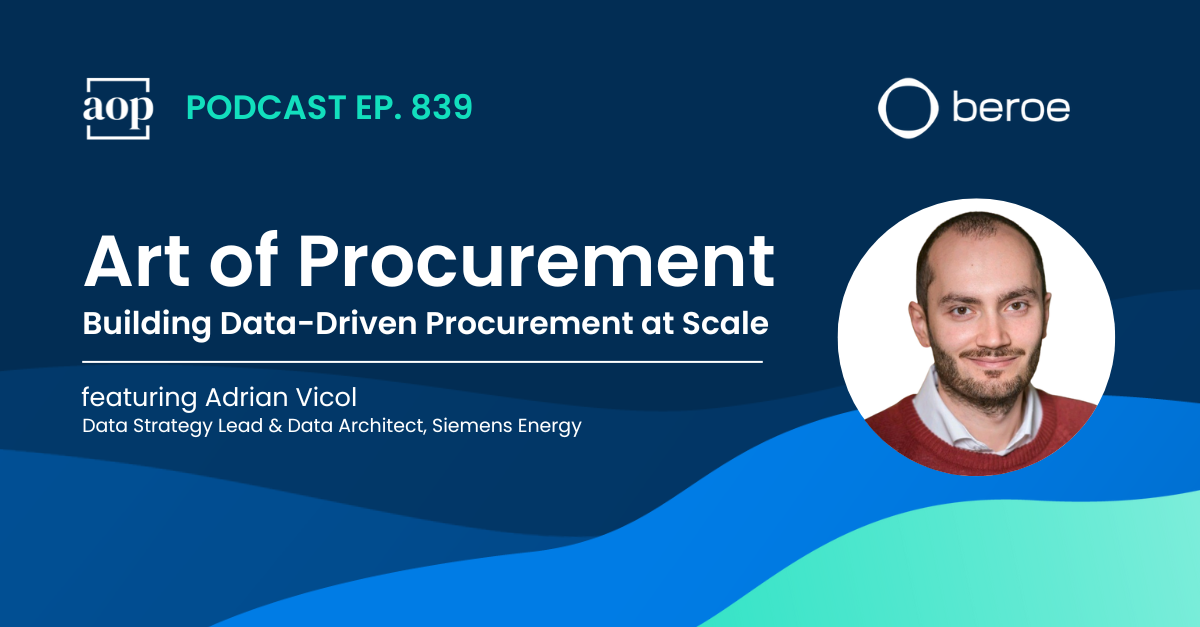
“The value you bring as a procurement function has transcended being a cost saver. They are now a discussion partner with other functions and bring value in the form of intelligence."
- Adrian Vicol, Data Strategy Lead & Data Architect, Siemens Energy
Procurement leaders talk a lot about AI and automation, but the truth is that most teams still struggle with the fundamentals: inconsistent data, siloed systems, and the ever-growing gap between what’s possible and what’s practical.
I had the chance to sit down in person with Adrian Vicol, Data Strategy Lead at Siemens Energy, at ProcureTEX in London. I was there as a guest of Beroe's to speak to some of their customers about what it really takes to close the gap between possible and practical and why it’s so much more than just a tech challenge.
Adrian’s approach is refreshingly pragmatic. He doesn’t just talk about future vision; he’s in the trenches making it happen, building the processes, roles, and infrastructure to support a truly data-driven procurement function. These are a few moments from our conversation that stood out to me.
Defining the North Star
“We actually have a North Star... and it centers around the full automation of the P2P process. That’s not something you can achieve tomorrow, but it’s something to strive towards.”
Setting a clear North Star gives data teams purpose and procurement functions direction. But Adrian was also realistic: full automation is aspirational. To even come close, you need foundational capabilities in place, starting with clean, structured, governed data. That includes building technical infrastructure and elevating data literacy across the team, especially on the consumption side: buyers, category managers, and business partners who rely on that data to make decisions.
Cleaning the Backlog and Staying Clean
“We practically split it between ‘get clean’ and ‘stay clean.’ So, there’s a set of activities that have to do with cleaning the backlog... That’s like the hardest thing, all the historical data.”
Adrian’s team doesn’t sugarcoat the effort required to address legacy data challenges. Many organizations simply move forward, hoping the old data won’t trip them up. But Adrian makes a strong case that both phases – the initial heavy lift to clean the backlog and the discipline to maintain quality moving forward – are essential. Without that dual focus, new digital investments are built on sand.
Bringing Human Insight into Systems
“You involve the professionals who are directly working with this... because in one way or another, most of them have been asking for a solution to make their lives easier.”
Adoption doesn’t come from a top-down mandate or a sleek UI. It starts with empathy for the people who hold deep knowledge – the engineers, buyers, and cost modelers – and who are often too busy to see how their insights could be systematized. Adrian emphasized how crucial it is to involve these professionals early in the design process, so the tools reflect their needs and elevate their contributions. That’s how you win buy-in and turn experience into scalable intelligence.
Treating Data as a Product
“Each team needs to create, handle, and maintain that data as if it were their own product... It needs to have proper labeling – like nutrition labels – so the person consuming that data knows what they’re getting.”
This shift in mindset is foundational. When teams see data not as an exhaust of operations but as a product in its own right, quality and ownership naturally improve. Procurement sits at the crossroads of so many data flows – logistics, finance, operations – and Adrian’s approach helps clarify responsibilities and expectations. A clean, documented dataset isn’t a bonus anymore; it’s a prerequisite for confident decision-making.
Cost Models and Market Intelligence Are Now Strategic
“We’ve gotten to a point where we can deconstruct at scale what the main cost drivers behind our commodities are... That was very difficult even five or six years ago.”
The combination of cost modeling and real-time market intelligence is transforming how procurement supports the business. Adrian talked about linking expert knowledge to external data (not just steel or rare earth prices, but how cost drivers vary globally) and embedding that into systems so the knowledge travels. That elevates procurement’s contribution from transactional sourcing to strategic, proactive decision support across the business.
Procurement as a Short-Term Intelligence Engine
“Procurement is positioning itself as a sort of short- to mid-term market intelligence provider for the organization.”
This reframes procurement’s role in a really compelling way. While strategy teams focus on long-term trends, procurement is becoming the go-to partner for near- and mid-term forecasts that affect day-to-day and quarter-to-quarter decisions. That’s a powerful position, but it also means procurement must sharpen its analytics, storytelling, and stakeholder alignment skills to meet the moment.