

4 min read
When Agents Make Bad Supply Chain Decisions at Machine Speed
Kelly Barner : October 8, 2026
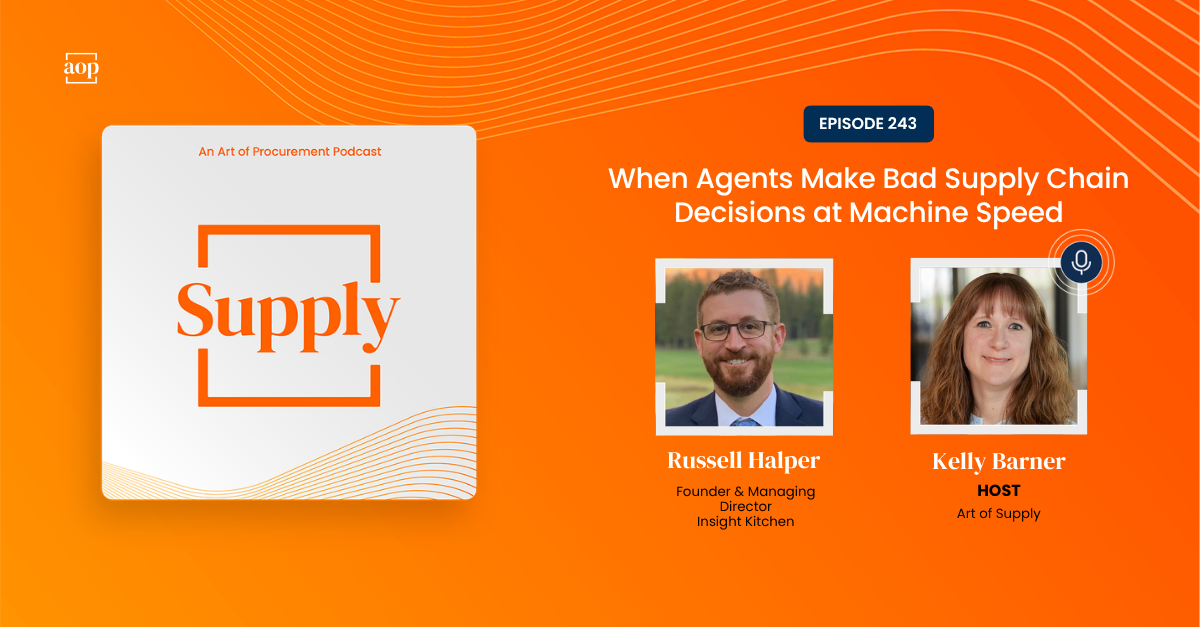
"Am I just making worse decisions way more quickly than I ever would before, and they're compounding and driving me down the wrong path?" – Russell Halper, Founder & Managing Director, Insight Kitchen
Artificial intelligence comes up in nearly every conversation about supply chain technology, from demand forecasting to production scheduling to distribution planning. But interest in AI doesn't automatically turn into operational results. The path from an early idea to measurable business value is often longer and more complicated than conference presentations suggest.
Russell Halper has spent his career working on that path. He is the founder and managing director of Insight Kitchen, an AI-native consultancy that applies data science to supply chain, revenue management, and integrated business planning.
In this episode of Art of Supply, we discuss where companies should start with AI, why supply chain has adopted it more slowly than some other functions, and how to build a roadmap that delivers progress along the way.
Applying Math in the Real World
Russell began in applied mathematics, studying chaos theory, before deciding academia wasn't the right fit. While still in school he took courses in operations research, the discipline of using mathematical models to improve business decisions. As he puts it, a more modern name for it would be data science and supply chain, or supply chain AI.
He joined a large consumer goods company's supply chain organization. There he worked on production scheduling and the systems behind it, as well as forecasting, distribution center operations, and transportation. He then spent eight years at End-to-End Analytics, a Palo Alto consulting firm that grew from 15 to 100 people while he moved from consultant to partner. After the firm was acquired by a larger consulting company, Russell ran a global supply chain solutions program and, after ChatGPT was released, helped build the firm's West Coast generative AI practice.
That experience shaped the idea behind Insight Kitchen, including its name. Russell described a pattern he saw repeatedly in technology projects:
"One of the challenges is that I felt like it was always about what technology do we need to put our customers into. It was never about the business problem first."
The "kitchen" is about finding the right recipe for each client. Sometimes that means recommending a planning platform, sometimes building something custom, and sometimes a combination of the two.
Starting with Data v. Desired Outcomes
Many AI initiatives begin with excitement about the technology and only later turn to the condition of the data. Russell's view is that very few companies have excellent data quality across the board:
"There's two categories generally: One is organizations that know they have bad data and the other is organizations that don't know they have bad data."
Rather than treating data cleanup as the first project, he recommends starting with the business result and working backward to what the data needs to support:
"My personal philosophy is generally not to start with data as the primary business focus of what we're trying to do, but more so to start with what's the outcome we're trying to achieve, and then trying to figure out what's the gap we need to get to from the current state to drive that outcome when looking at the data."
The move from generative AI to agentic AI, where software can carry out multi-step tasks and recommend or make decisions, cuts both ways. Data problems can spread further when data is used for more purposes. At the same time, Russell noted, "I have way better tools now than ever to be able to work on my data quality." He pointed to companies building data ontologies, which are structured models of how a business's products, locations, customers, and processes relate to each other, along with agents that can flag gaps in the data they are working with.
Why has supply chain been slower to adopt AI?
Some uses of AI, such as writing software code, have spread quickly because the benefits are immediate and the risks are easy to see. Supply chain is different. It involves physical constraints and processes that are hard to quantify, and the systems that capture what happens in the real world are often separate from the systems making decisions.
"If I'm using AI in the context of physical AI, I have a robot or a driverless car that's getting real world feedback. There's that immediate interaction feedback of if it's doing good or bad. In a supply chain, you have physical operations, but there's not this real time physical feedback into what the AI is doing often."
Russell added that supply chain technology has historically had longer implementation timelines than more transactional parts of the business. Many established supply chain solutions were also built on earlier generations of technology, with AI capabilities added later.
What should a supply chain AI roadmap focus on?
Because tools are changing so quickly, Russell encourages companies to treat their roadmap as a living document that emphasizes near-term wins over a fixed end state. He has seen some organizations move from connected, end-to-end solutions back toward best-of-breed tools because no one knows where technology will be in three or five years. What doesn't change is the underlying business problem:
Adoption has always been one of the biggest hurdles for new supply chain systems, and it determines whether a project produces a return. Russell sees promise in using AI to make tools easier to use, which he calls AI for UI:
"If I can use a prompt to help me answer some of the questions that otherwise I'd have to dig through reports for, that could be a huge win for the user community."
Running planning scenarios by typing a request is another example. The goal is to avoid a situation where users feel they are doing two jobs, operating the old system and the new one at the same time.
Build More Clarity Up Front
Russell's closing recommendation was to define what success looks like for each milestone before building anything, even for small projects:
"And so building more clarity up front, even for the little wins, on what actually is that win, will make the entire process of experimenting, of building enterprise capabilities, and everything in between, more predictable for the organization and an easier journey."
Russell's experience points to a consistent theme: AI delivers the most value when it is tied to a specific business outcome rather than adopted for its own sake. That means starting with areas like addressable spend, revenue leakage, or customer service, then assessing whether the data can support the goal, with the expectation that data quality will be imperfect and that current tools can help close the gaps. Supply chain teams should plan for longer timelines than more transactional functions, build roadmaps around near-term wins that are revisited as technology changes, and define how each milestone will be measured before work begins. When evaluating supply chain technology, it also helps to clarify what "AI" refers to in each solution, since the term now covers both new and long-established techniques. Finally, usability belongs in the business case, because adoption is what turns any of these investments into results.