
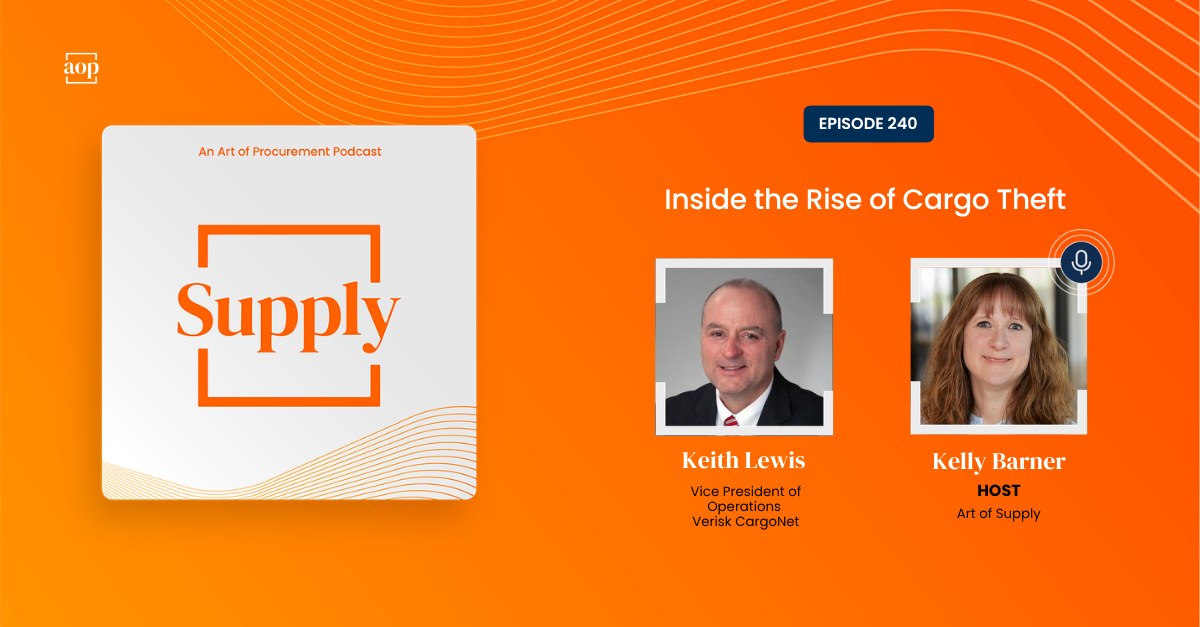
“I want your phone numbers, I want your internet domain, I want everything, your PO box, everything. Now I've become you.” - Keith Lewis, Vice President of Operations at Verisk CargoNet
Keith Lewis has spent more than 25 years on both sides of cargo crime. Before joining Verisk CargoNet, the theft prevention and recovery division of the data analytics firm Verisk, he worked in trucking, freight brokerage, and international supply chain logistics, including a stint managing just-in-time automotive shipments for Mercedes in Graz, Austria.
He earned a degree in criminal justice and became a police officer, spending 26 years in law enforcement before joining CargoNet's crime analyst unit in 2011. He remains an active, part-time law enforcement officer today, and his team works daily with agencies across the country to identify and help recover stolen freight.
In this episode, Keith explains how cargo theft has changed from a regional, seasonal nuisance into an organized, nationwide business, and what companies moving freight can actually do about it.
What is a purchased MC number, and why does it matter?
Every legal motor carrier in the U.S. operates under a motor carrier (MC) number, a credential that functions as a trucking company's identity and track record. According to Keith, criminal groups sometimes buy MC numbers directly from small carriers that have gone out of business. They might pay as little as $5,000 or as much as $200,000.
“In our world, if you're in business three years, that's an eternity,” Keith explained. “You've got a lot of credibility, you've got a good rating.” Once purchased, the buyer takes over the carrier's phone numbers, domain name, and mailing address. They effectively become that company for as long as it takes to book and disappear with several high-value loads. Because the MC number belongs to a business that's built up trust with shippers and brokers over the years, the fraud is difficult to catch until the freight is already gone.
A related tactic, a “misdirected” or “compromised” load, works differently. A driver picks up a shipment believing it's a normal blind shipment, common in trucking when the buyer and seller don't know each other, and is simply told to deliver it somewhere other than its intended destination. Some drivers are unaware anything is wrong; others suspect it but go along anyway.
Why has cargo theft's target list changed?
Ten to fifteen years ago, high-value cargo theft outside of pharmaceuticals was rare. Keith says that shifted with the buildout of data center infrastructure to support AI.
“A general shipment of some type of AI product could be in the $20 to $30 Million range,” he said, referring to servers, memory components, and the raw materials (including copper) used to build and wire data centers. That equipment has strong, immediate international demand, and so stolen loads can be resold close to full value, unlike lower-value goods that typically fetch a fraction of retail price on the resale market.
Why do some stolen goods disappear for good, and others don't?
The type of product stolen shapes what recovery even means. Perishable goods, like the $400,000 in lobster and crab meat stolen from a Taunton, Massachusetts cold-storage facility in December, provide a perfect example. This scheme involved a fraudulent carrier, a fake commercial driver's license, and forged paperwork. The thieves have a narrow window before products like that are unsellable and, often, unsafe to consume even if recovered.
Metals like copper behave differently: even if a load's market value drops, it can be melted down and resold as raw material. Electronics sit in between; they are not perishable in a matter of days, but subject to the same technology cycles that make yesterday's server rack less valuable than this year's model.
Why is theft reporting the biggest bottleneck to recovery?
Even when law enforcement locates stolen freight, sometimes an entire warehouse of it, as in a June 2026 Manhattan District Attorney indictment that CargoNet supported, recovery isn't automatic. In that case, eight people were charged with impersonating carriers to steal nearly $5 Million in lamb, cheese, beef, copper, and cigarettes across New Jersey, Pennsylvania, and Virginia.
“The biggest challenge that we have here is I need a theft report,” Keith said. Without a formal police report on file, officers can't legally seize goods under the Fourth Amendment, even when they strongly suspect the goods are stolen. Underreporting doesn't just hide the scale of the problem; it actively prevents the system from recovering freight that's already been located.
How does theft affect small businesses differently than large ones?
Keith described working with a small, family-run tile company in San Francisco that lost a quarter of a Million dollars after being defrauded by a fake carrier. Because the fraud invalidated the carrier's insurance, the loss fell entirely on the shipper.
It was significant enough, Keith said, that it nearly ended the business. Larger companies typically absorb similar losses more easily, often passing the added cost back to consumers through pricing rather than facing existential risk.
For procurement and supply chain leaders, the biggest shift here isn't the size of the losses. It is how easily a carrier's identity can be borrowed rather than built.
Vetting a company's MC number and safety rating isn't enough on its own anymore, since both can be purchased along with everything else that used to make a small carrier trustworthy.
The reporting gap matters just as much: a theft that never becomes an official police report is one law enforcement can locate but not legally touch. Multi-layered vetting, tighter data capture at the point of pickup, and faster reporting won't stop every attempt, but they close the gaps that make this kind of fraud so easy to run at scale.