

5 min read
How Physical AI Is Bringing Robots Into Real-World Warehouses
Kelly Barner : October 22, 2026
Most warehouses operating today were not designed with robots in mind. Pallets arrive with labels in unexpected places, aisles get blocked, and priorities shift in the middle of a shift. Those everyday conditions have kept large parts of warehousing and logistics manual, even as automation has advanced in more controlled settings.
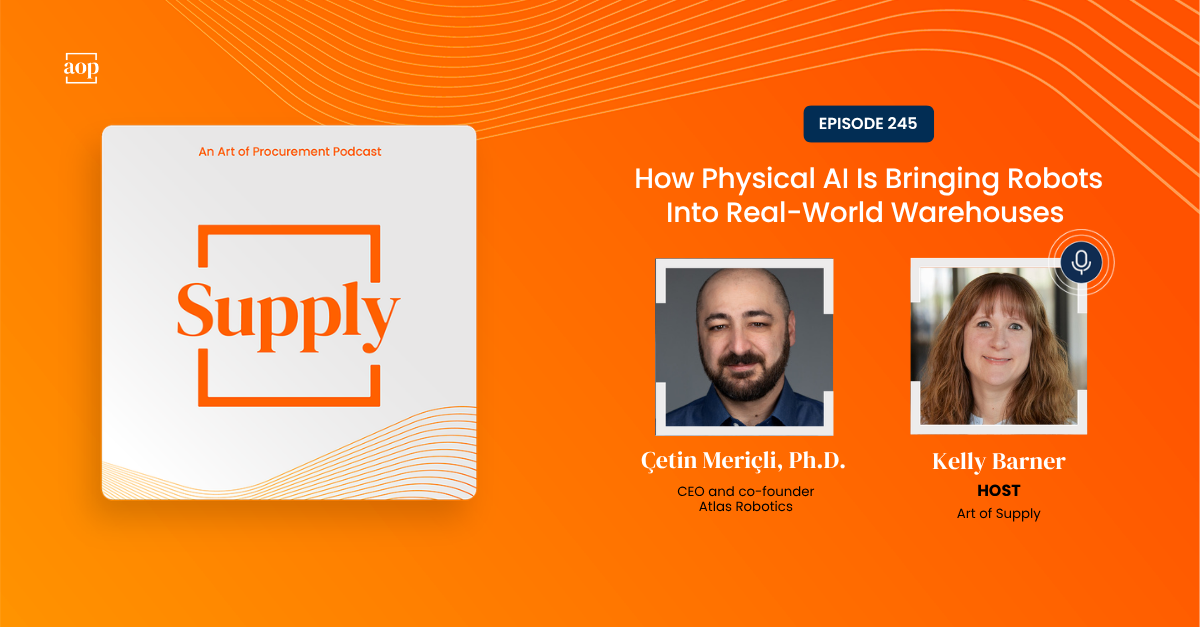
In this episode of Art of Supply, I talk with Çetin Meriçli, Ph.D., CEO and co-founder of Atlas Robotics, a physical AI company building autonomous robots that are deployed in working warehouses. Çetin has worked on artificial intelligence and intelligent robots professionally for more than 25 years. He spent roughly the first decade in research and academia, including at Carnegie Mellon's National Robotics Engineering Center, before moving to the applied side. He has been a full-time entrepreneur for about the past ten years, and Atlas, which he co-founded with his brother, is his second startup.
In this conversation, we cover what physical AI is, why tasks that are simple for people are difficult for machines, how people and robots will share warehouse work, and why Atlas structures its customer trials as "probation" rather than pilots.
What is physical AI?
"Physical AI" is a relatively new term, and Çetin acknowledges that some people hear it as a repackaging of robotics or automation. He sees a meaningful difference. Traditional automation works from fixed rules in controlled conditions, which is why it has done well in tidy, predictable environments. Physical AI draws on recent advances across the broader AI field to handle variation.
As Çetin told me, "Physical AI, leveraging some of the developments in the broader AI industry in the last couple of years, for the first time is giving us tools that we can build flexible systems, that we can build systems that can understand nuances in the world, understand, comprehend variabilities, and not just understanding them, be quick on the feet and reacting to the exceptions, reacting to the flavors, nuances of the real world. This was simply not possible before, and now we have the tools to basically build machines that can accept and embrace the world as is and operate in it."
What does "one brain, many bodies" mean?
The conventional approach to automation is task by task: design one system for one job, then a separate system for the next, often with no overlap between them. Atlas takes a general-purpose approach instead, building shared capabilities for understanding the world, planning, and making decisions, then applying them across different roles.
"The underlying structure is the same brain. But it works in different form factors because every task, every role requires different physical capabilities. Decision-making, understanding, and intelligence stay mostly the same. The manifestation looks a little bit different."
That same thinking shapes how Atlas builds their hardware. The company makes every design decision about the system itself, then sources components off the shelf wherever they meet their requirements, building custom parts only where they don't.
"If there are off-the-shelf components or off-the-shelf pieces that fit the bill of what we decided, we actually prefer to use off-the-shelf systems to basically benefit from someone else's work, the economy of scale. Someone else made them reliable for them to be commoditized, if you will. Someone else made them cheaper. Someone else de-risked the supply chain risks."
Why are everyday tasks so hard for robots?
Çetin explained the challenge by referencing Moravec's Paradox, named for Carnegie Mellon roboticist Hans Moravec: the things machines find easy tend to be hard for people, and vice versa.
"Think about multiplying two million-digit numbers. It's insanely difficult for us, but a calculator can do it ‘like that.’ In reverse, things that are so trivial for humans that you don't even explicitly talk about them, turn out to be extremely, extremely challenging and very difficult for machines."
In a warehouse, that shows up in ordinary moments. Inbound pallets carry a barcode label, or license plate, that is supposed to be placed in a specific spot, but it is sometimes in another corner, badly oriented, damaged in transit, or missing altogether. A person simply looks elsewhere. A machine has to be told about every possibility, or it registers an error. The same is true of an empty pallet left where it shouldn't be: a forklift operator moves it aside in seconds, while a robot needs judgment that has to be built intentionally.
How will people and robots share the work?
Çetin sees human-robot collaboration as a moving target rather than a fixed division of labor. Today, people handle the most flexible, infrequent, and judgment-heavy parts of the job, along with interactions with other people. Over time, robots will take on more tactical and operational work, and people will be consulted in more strategic ways.
"I think regardless of the individual capabilities, robots and physical AI systems, particularly, will continue to seek humans as supervisors. Increasingly less so, because they will be learning, and they will be getting more competent. They won't have to ask the same question twice, but for a really, really long while, maybe forever, there will always be one next question that the individual physical AI system would rather get a second opinion."
What drives the business case for warehouse robotics?
According to Çetin, the starting point is always the operator's existing obligations: moving a set number of pallets, truckloads, and SKUs for internal or external customers.
"First and foremost, they need to make sure that they are delivering on that. And that dictates certain other things like, well, you need to be fast enough. You need to be agile enough. You need to be flexible enough because exception is the rule."
Once throughput is secure, the conversation turns to reliability, efficiency, fewer mistakes, and safety. Çetin noted that warehouse incidents range from minor bumps to fatalities, and said that in the United States, someone dies in a forklift-related accident every three days. Longer term, operators look to do more with the same resources and the same footprint.
How is a probation deployment different from a pilot?
When Atlas looked at why warehouse robots have been slow to take hold, one recurring problem was the pilot that never ends. Pilots often sit off the critical path and lack clear exit criteria. Atlas modeled its alternative on how companies bring on a new employee: a probation period with real work and a clear definition of success.
"That's why we decided to call our trial probation and structured it in such a way that before we even start that probation period, we need to do a little bit of the legwork collectively with our prospective customer to define what it means to succeed, to find how are we going to measure that, and then basically go on and measure it."
Whenever possible, success is defined using the KPIs customers already use to judge their operations: throughput, availability, reliability, and uptime, with safety incidents held at zero. Where those metrics aren't well defined, Atlas helps the customer define them. Because outcomes are agreed before the trial begins, the result is clear either way.
"Everybody feels better about the clarity because everybody knows that if we are succeeding, we will know. If we are failing, we will know. There's no second guesses, no questions, no ambiguity."
What is next for warehouse robotics?
Atlas starts with palletized material handling and is working toward case picking, item picking, palletizing, and depalletizing, tasks that call for more dexterous manipulation. The near-term goal is to automate an entire existing, or brownfield, warehouse without physically changing it, redesigning its processes, or requiring significant behavior change from the people working there. The same capabilities also apply beyond the warehouse, wherever shipments are unloaded and reloaded.
More broadly, Çetin sees growing agreement across physical AI on the value of mobile manipulation: combining the ability to move autonomously with the ability to handle objects.
"But something magical happens when you combine the two capabilities, either in the form of a mobile manipulator being able to pick something from one part of the world and go to the other side of the world and drop it there unattended, unsupervised, or your ability to move your manipulation capability from point to point wherever manipulation is needed. So that's a ‘one plus one equals ten’ type of very synergistic, very explosive value add."
When evaluating warehouse automation, start with the operational measures already used to judge a good or bad day, such as throughput, availability, uptime, and safety, and agree on what success looks like, and what happens next, before any trial begins. Ask how a system handles exceptions as well as the planned flow, since misplaced labels and stray pallets are a normal part of warehouse life. Consider whether a solution can operate inside an existing facility and alongside current staff, or whether it depends on redesigning the building and its processes.
When assessing providers, understand which parts of the system they design themselves and which rely on off-the-shelf components, because that affects cost, reliability, and supply risk. And plan for people to remain involved as supervisors and decision-makers for a long time, with their role shifting as the systems learn.