
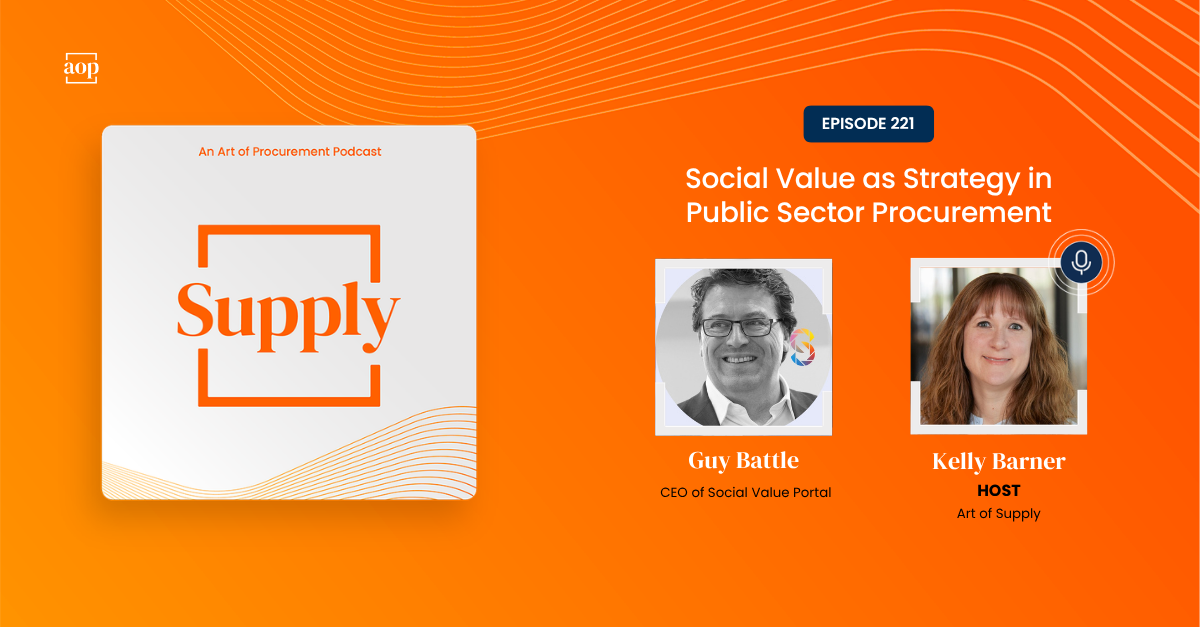
“We have seen a transformation between the public sector and the private sector in terms of their relationship. We've seen enormous change in this country.“ - Guy Battle, CEO of Social Value Portal
One of the greatest opportunities enjoyed by public sector procurement is their ability to influence not just policy, but private sector decision making. The sheer scale of their spend has a way of slowly but surely influencing the decisions made by government suppliers - and then those changes eventually make their way into the private sector.
Guy Battle is the CEO of the Social Value Portal, and the author of a recent article published in the Journal of Public Procurement: “Social value as a lever for achieving value for money and community outcomes in procurement.” He describes social value as a business’s answer to the question: How do you contribute to our environment, support the local community, and bolster the local economy?
Evolution from CSR to ESG to Social Value
The U.K. Social Value Act of 2012 requires all public sector buyers to ask suppliers how much their business will contribute to the community if they win a contract. It has not just become a differentiator among supplier proposals, it has shifted how the government is awarding its contracts.
It is an important piece of legislation, but it is certainly not the first regulated attempt to move spending decisions beyond cost and quality. Social value occupies a place in a progression that dates back to the 1960s.
“If you think back to history, if you go back to the 60s or 70s, businesses were saying, ‘What's our corporate social responsibility? What good are we adding into society?’” Guy explained.
“We then move on to the world of investment in ESG, environmental, social, and governance, and you have investment community saying, if we want to understand what a business is doing and we want to understand how that business is performing from an environmental perspective, how that business is performing from a social perspective, and by the way, does that business have the right governance around it? So that's CSR moving into ESG.”
“Then we have an evolution again,” he concluded. “Social value is effectively that journey that goes beyond compliance, beyond the environment, social governments. Are you a great supplier? Do you have the right policies in place? And then how do you add value to society? That's what social value is all about. It's about that value add, that creative contribution to our communities.”
The net effect of this evolution has been positive for businesses and communities alike. And while the change hasn’t happened over night, there is real and lasting traction being built.
What does ‘good’ look like?
When regulations play a role in the motivation to do something, there is always a risk that people will ‘box check’ rather than trying to deliver excellence. I asked Guy how he might differentiate between an organization doing the required minimum and one that truly exceeds expectations.
“Delivering social value is a process. The best social value starts with understanding the needs of the community,” he answered. “If you can match that need with what their business comes in and does, then that's going to be where the most value is delivered. It also implies that the public sector buyer is building supply chain capacity. So how are they helping their supplies to understand what social value is?”
Before suppliers can participate in the social value creation process, they have to understand what it means. That is especially true when suppliers first encounter social value because it is part of the evaluation or scoring framework that will be used to award contracts. The answer is education, making sure suppliers understand what social value means, how they can contribute to it, and why it is such a critical part of their public sector relationships.
“Here in the U.K., there's a minimum weighting of 10 percent, so that means that price might be 45 percent, quality might be 45 percent, and 10 percent weighting on social value. We have a lot of councils who are operating now at 20 percent [social value]. In some places like Manchester, that some of your listeners will have heard about, they're at 30 percent social value, which is like, wow, that is significant.”
Each supplier needs to figure out how they are going to address and capture the social value quotient of their bid, but the work doesn’t end there. There is a ‘right’ way, and a - let’s call it a ‘less right’ way to build social value.
Present Fundamentals Before Future Vision
Most suppliers could probably handle the 10 percent minimum social value without too much discomfort, but once the standard starts going up to 20 or 30 percent, a new approach is required.
“If you're a supplier, and you think ‘I'm just going to buy social value,’ and it's weighted at 30%, it'll cost more, your price will go up. The only way to deliver the right price, the right quality is by embedding social value into how you go about business,” Guy said. “That means your processes and programs, and the way you manage people has to be redesigned, and you need a change management process to make sure that social value is cut through how you go about your business.”
The ultimate goal is to embed the spirit of the Social Value Act in what each business does. Regulations might compel a supplier to create social value, but it also makes good sense.
“Most businesses, especially large manufacturers, are place based,” Guy explained. We're working with a big manufacturer of confectionery in the U.K. They have a big, big factory just west of London.
“They're employing lots of people. They're doing loads of great community work. So they've worked with us to understand their social impact, social value created. That helps them in the conversation, not only with the people they're trying to employ and are employing in the community, but also the local authority, the council. Because they are doing this and measuring it, they are actually building better relationships with the community, which means it's easier to employ people, which means that those people want to come and work with this business.”
Especially in the case of consumer-facing brands, those community investment or community involvement opportunities can be just as good for the top line as they are for a social value metric.
So what is next on social value’s evolutionary journey?
Understanding the difference that these companies are making, and capturing that quantitative impact is huge, but so are making sure the stories are told and heard.
“We need to find a way of bringing those stories alive and actually finding out the true longer term impact that we're having and bringing that forward to our decision making. That for me is a really important part,” Guy said.
At the same time, he’s very focused on the present moment. There is always more basic work to be done, even if that just means thinking about the community impact of each procurement- or supplier-related decision. Each one is an opportunity to make a difference.