Until recently, I wouldn’t have thought about intermodal as an industry. I would have thought about it as an approach to moving freight, but not as a formal, structured idea.
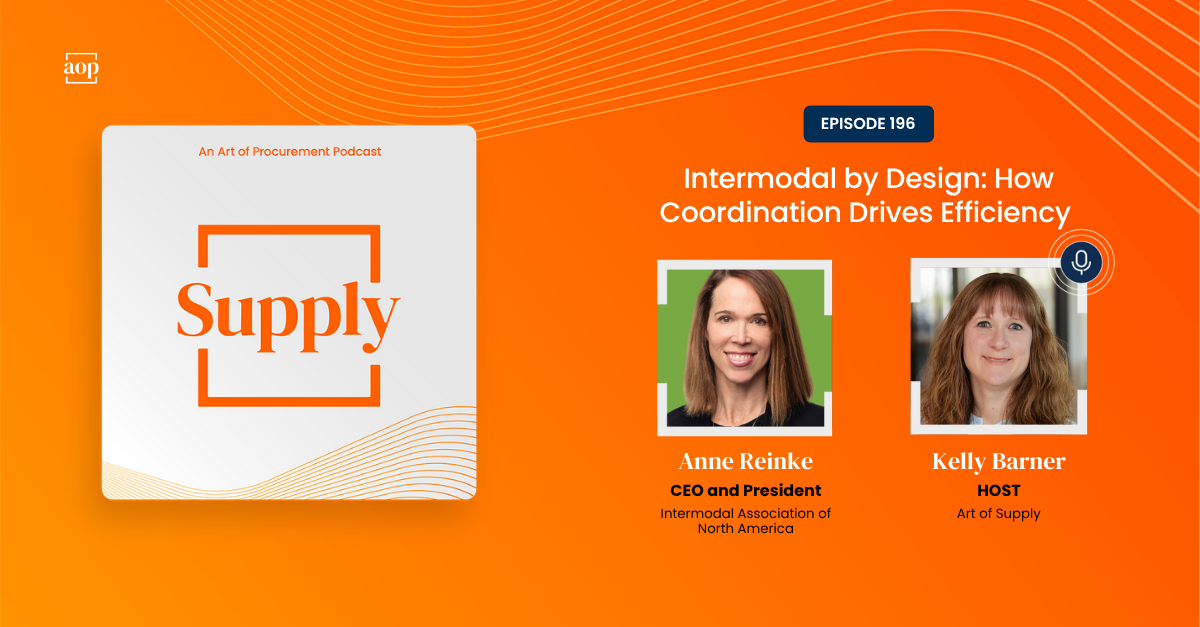
In this week’s episode of Art of Supply, I had the opportunity to rethink intermodal and more - learning about it from Anne Reinke, CEO and President of the Intermodal Association of North America (IANA). Anne has experience lobbying for the rail industry and working at the Department of Transportation, as well as with an organization representing 3PLs. She has been at the head of IANA for just under a year, with plenty of dynamics to handle.
Intermodal Intentionality
As Anne explained, intermodal “is not something that just happens. It has to be designed in advance.” It isn’t selected in isolation, either. The market dynamics that drive capacity and cost in other modes of transportation, like over-the-road freight, play a large role in determining whether a company pursues intermodal transportation or not.
“Typically, intermodal is attractive as a competitor to over-the-road when over-the-road has sort of scarce capacity,” she said. “Obviously that drives up the price. And, as you know, over-the-road does not have scarce capacity at the moment.”
Intermodal can include everything from ocean carriers (with international shipments), drayage, rail, and over-the-road trucking. Some carriers are more involved in intermodal than others, but many of the carriers supply chain professionals are familiar with also play in this space. J.B. Hunt is known for being intermodal, and according to Anne, all of the class one railroads and some of the short-line railroads offer varying degrees of intermodal services.
“There are some who truly specialize, but there are those who kind of flirt with intermodal,” Anne explained. “They'll dedicate some portion of their shipment base to intermodal. Our hope as an industry, and me as the head of the industry association, is to convert more of those folks who are flirting with us into long-term engagements.
Factors Driving Demand for Intermodal
Cost will always play some role in all business decisions. Over-the-road truck capacity (and therefore price) is a key factor, and so is rail service.
“During the pandemic, rail service went quite poorly for a number of reasons, and so when you have poor rail service, that does not make rail and intermodal a competitive product,” Anne told me. “Now, rail service has actually rebounded. It's doing far better, so intermodal has sort of improved from that perspective.“
“But on the other hand, of course, you still have this excess truck capacity. What we'd love to do is make the destiny slightly more within our own control, meaning people choose intermodal because it is the highest, best use of the mode and because it does provide a product at a great price.”
There are other influencing factors in addition to cost that impact whether a company chooses to use intermodal or not. Anne points to two: sustainability objectives and driver scarcity/availability.
For the distance goods traveling via rail, less emissions are created, helping companies towards their sustainability targets and regulatory requirements. Rail also helps from a labor
perspective, with far less people required to move goods than are needed to drive a fleet of trucks.
Where is my stuff?
Companies are no different from consumers in that they want to know where their goods are and when they are likely to arrive. In both cases, the solution is the same - although the challenge is different.
Data can solve the problem, but when information is stored, not just in different systems, but in different company’s systems, getting to the answer is difficult.
“You're pulling on something that I'm becoming a ‘holy roller’ on, which is visibility and data and having that customer-forward face,” Anne said. “We all try to track our packages, and so if you're a shipper or an end user and receiver, you have that same inclination.”
“I think it is incumbent on the intermodal industry to absorb that and make it so that we move and adapt to the next century because we don't want to be left behind.”
Using railroads as an example of one mode of transportation, a railroad may have its own visibility platform. That platform may give the railroad everything it needs to operate. But if the other carriers in the supply chain don’t ‘talk’ to the railroad, visibility quickly breaks down.
“How do you integrate that and how do you have it so that everybody can talk to each other and they can all see where they are across the move?” Anne asked. Clearly that is a massive question that the intermodal industry needs to answer.
Anyone that has worked in a company with multiple ERP systems knows that the breaks between systems, where you're trying to get a process or data to jump from one system to another, create places for data to get lost… never to be seen again.
This is a worthy challenge to take on, but will not be easy by any means, even with the best intent.
In the meantime, intermodal continues on, providing shippers an alternate way to move their goods because it leverages the advantages of each mode of transportation, efficiently and cost effectively.