
A foreign-trade zone (FTZ) is a secure, customs-controlled site inside the United States that, for duty purposes, is treated as if it sits outside U.S. customs territory. Goods can be admitted to a zone and then stored, inspected, repackaged, assembled, or in many cases manufactured before any duty is paid. Duty comes due when the goods leave the zone and enter U.S. commerce. If they are re-exported instead, it may never come due at all. The program is overseen by the Foreign-Trade Zones Board and administered day to day by U.S. Customs and Border Protection under 19 CFR Part 146.
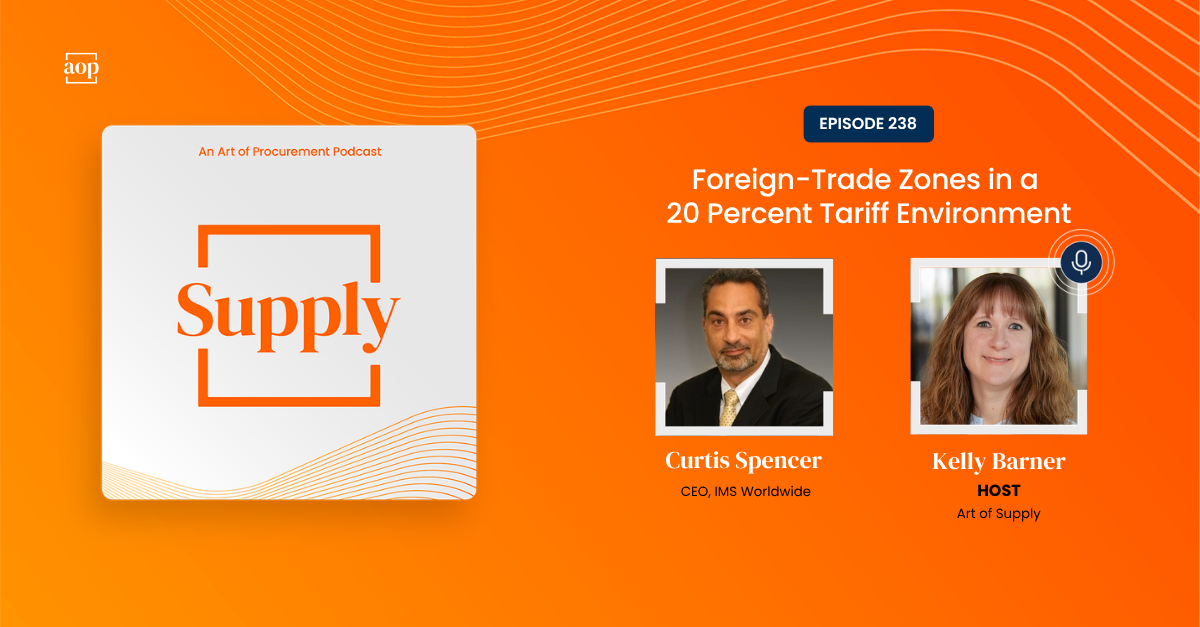
In this episode of Art of Supply, I’m joined by Curtis Spencer, CEO of IMS Worldwide, a firm that both consults on and operates foreign-trade zones and bonded warehouses.
Curtis has worked in FTZs for more than four decades. He learned the business from his father, who set up some of the earliest zones in the country; he has contributed to the drafting of portions of the FTZ regulations, including Part 146; and he has served on the board of the National Association of Foreign-Trade Zones and on COAC, the advisory committee that consults with customs on trade operations. Our conversation covers where the program came from, what running a zone actually requires, when a zone is the wrong tool, and why country of origin has become the hardest question in importing.
Where did the FTZ program come from?
The foreign-trade zone program is a product of the last great tariff era. Congress created it in 1934, four years after the Smoot-Hawley Tariff Act pushed average U.S. duty rates to historic highs. As Curtis describes the origin, the fact pattern is almost identical to today's: "We had huge high tariffs and everybody went, oh my gosh, how do we mitigate that and not hurt domestic industry, domestic U.S. industry? And so the foreign-trade zone program was created."
The program stayed small until manufacturing was permitted inside zones in the 1950s and 1960s. "The very first foreign auto plant that came into the U.S. was Volkswagen, 1979," Curtis said. "Went into it as a foreign-trade zone and every other auto plant since then has been a foreign-trade zone." Refineries followed; Curtis credits his father with putting three mothballed refineries in Corpus Christi, Texas into a zone and restarting them.
The growth is easy to measure by zone number. The McAllen, Texas zone that his father, F.J. Spencer, helped establish in the 1960s was number 12. Customs, Curtis said, is now about to issue number 302.
Why are importers revisiting FTZs now?
The value of a foreign-trade zone scales directly with the duty rate, because what a zone principally does is defer, reduce, or eliminate duty. When duty is small, the savings are small. When duty is large, they are not.
For most of the post-war period, Curtis said, the average U.S. tariff rate ran about two and a half percent, with apparel, footwear, and certain electronics carrying higher rates. Across the tariff actions of the last several administrations, he now puts the effective floor at roughly 20 percent. That shift is the entire explanation for renewed interest in a program that has existed since 1934.
What does it take to operate a zone?
Two things: a data flow and a discipline. Curtis was direct about how modest the data requirement actually is. "All customs want is beginning balance plus receipts minus shipments equals ending balance, plus or minus adjustments," he said. "That's all they want. That's all they care about."
The information to satisfy that already exists in most companies. The work is connecting it. "Between your customs broker, freight forwarder, and your WMS system, your warehouse management system, or your ERP, all that data is sitting there. It exists," Curtis said.
Zone inventory is tracked on a FIFO basis unless goods carry serial numbers, in which case specific identification applies. This matters because different countries of origin carry different duty rates, and the software has to know which layer is being withdrawn.
The discipline is more important than the technology. "The thing that pushes noncompliant efforts is people moving so fast that they forget to do the procedure," Curtis said. "As long as you do the procedure and you also know how to fix the problems when they occur."
Staffing is the practical obstacle for many companies, and it is usually a headcount policy rather than a cost question. IMS Worldwide set up an operating arm two decades ago for exactly that reason, and Curtis was specific about how they handle the software: "We make sure that the software is owned and leased by the company because if they ever want to get rid of us and get somebody else or bring in house, it's their data." It is a fair question to ask any third-party zone operator.
Why is country of origin getting harder?
Country of origin is determined by a doctrine called substantial transformation: whether a manufacturing step changes a product's essential character enough to make a new country the origin. Curtis illustrated it with a pen. "If I just screw on the tip, I have not changed the essential character because the tip can't be used for anything else other than a pen tip."
The complication is that the test is not uniform. "An automobile has a different set of rules than apparel," Curtis said. "Apparel substantial transformation has a whole set of its own rules."
He traced the enforcement trend back to an early solar anti-dumping case, which he described as the first time customs followed a product into secondary and tertiary manufacturing in other countries rather than stopping at the exporter.
Semiconductors show why that is hard: a wafer is sliced and etched in one country, sent to Malaysia, Singapore, or China to be stamped out, have leads attached, and be packaged, and then returns as a finished chip. Curtis noted that TSMC is now bringing the packaging step to North Phoenix, which by his account is the first time in forty years that work has been done in the United States.
His practical advice for importers in that position is to stop guessing. "Most people who are smart will go get a customs ruling," he said. This is a binding determination from customs on where a specific product is substantially transformed, which the importer then keeps on file.
A zone helps here in a way that has nothing to do with savings. Manufacturer ID and country of origin are mandatory data elements on every admission to a foreign-trade zone. "You have to have that," Curtis said. "And it can't be found out later." That documentation, captured at admission and held under customs control, is part of why FTZ status is recognized as a best practice under CTPAT.
What does customs mean by "reasonable care"?
Reasonable care is the standard customs applies to importer conduct, and Curtis called it "the best term out there." It is not a fixed checklist. It scales with the risk profile of what you import. "If I'm importing tequila, I have a higher reasonable care than if I'm importing sweaters," he said. "If I'm importing diamonds, I have a higher reasonable care than if I'm importing shoes or flip-flops."
Demonstrating reasonable care means accumulating evidence of diligence: working with a customs attorney, engaging your broker properly, training your team, maintaining a documented importer compliance process, participating in CTPAT, operating a zone. Each of those counts as a mitigating factor if something goes wrong.
Curtis's baseline advice was simply to over prepare. "In anything having to do with customs, know the rules, know the regulations, know what you're supposed to do as good or better than they do." He pointed out that a customs officer is responsible for roughly 2,400 pages of regulation, while the FTZ regulations run about 50 to 60 pages. "So we know it 15 miles deep."
The practical takeaway is that a foreign-trade zone is an arithmetic question before it is a strategic one.
Whether a zone makes sense depends on duty spend, volumes, and how goods move through the network, and all of that can be modeled before committing to anything. What has changed is not the program but the stakes attached to it. Where inventory sits, whose custody it sits in, and when duty is triggered were low-consequence decisions when the average rate was two and a half percent, and at current rates they are not. The compliance side compounds it: documented country of origin, a customs ruling where the supply chain genuinely crosses several countries, and an accumulated record of reasonable care all take time to build, and each is worth considerably more before a question is asked than after.