
3 min read
Sledgehammers, Crowbars, and the Future of U.S. Trade Policy
Kelly Barner : September 24, 2026
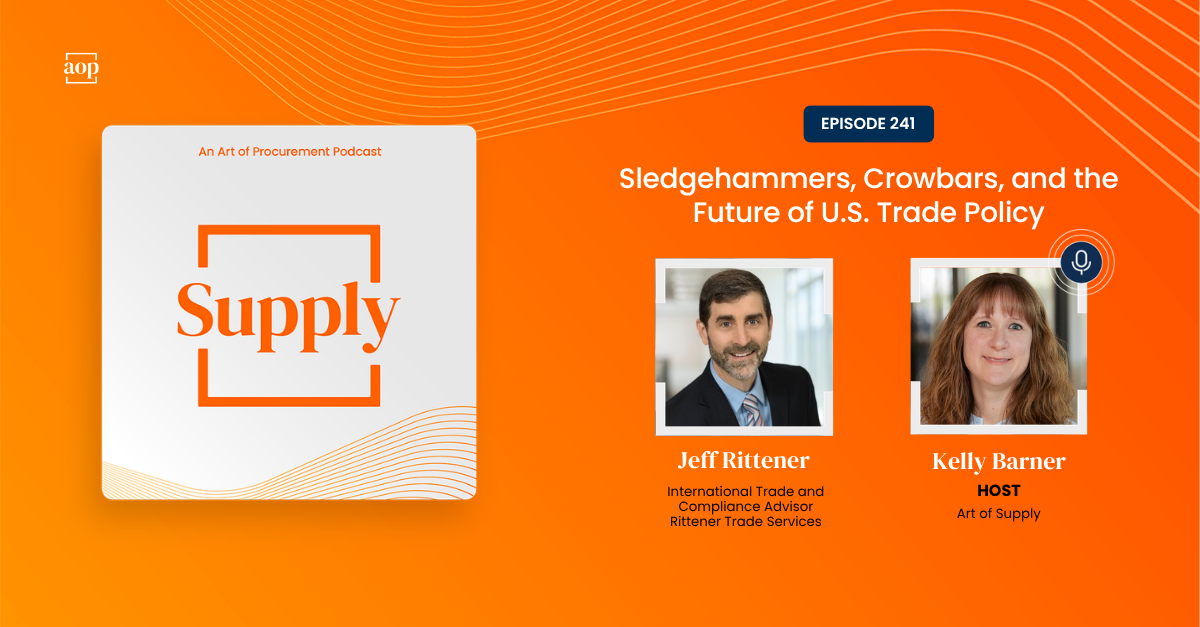
“IEEPA, in many ways, I called it the sledgehammer. It was like everything, everywhere, all at once.” - Jeff Rittener, International Trade and Compliance Advisor, Rittener Trade Services
If you’re trying to follow U.S. tariff policy, you’re probably… confused.
A tariff gets announced under one legal authority. A court challenges it. The Trump administration invokes a different authority within hours. The target list keeps shifting between countries and industries. It's genuinely hard to tell which tariffs are built to last and which ones might not survive their next legal challenge.
In this episode of Art of Supply, I speak with Jeff Rittener, an international trade and compliance advisor who spent more than 30 years at Intel Corporation before starting his own consulting practice, Rittener Trade Services.
Jeff began his career doing export control analysis, literally reading incoming faxes to figure out whether a shipment needed a license, and by 2012 he was leading Intel's entire trade organization, a team that grew to more than 130 people worldwide.
I asked Jeff to walk me through the different legal tools the current administration has used to impose tariffs, and why some keep getting struck down in court while others hold up.
What is IEEPA, and why did the Supreme Court strike it down?
The International Emergency Economic Powers Act, or IEEPA, lets the President regulate transactions during a declared national emergency. The administration used it to impose sweeping “reciprocal” tariffs on nearly every trading partner at once, starting on what the White House called Liberation Day.
Jeff compared this approach to a sledgehammer: “It was like everything, everywhere, all at once.” On February 20, 2026, the Supreme Court ruled 6-3 that IEEPA does not authorize the President to impose tariffs at all. That struck down the legal basis for the entire strategy.
Within hours, the administration pivoted to a new authority: a temporary 10 percent global surcharge under Section 122 of the Trade Act of 1974, a tool capped by statute at 15 percent and 150 days. Jeff explained why speed mattered so much in the first place: “I think the reason for the speed is because there's a short amount of time, there's a lot of countries, and the U.S. government wants to change the balance of trade. These are tools that are used to do that quickly.”
Why do Section 301 and Section 232 tariffs last longer than others?
Not every tariff tool is built for speed. Jeff pointed to Section 301 and Section 232 as tools built for durability instead. Both require the government to formally study an issue and build a legal record before a tariff can be imposed.
“Those tools allow the administration to study an issue and put forward a tariff based on an issue that's been studied and has passed legal scrutiny,” Jeff said. “I think these tools will stay. If you go back to the original Section 301 against China under Trump one, that still exists today. Even through the Biden administration, it was not changed.”
Section 232 investigations are currently examining excess global manufacturing capacity in industries like steel and semiconductors.
What is Section 338, and why is it being used against Canada?
Section 338 of the Tariff Act of 1930 is a rarely used provision that lets the President impose duties of up to 50 percent to offset trade practices that discriminate against U.S. commerce.
In July 2026, the Trump administration invoked it against Canada, initially targeting dairy, alcohol, and motor vehicles with a 50 percent tariff, and later escalating to outright import bans effective September 29, 2026.
Jeff calls it “the crowbar, the lever,” a tool meant to force Canada back to the negotiating table. According to Jeff, Canada had a deal ready to sign before rejecting it, a decision some observers attribute to domestic politics.
Canada answered with its own roughly $20 billion in retaliatory tariffs on September 8, 2026.
The dispute has already changed at least one company's manufacturing footprint. Sapporo Breweries announced it is moving production of its non-alcoholic beer from Canada to the U.S. by the first half of 2027, in direct response to the 50 percent tariff on Canadian beer. “Tariffs are something out of our control,” Chief Strategy Officer Rieko Shofu told reporters. “We're going to move ahead with local production.”
How should companies think about trade compliance right now?
Jeff, who managed compliance at Intel's scale before moving to consulting, breaks compliance down into three questions companies should ask before acting.
“One is there's the letter of the law and you have to be legal,” he said. “Two is ethics. Sometimes the law doesn't prohibit what you want to do, but it's not ethical. And number three is reputational.”
He also pointed out that the resources available to answer those questions differ enormously by company size. Large multinationals that received IEEPA refunds, he said, “better make sure I'm focusing on compliance, because when you've received that much money back, you know the government's going to come knocking.”
Smaller companies have fewer resources but more agility, and Jeff recommends they lean on a customs broker or consultant to help navigate refund processes and compliance questions they don't have the in-house staff to handle alone.
Whatever tool the Trump administration reaches for next, Jeff's toolbox framework is a useful way to sort through it: some tariff authorities are built for speed, others are built to survive a legal challenge, and that distinction matters more to a company's planning than which country or product happens to be in the headlines this week.