
“With tariffs in the news again and the trade policy environment shifting, folks are back to wanting to relearn about the [foreign-trade zone] program.”
To quote the National Association of foreign-trade Associations (NAFTZ):
“Foreign-Trade Zones (FTZ) are secured, designated locations around the United States in or near a U.S. Customs Port of Entry where foreign and domestic merchandise is generally considered to be in international commerce and outside of US Customs territory. As a result, activated businesses in an FTZ can reduce or eliminate duty on imports and take advantage of other benefits to encourage foreign commerce within the United States.”
FTZs are used by manufacturers, retailers, and others to store goods and inventory physically within the United States but outside of U.S. commerce so that they can strategically time when taxes, duties, and fees are owed and therefore paid.
With global trade uncertainty reaching new highs, companies that have not participated in an FTZ program before are now evaluating their benefits.
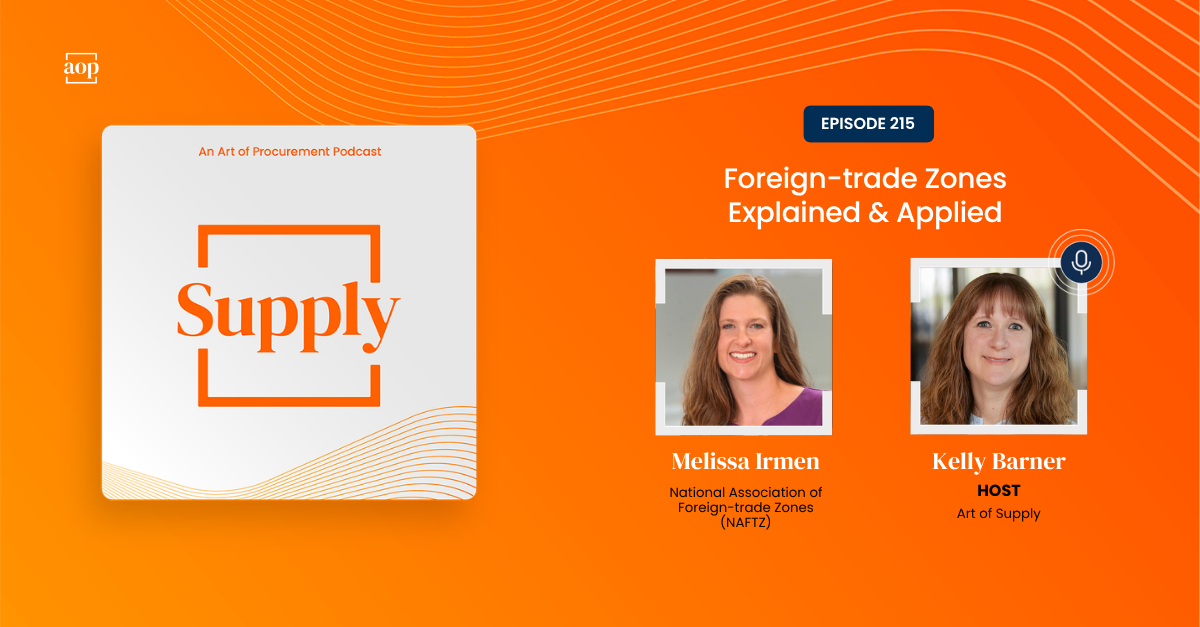
Melissa Irmen is the Director of Advocacy and Strategic Relations for NAFTZ, and she joins me for this episode of Art of Supply to share the fundamental benefits of FTZs as well as how they are helping companies deal with today’s trade environment.
Where are FTZs located?
Geographically speaking, foreign-trade zones are in the United States, but they're not part of the U.S. commerce system.
“Within the regulations for the program itself, you have to be within certain boundaries of a U.S. port, Melissa explained. “That's because it is a bonded facility overseen by customs and border protection.”
Being in close proximity to a CBP port of entry allows officers to get to the site as needed. That said, we should not assume that they are confined to ocean ports. FTZs can also be located near airports and inland ports.
What do companies use FTZs for?
FTZs can be used to store goods, but not as straight inventory. There has to be a reason to select an FTZ, but it could be one reason of many.
Retailers (Melissa suggested thinking of textiles and high fashion) might use a U.S. foreign-trade zone to store goods and to service their field stores.
Manufacturers can have additional use cases depending on their focus. Automotive, electronics, heavy machinery, and pharmaceuticals all make use of FTZs.
Melissa shared an interesting example that she has seen in the pharmaceutical industry. Let’s say a company is importing a prescription that has not yet received FDA approval. They can have the product here already, but not be responsible for paying taxes and duties until that product is on the way to a customer ready to pay for it.
“A perfect example was COVID,“ she shared. “A lot of folks used FTZs to store their COVID vaccines close to the market. They were waiting on FDA approval, and then the very day that they got it, they were able to ship into retail outlets and get the product out because they'd been staged here in the U.S. FTZ prior to getting approvals.”
Don’t Forget About the Exports
In addition to imported goods, FTZs can also be part of a company’s export strategy. Goods and materials that come into the United States can be assembled in an FTZ and then leave again, as though they were never here from a commercial standpoint.
“If you import any goods and export in any fashion, either distribution or manufacturing, then the program helps you stay here in the U.S., use American workers to do the operation, but not pay US duties, taxes, and fees because you're exporting.”
How do companies get involved with an FTZ program?
The NAFTZ provides a number of resources and fundamentals courses for companies that are evaluating or re-evaluating foreign-trade zones. Melissa also recommends enlisting the help of an experienced consultant or trade attorney.
“You want to make sure you have somebody who really understands the ins and outs of this program, not just importing broadly,” Melissa told me. “That's a good place to start to try to find consultants that specialize in helping companies get involved in the program.”
The next step is to find your grantee: “They have more local knowledge, so they can help you get connected with your local port director, who's going to be one of your new best friends in this program. They can help you develop that relationship too.”
Why aren’t more businesses aware of foreign-trade zones?
With all of the advantages Melissa and I discussed, and the high profile position global trade plays in the news, I’m surprised that FTZs aren’t a more commonly discussed part of import/export strategy.
“There's not a lot of awareness in the brokerage community of the program per se,” she told me. “If you're a smaller importer and you've been working through your broker and you rely upon them to help you understand what opportunities and programs are available to you, it's not top of mind, something that a broker might bring up with you in a conversation.”
There is also a real possibility that companies who looked into the program previously need to take a second look.
“Now with tariffs in the news again and the trade policy environment shifting, folks are back to wanting to relearn about the program or maybe the people who investigated it for your company earlier may have moved on and they're elsewhere. It might be new to the company, but a lot of things have changed even within the program itself.”
In a trade environment defined by volatility and constant change, foreign-trade zones offer something increasingly valuable: time, flexibility, and control. Whether companies are exploring FTZs for the first time or revisiting them after years on the sidelines, the program is proving to be a strategic lever worth understanding. As Melissa Irmen’s insights make clear, this may be the right moment to take a closer look at how FTZs could fit into your supply chain strategy.