“The value isn't in giving them the coffee beans and hoping they take that away and make a cup of coffee – what they need is a drink. So instead of giving them the data, do the extra steps and pull out the insights for them.the government of that benefit is inherently wrongful."
- Satvinder Panesar, Data and Analytics Strategy Director, AstraZeneca
Procurement has never had more access to data… or more confusion about what to do with it.
Many organizations are still drowning in dashboards, reports, and metrics that might look impressive but ultimately fail to drive action. At AstraZeneca, that’s changing.
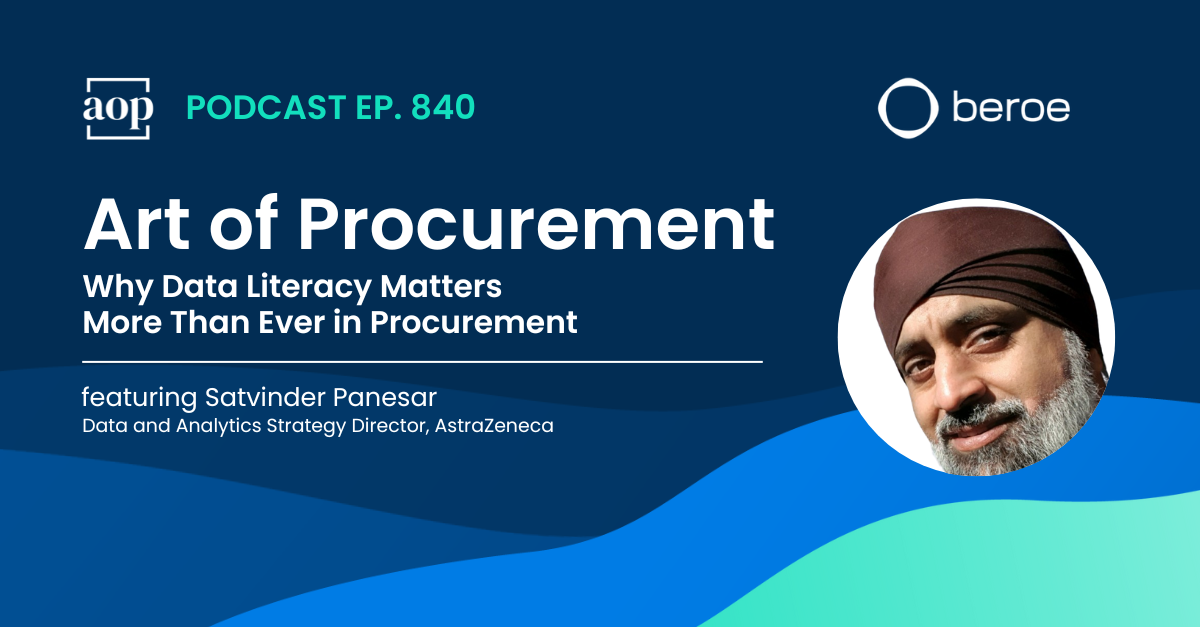
In this conversation, I speak with Satvinder Panesar, Data and Analytics Strategy Director at AstraZeneca, about his philosophy on how to turn information into impact. He and I had the opportunity to meet at the ProcureTEX event in London, where Beroe had invited me to speak with some of their customers about what insight-driven decision-making means in practice.
Here, in Sat’s own words, are some of the stand-out moments from our discussion:
From Data to Insights
"Instead of just giving people data, we have to do the extra steps and pull out the insights for them and support them throughout that whole process. … It's about understanding that process, understanding your customers, and not assuming that what you do is going to automatically deliver value."
Sat captures a truth procurement leaders often miss: data itself isn’t the goal. Teams can spend months refining reports that never translate into better decisions. The real challenge and opportunity lies in creating the processes, context, and conversations that transform raw data into actionable insight. That’s where procurement becomes a strategic driver rather than a reporting function.
The Role of Tension in Creating Value
"It happens all the time. People believe that bringing information forward is automatically valuable. But part of our job today is to create that tension and really understand: what are you using this for? How do you plan to drive action from it?"
Too often, procurement analytics is an exercise in output, not outcomes. Encouraging productive tension – asking why this report, why now, what happens next – is essential to ensure that analytics work serves a purpose. Mature teams welcome this friction because it sharpens their focus and connects effort to impact.
Why Data Literacy Is a Necessity, Not a Bonus
"I don’t think data literacy is a nice-to-have anymore. It’s a necessity to be successful in this function."
Sat is direct about the evolution of skill sets in procurement. The days of relying on a separate analytics team are fading fast. Every category leader now needs to understand the basics of how data is modeled, validated, and interpreted. This doesn’t mean everyone must become a data scientist, but it does mean that procurement professionals must be fluent enough to question assumptions and engage intelligently with digital tools.
Bridging Procurement and Data Science
"I don’t think extremes exist anymore. Data scientists know they need business context, and procurement professionals need to understand data. The middle ground is where the magic happens."
This merging of worlds between technical literacy meeting business acumen defines the future of procurement. As technology becomes more advanced, the differentiator won’t be access to data, but the ability to interpret, apply, and communicate it with precision. Collaboration between analysts and category leaders isn’t optional. It’s the engine of progress.
Preparing for the AI-Driven Future
"If you put your data into an AI model, you need to be able to validate it, which means I can tell you this is an outlier, or this isn’t. That’s where the procurement professional still matters."
Even as automation accelerates, the human role in ensuring data integrity remains critical. Procurement leaders must be able to challenge AI outputs, recognize when something doesn’t align with context, and validate assumptions. This inherently human oversight, grounded in literacy and judgment, is what keeps procurement credible in an increasingly algorithmic world.
The conversation with Sat was a deep dive in redefining how procurement approaches data. His message to procurement is clear: the tools are here, but they’re only as powerful as the people using them. Procurement’s future belongs to those who can connect analysis with action and who are ready to move from data for its own sake to something far more energizing.