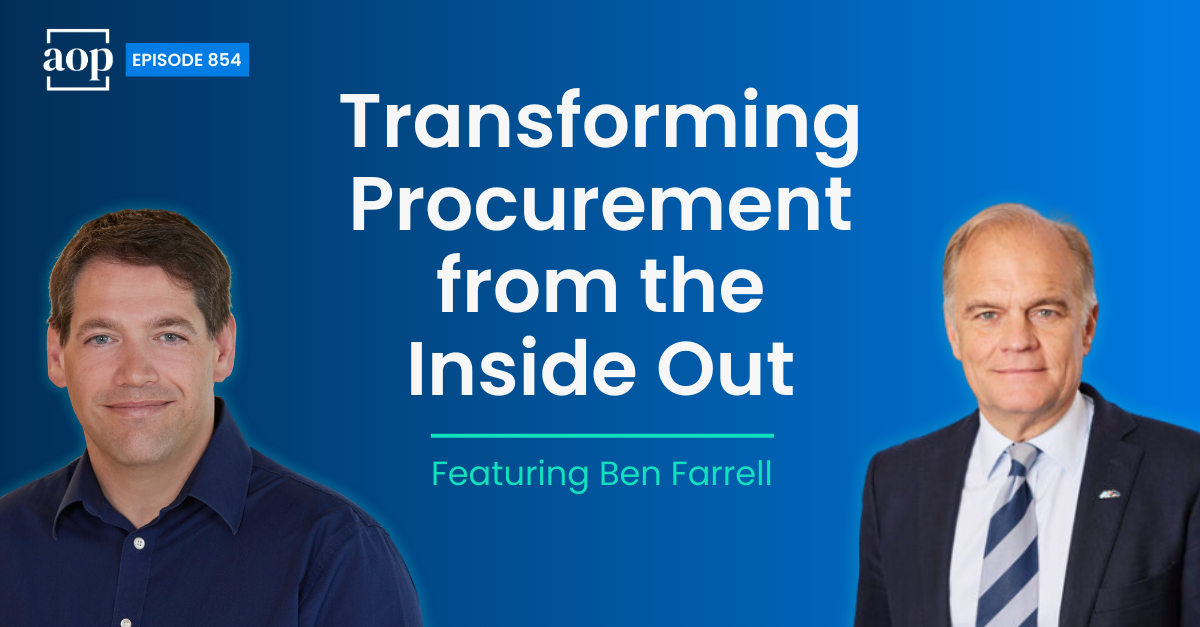
“The procurement and supply chain professions are ever more relevant to the prosperity of nations and to businesses as we go into the future.” - Ben Farrell, Global Chief Executive Officer, CIPS - The Chartered Institute of Procurement & Supply
Procurement is at a crossroads. Global uncertainty, technological acceleration, and ever-higher business expectations have placed procurement teams squarely in the spotlight. But greater visibility does not automatically translate into greater influence.
To close that gap, leaders have to move quickly, reframing how the profession is seen, what it delivers, and how it leads.
I recently spoke with Ben Farrell, the Global CEO of the Chartered Institute for Procurement & Supply (CIPS), about what it takes to elevate procurement’s impact in this environment. Ben’s background spans the British Army, major corporate roles at John Lewis, and now leadership at one of the profession’s most influential organizations.
Here are some of the standout moments from our conversation, in Ben’s own words, along with my reflections on what they might mean for today’s procurement leaders.
From British Army to Corporate: Translating Lessons in Risk and Resourcefulness
“The Army had 14 billion pounds a year to run itself in 2010, which was reduced to 11 billion. So we had to find savings of three billion… And in my first meeting at John Lewis, the top point on the agenda was the lack of decaffeinated coffee in the dining room. And I thought, wow, this is going to be a difficult transition.”
Ben’s shift from defense to retail was more than a change of sector. It highlighted the vastly different ways organizations prioritize and respond to pressure. Managing a multibillion-pound reduction in defense spending forces clarity around trade-offs, timing, and consequences. That kind of experience sharpens judgment.
For procurement leaders, the lesson is about perspective. The challenges we face inside corporate environments are real, but they require proportion and discipline. When budgets tighten or expectations rise, leaders must keep teams focused on what truly moves the needle. The ability to navigate constraints without losing strategic direction is one of the most important capabilities a CPO can develop.
Defining Leadership Through Freedom
“Leadership is about freedoms and creating an environment where people are free to thrive in the direction of travel that they're clearly, collectively managed to get behind. What it doesn't do is provide constraints.”
This definition of leadership resonates deeply with me. Procurement has historically leaned toward control, governance, and compliance. Those elements matter, but they cannot dominate the culture.
Experienced procurement leaders know that performance scales through people. When the mission is clear and teams understand the broader objectives, autonomy drives engagement and innovation. Freedom within guardrails enables professionals to stretch beyond process and deliver business impact. If we want procurement to operate at a higher strategic level, we have to lead in a way that invites ownership rather than restricts it.
Raising the Voice of Procurement
“I believe the voice of the profession, championing the profession globally, has to come from us. If someone wants to say, ‘Look, what's going on in global trade or in this supply chain space?’ they should come to us. And that is beginning to happen.”
For too long, procurement has excelled quietly. We solve problems, mitigate risk, and drive savings, but we rarely control the narrative. Ben is clear that advocacy must become part of the profession’s mandate.
This matters for experienced leaders. Influence is shaped externally as much as internally. If CEOs, policymakers, and investors do not understand the strategic value procurement delivers, investment will lag and expectations will remain narrowly defined. Elevating the voice of the profession requires deliberate outreach, stronger storytelling, and consistent engagement beyond our own community. The more visible procurement becomes in global conversations, the stronger their position inside the enterprise.
Shaping the Next Job Description
“I’m thinking about this new job description… What’s the role of a chief procurement officer with supply and all the other bits I’ve talked about in the future?”
The CPO role is evolving in front of us. Supply continuity, ESG, geopolitical risk, digital enablement, and value creation are converging into a broader leadership mandate. The traditional sourcing playbook does not fully capture that scope.
As leaders, we have to be intentional about redefining what success looks like. If we continue to describe our impact primarily in terms of cost, we limit how others perceive us. Expanding the narrative to include resilience, growth enablement, and responsible sourcing opens new strategic doors. Whether the title changes or not, the substance of the role already has. Our behaviors and priorities must reflect that reality.
The Case for Embracing AI
“This is not going away. This is here to stay. And as an organization, you should get busy embracing it. I think it’s a liberating thing for procurement.”
AI and advanced analytics are reshaping supply networks, risk visibility, and decision speed. Some leaders hesitate, concerned about uncertainty or capability gaps. Ben’s view is pragmatic and forward-looking.
From my perspective, experienced procurement leaders should see technology as an amplifier. Automation reduces manual effort. Predictive tools surface insights that were previously buried in data. That frees teams to focus on strategy, stakeholder alignment, and supplier innovation. The competitive advantage will sit with those who integrate new tools thoughtfully and quickly, building capability as they go rather than waiting for perfect clarity.
Modernizing the Institution
“We’ve moved to a sparkling, modern, relevant office where we can be globally connected… It was an urgent requirement to set the right tone for us to be the right organization for the future.”
Symbolism matters. When Ben chose to modernize CIPS’ headquarters, he was reinforcing a message about ambition and direction. Environment influences energy. Energy influences performance.
For procurement leaders, this is a reminder that transformation is visible. The systems we use, the language we adopt, and the spaces we create all communicate what we value. If we want procurement to be seen as progressive and future-ready, our operating model and our culture must reflect that aspiration consistently.
Ben’s mission should be a shared one: elevate procurement’s influence and relevance on a global stage. For those of us who have spent decades in the profession, this moment feels significant. The capability is there. The demand is there. The responsibility now sits with leadership to translate that opportunity into lasting impact.
Links:
- Ben Farrell on LinkedIn
- Subscribe to This Week in Procurement
- Subscribe to Art of Procurement on YouTube