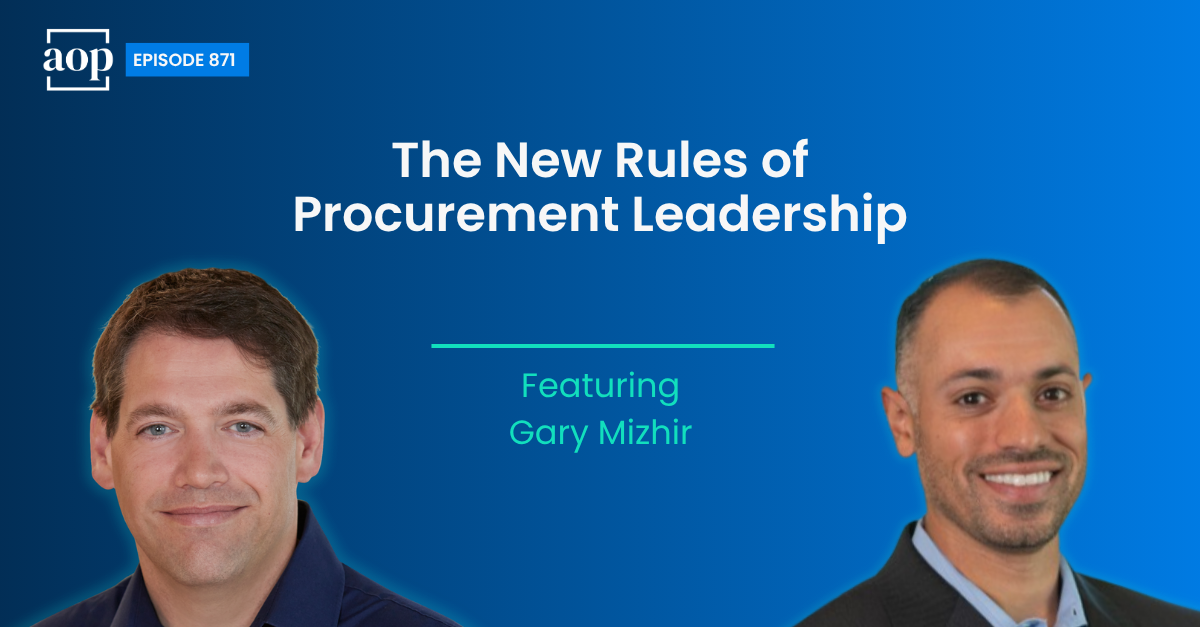
“I measure success by the number of executives that come to us before they make decisions.” - Gary Mizhir, Senior Director, Head of Innovation & Excellence, FIS
For years, procurement leaders have been asking a version of the same question: how do we earn a more strategic role in the business?
We have spent decades proving our ability to negotiate savings, manage risk, and build effective sourcing processes. Yet many procurement teams still find themselves fighting for influence, trying to find our voice in conversations that shape the future of the company.
What struck me during this conversation with Gary Mizhir, Senior Director and Head of Innovation & Excellence at FIS, is that he isn't waiting for someone to define procurement's role for him. He's actively exploring what that next role could look like.
Gary's perspective is particularly interesting because his career has spanned military supply chain, consulting, category management, product management, and procurement transformation. That breadth of experience gives him a unique lens on where procurement can create value, especially as AI changes how work gets done.
Throughout this episode, one theme emerges repeatedly: the future of procurement won't be defined by process execution. It will be defined by our ability to influence decisions, connect information, provide value to executive decision makers, and help businesses navigate complexity.
Procurement Needs to Show Up in New Places
"One of the things I love thinking about are the roles that we can play in the organization that we traditionally wouldn't be playing."
Procurement can’t become too comfortable operating within the boundaries we've historically occupied.
Gary shares an example in this episode of working directly with pricing teams to understand how supply chain decisions affect product profitability. That's not traditionally viewed as procurement territory, but it highlights something important. The most influential procurement leaders I've worked with throughout my career rarely wait for an invitation. They actively look for opportunities to contribute in places where their perspective can create value.
AI Should Change the Function, Not Just the Workflow
"I don't think about it as how we can append AI to our existing process. I think about how we create a paradigm shift in the way we operate and think about our function because we have AI that enables that to happen."
Much of the conversation around AI in procurement still centers on efficiency. Faster contract reviews. Better sourcing analysis. Automated workflows. Those are all valuable use cases, but they largely assume the operating model stays the same.
Gary challenges that assumption.
The bigger opportunity, he says, is rethinking what procurement should spend their time doing in the first place. When AI can process information at a scale humans never could, the role of procurement shifts from gathering data to interpreting it, influencing decisions, and helping the business act on insight.
That is a fundamentally different value proposition.
Procurement's Metrics Need to Mature
"I think our ROI has to be tied directly to the corporate metrics. How is the company profiting from the investment?"
Savings matter. Cost reduction matters. Efficiency matters. But if procurement wants to be viewed as a strategic business function, we have to become more fluent in the metrics that matter to the rest of the executive team.
Are we helping improve profitability? Supporting growth? Accelerating innovation? Improving decision quality? Those conversations resonate differently in the boardroom than discussions focused solely on procurement-specific metrics.
Empathy Is Becoming a Competitive Advantage
"Our ability to put ourselves in the shoes of the stakeholders and say, this is what they need from our organization, not what we believe we should be giving them, but what they actually need that adds value to their business, is a mindset shift."
Procurement teams often spend significant time designing processes, policies, and controls. Far less time is spent understanding how those things are actually experienced by stakeholders.
The best procurement organizations are deeply curious about the businesses they support. They understand stakeholder priorities. They speak the language of the function they're partnering with. And they continuously adapt their approach based on what creates value for those partners.
Be a Customer of Your Own Process
"The best advice I can give somebody is to be a customer of your own process and then understand what it's like to be one of your stakeholders."
Gary describes needing to navigate one of his own procurement processes and realizing how difficult it was. The experience completely changed how he thought about process design.
We often assume stakeholders are bypassing procurement because they don't understand the rules or because they're trying to avoid compliance. Sometimes the reality is much simpler; the process is harder than it needs to be.
Procurement must remove friction rather than adding it. We have to make the right decisions easier to make. We should focus on outcomes rather than bureaucracy. As AI continues to automate more transactional work, that human-centered approach will become even more important.
Technology may dramatically change how procurement operates, but it won't diminish the importance of relationships, influence, empathy, and judgment.
In fact, those capabilities may become the very things that distinguish great procurement leaders from everyone else. And that might be procurement's most important opportunity of all.