
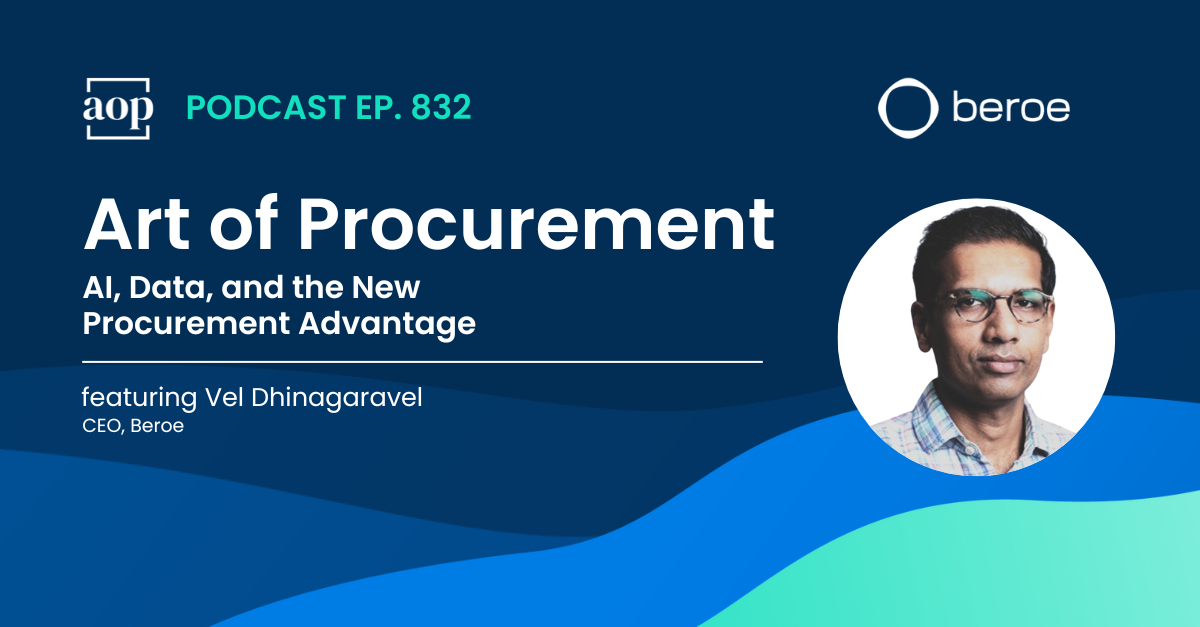
“Procurement is going to be on the front lines, creating competitive advantage for the corporation.”- Vel Dhinagaravel
CEO at Beroe
For many years, procurement has leaned on point-in-time savings projects and limited market insight to deliver value. But the landscape is changing… and fast.
Boards and CFOs expect constant competitiveness, not just periodic cost reductions, pushing procurement leaders to look for new ways to stay ahead.
To dig into what’s really shifting, I recently spoke with Vel Dhinagaravel, CEO of Beroe. With 25 years in the profession and a front-row seat to its tech evolution, Vel shares sharp, practical advice on how AI, data, and always-on intelligence are transforming procurement’s role, impact, and the expectations of leadership teams.
Here are a few moments from our conversation that struck me as especially valuable.
The Shift: From Periodic Projects to Continuous Advantage
"Now we see some leading-edge CPOs… challenging procurement to move away from that conventional model of cost savings that are project-related to deliver continuous improvement and continuous competitiveness."
Procurement is moving away from discrete, calendar-driven events to a world where real-time, ongoing benchmarking and improvement are mandatory. For teams, that means building systems – and mindsets – for constant assessment and action. This shift challenges us to deliver measurable value consistently, not just when contracts are due or budgets are under review. It's a fundamental change in cadence that demands a reevaluation of how we prioritize projects, resource our teams, and engage with the business.
The New KPI: Benchmarking Against Competitors, Not Just Budgets
“What is procurement's equivalent of market share?... You're talking about savings... but where are you bringing in the market share equivalent, which compares our cost structure with that of our key competitors?”
This idea struck me as one of the most powerful takeaways from our conversation. We’ve long evaluated procurement performance through internal baselines: did we beat last year’s budget, or hit our cost savings target? But Vel makes a compelling case that this is no longer enough. C-suites want to know: Are we outperforming our competitors? That kind of external benchmark reframes the goal from “better than we were” to “better than the rest.”
To meet that challenge, we need to look beyond scope-limited RFPs and budget-driven targets. We need real-time intelligence that allows us to benchmark cost structures, supply base strategy, and contract performance against industry peers. It's a more difficult ask, but one that positions procurement as a source of durable competitive advantage, not just tactical savings.
AI Enables Finer, Faster Value Creation
"If you can reduce the economically viable threshold of intervention down as low as possible, I think that’s a great way to think about AI. That, I think, also shifts the paradigm from once in a while optimization to always-on optimization."
AI can unlock economic viability at a new scale for procurement. With automation and intelligence, procurement teams can act on small opportunities that used to fall below the threshold of ROI. These “micro-wins” might be invisible on their own, but in aggregate, they represent a huge untapped value pool. The ability to monitor and act on them in real time changes how we think about value capture, resource allocation, and what we consider “worth the effort.”
The Human Factor Remains, But Focus Shifts
"I think the future from a market intelligence perspective is… how do we focus our energies on the information that is in people’s heads, get that qualitative expert input, supplier input, the community input. I think that’s going to be key."
As data collection and synthesis improve, the human role in procurement doesn’t diminish, it evolves. The real value lies in interpreting that data, applying business context, and enabling action. This is where our people add irreplaceable value: bridging the gap between information and outcomes, especially in ambiguous or unprecedented situations. The role of analysts and category managers will increasingly center around sense-making and collaborative decision support.
Caution Against Over-Hyped AI
"I do think there’s an opportunity to reduce the need for human intervention… But there’s a lot of hype around agentic tools… we’ve got data issues, we’ve got maverick spend, we’ve got stakeholders that may not necessarily always be as cooperative as you’d like."
The vision of fully autonomous procurement isn't feasible in today’s landscape. There are too many real-world variables, from poor data hygiene to stakeholder complexity, standing in the way. We should be ambitious but grounded. Smart teams are embracing AI where it complements human judgment, not replaces it. And they’re putting just as much focus on getting foundational elements right – like process, data, and governance – as they are on deploying the latest tools.
Procurement’s Next Great Leap
"We have this group of organizations that become so good at integrating all of these data flows into a dynamic decision board… These are the organizations that are going to really leapfrog. And I think that’s going to be the key thing in the next five years… to determine who is going to win for the right."
We’re entering an era of differentiation through procurement, not just within functions, but across markets. The organizations that master real-time decision-making, competitive benchmarking, and intelligent automation will move ahead fast and stay there. Building systems and talent can help procurement stay ahead of a moving target, and the decisions we make now will determine whether we lead or lag over the next five years.
Links