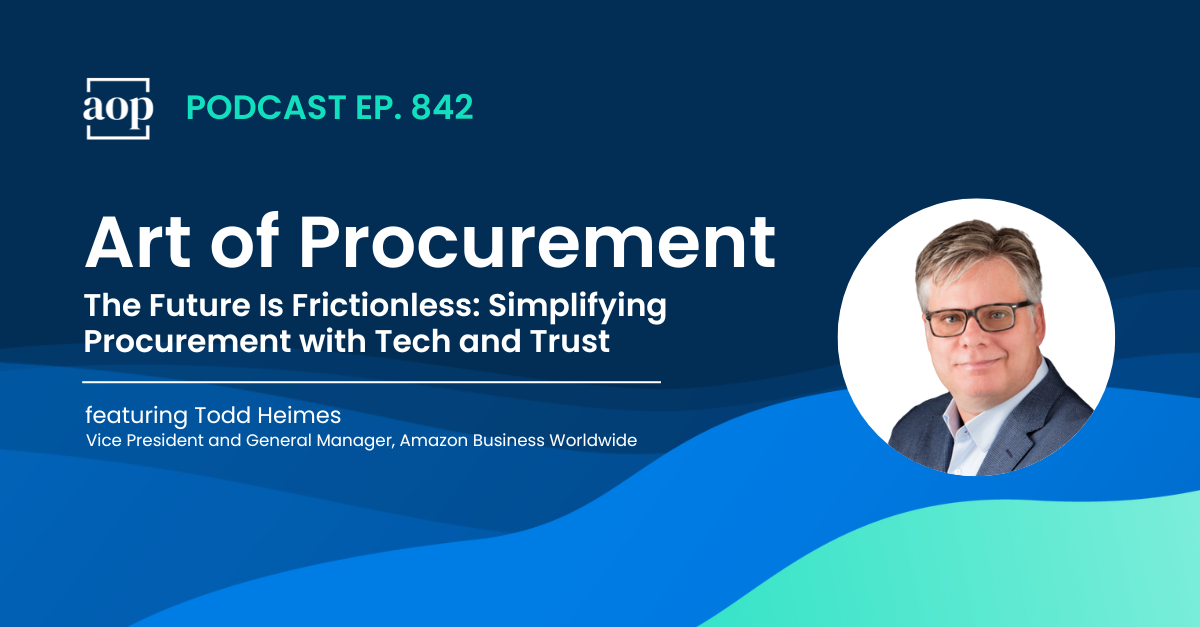
“We want our customers to be able to put their own internal procurement rules into our Amazon Business marketplace, so they can feel secure and still get that great experience.”
- Todd Heimes, Vice President and General Manager, Amazon Business Worldwide
Procurement is changing fast, and with more demands on their time, budget, and people, digitization must do more than add complexity or create new silos. That’s why I sat down with Todd Heimes, Vice President and General Manager of Amazon Business Worldwide, to talk about how their team is working to simplify enterprise purchasing without sacrificing control.
In our conversation, Todd shares his perspective on what’s really needed to modernize procurement and how Amazon Business is evolving to meet those needs. Here are a few highlights from the episode.
Integration, Not Disruption
“Our large business customers have an ecosystem of different services that they use. We think of Amazon Business as plugging into that ecosystem. We recognize that a large customer is going to most likely use an e-procurement system and want to punch out to Amazon Business as one of its suppliers… We think we need to be a partner in helping our customers make their procurement function more efficient.”
Procurement shouldn’t have to force users into new behaviors or rewire their entire stack just to take advantage of digital tools. Todd makes a strong case for embedding Amazon Business into the existing tech environment, so procurement can gain efficiency and visibility without pushing against entrenched workflows. That’s where transformation becomes sustainable.
Turning Tail Spend Into Opportunity
“There's a lot of rogue spend out there, and so we help our customers get their arms around that tail spend and often they want to really push that to a self-service model, so they say to their employees, ‘Hey, use Amazon Business...’ We allow them to put rules in place so that they don't have employees who may be buying products that they don't want them to buy.”
Tail spend may always be messy, but that doesn’t mean it has to be unmanaged. Todd explains how channeling those purchases through a digital environment – and adding lightweight controls – can protect procurement’s priorities while empowering the business. That balance between governance and user experience is essential for scalable impact.
Controls Without Friction: The Guided Buying Model
“We built a feature called guided buying that might say, if you're going to buy safety goggles, we want you to buy from this brand or one of these types. It's very important because when you're shopping on a marketplace like Amazon Business, you kind of lose control of which types of products are being bought…all of these different needs can be captured in our guided buying tool.”
Guided buying may sound like a small feature, but it has outsized implications. With this model, procurement can shift from enforcer to enabler, setting preferences and parameters that influence buying behavior without slowing people down. It’s a model that more teams should adopt as decentralization increases.
Data-Driven Insights for Action
“One tool we just launched is spend anomaly monitoring, so what this does is it allows our business customers to identify when their employees have made a purchase that is outside the norm. The other thing we just announced is savings insight, to identify where they can make changes that are going to drive savings for them.”
Data is only valuable if it leads to action, and that’s what makes these new tools at Amazon Business so interesting. They’re designed to help procurement move beyond lagging indicators and into real-time performance monitoring. By highlighting spend outliers and pinpointing savings opportunities, analytics become a lever for change, not just a dashboard.
Smarter Spend Starts With Data
“We have an analytics package… that helps identify trends, helps identify outliers… and then that might lead to, ‘Hey, this is a category or an item or a set of products that we should go and negotiate.’”
What stands out here is Todd’s emphasis on the actionability of procurement data – not just reporting. Instead of simply surfacing dashboards, this reflects a shift in procurement’s value proposition: from compliance policing to strategic spend guidance. It’s a great example of how operational data can serve as a launchpad for higher-level business impact.