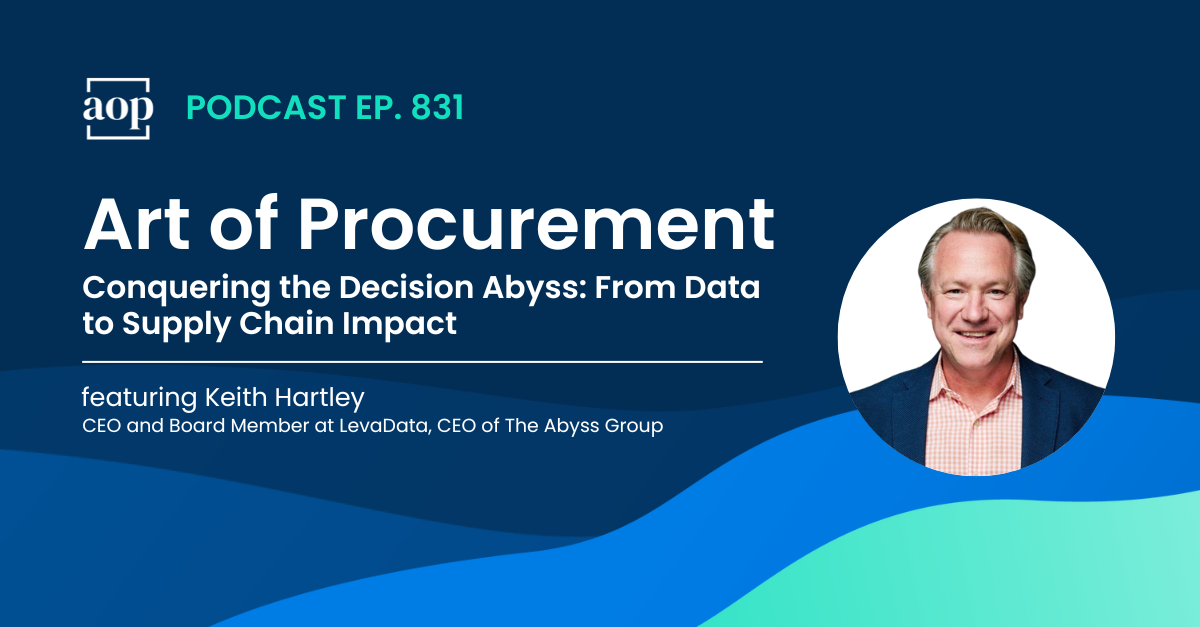
“A decision abyss is the chasm that forms between critical supply chain functions…and that's what keeps and prevents organizations from making fast, cross-functional, well-informed data-driven decisions.”
- Keith Hartley CEO and Board Member at LevaData, CEO of The Abyss Group
Getting lost in a sea of supply chain data is hardly a new story, but the urgency for procurement to take action has never been greater.
The challenge isn’t merely about how much information we’re dealing with or how fragmented our systems have become. The real risk is that slow, misaligned decisions are actively eroding competitiveness, adding cost, and undermining growth. Keith Hartley, CEO of LevaData, took this problem head-on in his new book, Conquering the Decision Abyss: Turning Data Into Action in the Modern Supply Chain.
Keith has decades of supply chain and procurement experience, both from the boardroom and the trenches. In our conversation, he shares how the “decision abyss” forms, why old behaviors stand in the way of progress, and what real change in data-driven decision making actually takes.
Here, in Keith’s own words, are some of the moments that stood out for me and why I think they matter to procurement leaders.
The Hidden Cost of Data Siloes
“This chasm that forms between critical supply chain functions – engineering, product design, sourcing and procurement, finance, operations – each operate typically with their own siloed data and processes and human behavior. And what happens is this leads to inefficient decision-making... They’re all right and yet all wrong because none of them had that view of the entire picture to make the best, most informed decision.”
For CPOs, siloed data has become more than just a persistent IT problem. It limits execution, increases exposure to risk, and quietly chips away at margin. What we need now is a candid assessment of where the gaps lie and a coordinated effort to bring the data landscape into focus across the enterprise.
Why Spreadsheet Culture Persists
“I go out of my way to talk about how sourcing professionals are doing unbelievably creative and difficult work with inadequate tooling... It’s about time we had a conversation to help these product-based companies.”
Procurement teams are navigating intense complexity, often armed with nothing more than spreadsheets and manual workarounds. This "normalization of pain" has kept teams in reactive mode for far too long. If we want faster, smarter decisions, we have to start by giving teams the tools they actually need to move at the speed the business demands.
The “Data Gulch” Beneath the Surface
“The decision abyss is a symptom of the real disease, which is the data gulch… Data is data. Companies and people and humans have to make decisions. And when those decisions are delayed or not taken with all the available information, you get some real negative outcomes.”
The real challenge isn’t that data is missing – it’s that we’re failing to bring it together in a way that supports meaningful action. Until we solve for that contextualization layer, organizations will continue to miss savings, overreact to disruptions, and fall behind more data-agile competitors. Prioritizing this shift is not optional for those looking to sustain long-term performance.
Human Behavior is the True Barrier
“The main point is that it’s a human behavior problem, right? Because what happens is we fall into patterns… The thought of doing things differently is scary… It’s really, really hard to do.”
Procurement transformation isn’t a tech-first initiative. It hinges on shifting how people think, act, and collaborate across functions. If leaders aren’t prepared to challenge entrenched habits, rally cross-functional alignment, and invest in change management, even the best tools will fall flat.
Technology’s New Promise: Agency and Speed
“Now the power resides with the user. I can make my own workflow with a process orchestration tool… Agency unlocks and really puts the power back in the user’s hands… The tools are there, the technology is there. Let’s change our behavior and our patterns because we can really make some big leaps forward.”
The next generation of AI-powered platforms isn’t about replacing people; it’s about finally giving them agency. Teams can now contextualize messy data, test new workflows rapidly, and adapt in real time. We’re no longer bound to year-long implementations. But to truly take advantage, we have to rethink how quickly we move from insight to action.
Keith’s book offers more than theory. It provides a practical lens to understand our current pain points, new language to guide cross-functional conversations, and proof that better decision-making is well within reach.
While the abyss may never fully disappear, procurement has never been in a stronger position to rise above it.