

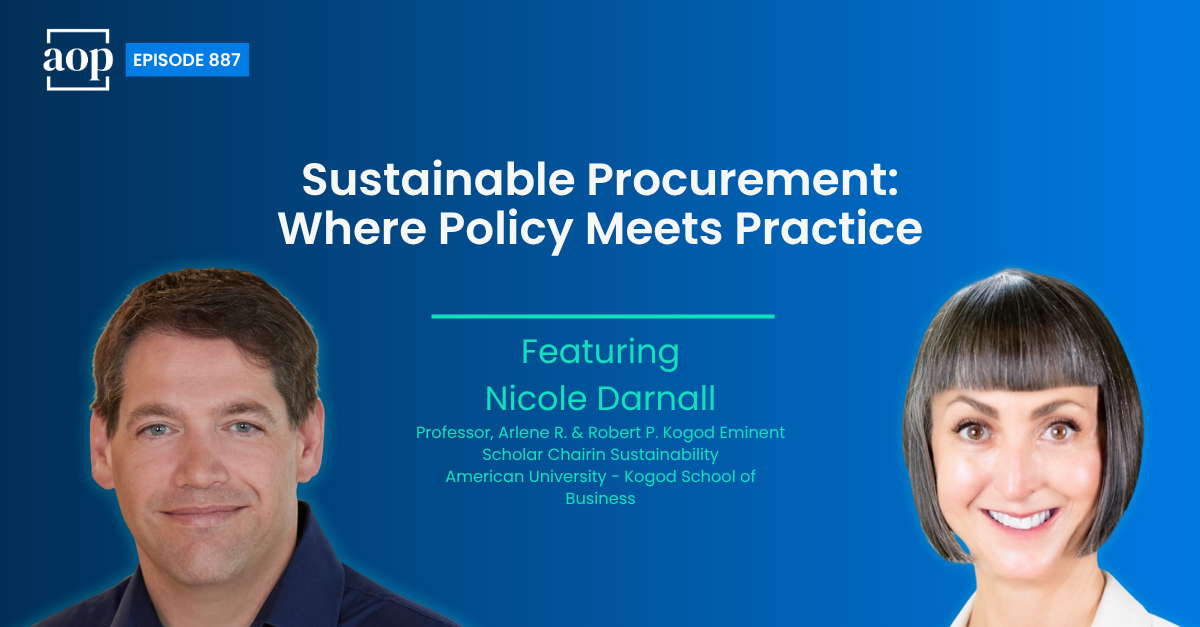
“If you're not thinking about what you inherit through your procurement decisions, then you're not truly serious about managing your climate impacts.” - Nicole Darnall, Professor, Arlene R. & Robert P. Kogod Eminent Scholar Chair in Sustainability, American University - Kogod School of Business
I’ve seen plenty of corporate sustainability commitments over the years. The ambition is usually clear, but the harder part is tracing those commitments all the way down to the individual decisions being made across the business.
That’s one reason I’ve always thought procurement has an interesting role to play in sustainability. We sit at a point where broad organizational goals eventually have to become everyday, practical choices: which suppliers we work with, what criteria we put into an RFP, how we evaluate cost, and what information we require before making an award.
My recent conversation with Nicole Darnall, Professor and Kogod Eminent Scholar Chair in Sustainability at American University, gave me a chance to explore that connection in depth. Nicole has spent more than two decades studying sustainability and the last decade specifically focused on procurement.
What struck me throughout our conversation was how many of the barriers to sustainable procurement have little to do with a lack of ambition. The real work begins when we try to turn that ambition into repeatable procurement decisions.
Policy only gets you so far
“That's what a lot of organizations default to. They know they have to adhere to a policy, and so what's the minimum effort that they need to undertake to check that box and say that they met certain expectations? That's a very different starting point than approaching sustainability with a really sincere value-based proposition that I am creating greater value to my organization and to society if I take this seriously.”
Procurement is very familiar with the gap between having a policy and changing behavior. We can create requirements, add fields to processes, and establish governance, but none of those things guarantee that people will make different decisions.
Sustainable procurement asks people to consider factors that may not have historically carried much weight in a sourcing decision. That can mean challenging familiar supplier relationships, established specifications, or assumptions about what constitutes the “best” commercial outcome.
Policies provide permission and direction. Culture determines whether people are willing to use that permission when a decision becomes difficult.
More supplier data isn’t necessarily better supplier data
“We have suppliers that are increasingly interested in telling their story, but there's a lot of mistrust on both sides related to information that they're receiving. How do you approach it with a degree of confidence? How do you deem that information to be legitimate?”
When an issue becomes important, our instinct is often to gather more information. We create another questionnaire, another assessment, another data requirement. Eventually suppliers are answering slightly different versions of the same questions for dozens of customers, while buyers still aren’t completely confident that they have the information they need.
Sustainability doesn’t suffer from a lack of data as much as it suffers from difficulty determining which information is useful, comparable, and trustworthy. That changes the job for procurement. We need to become better at asking questions that can actually influence a decision rather than collecting information simply because we can.
Purchase price can hide the real economics
“The cheapest product at the point of purchase could be considerably more expensive when you account for water use, energy use, maintenance, durability, disposal costs, all of this. So we need to start thinking about cost more broadly.”
A sustainable choice can sometimes be framed as though the business is being asked to pay a premium in exchange for doing the responsible thing. That framing becomes much less convincing when we broaden the economics of the decision.
A lower purchase price can carry costs elsewhere, whether through resource consumption, maintenance, disposal, risk, or a shorter useful life. Some of those costs are easier to quantify than others, but excluding them from the decision doesn’t make them disappear.
Start where procurement can actually have an impact
“It's easy to skip over this step, but that's where you determine where your biggest impact is. You have to understand your spend, and you have to identify the highest impact purchasing categories when you focus your efforts there.”
Sustainability is enormous in scope. Trying to account for every environmental and social consideration across every supplier and every purchase can quickly become overwhelming. It can also lead to a lot of activity without a clear sense of whether that activity is changing anything.
Procurement has an advantage because they already know how to segment spend, prioritize categories, and focus resources where they can create the greatest return. We can apply the same discipline here.
That might mean looking at where environmental or social impacts are highest and then mapping those priorities back to the relevant spend. It might mean examining major upcoming RFPs where decisions will lock the company into supplier relationships for years. The right starting point will differ by organization, which makes the prioritization work even more important.
The opportunity is to apply those capabilities with a broader understanding of the consequences of what we buy.
Links:
- Nicole Darnall on LinkedIn
- Learn more about the Sustainable Procurement Research Initiative
- Subscribe to the AOP Newsletter