
3 min read
Procurement Should Be a Safe Pair of Hands in a Complex World
Philip Ideson : September 27, 2026
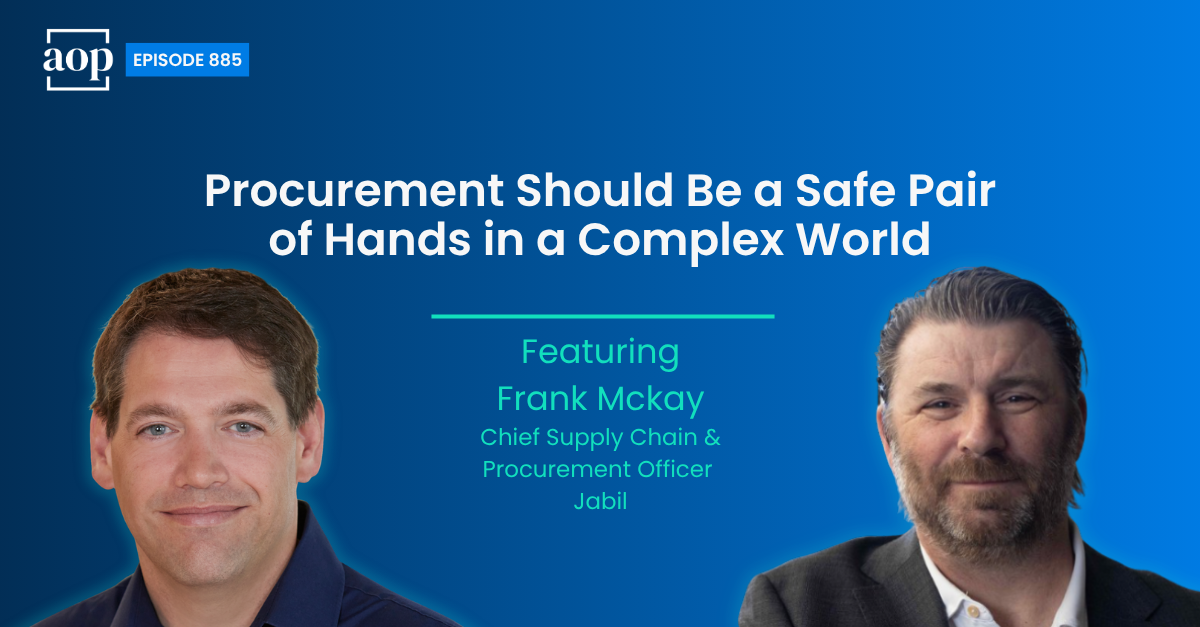
“Do we have a supply chain that we are building that is going to allow us to navigate and be agile enough, no matter what the world continues to throw at us?” - Frank Mckay, Chief Supply Chain & Procurement Officer, Jabil
When I first spoke with Frank Mckay a couple of years ago, much of our conversation was about procurement influence, resilience, and earning credibility with the business.
When we reconnected this year, what struck me was how much further that thinking has gone at Jabil. As Chief Supply Chain & Procurement Officer, Frank has a perspective that naturally crosses the boundaries we often draw between procurement and supply chain. Those boundaries are becoming harder to justify when the technology, data, risks, and business outcomes behind them are so interconnected.
Our conversation gives me a lot to think about, particularly around what happens when procurement starts taking responsibility for a much broader definition of value.
Technology can give procurement and supply chain a reason to come together
“We [procurement and supply chain] are actually better as one.”
Frank describes technology as one of the catalysts that initially brought Jabil’s procurement and supply chain organizations closer together.
That makes a lot of sense to me. You can design separate reporting lines and organizational structures, but data rarely respects those boundaries. Neither do many of the problems we are trying to solve.
A shortage doesn't become a procurement or supply chain issue depending on which system identifies it. The same is true of inventory, logistics, supplier risk, and resilience. Building technology around a common source of truth forces us to confront how interconnected those decisions actually are.
For organizations where procurement and supply chain remain separate, there may be an important lesson here: alignment doesn't necessarily have to begin with an organizational redesign. It can begin by identifying the capabilities that neither function can build as effectively on its own.
AI should change the work, not simply remove the worker
“This isn't about going lights-out purchasing or taking people out. It is about doing more with the same.”
There is a tendency for discussions about AI and procurement headcount to become binary very quickly. Frank’s approach is more useful because it starts with the work itself.
Jabil went back to its job descriptions and asked whether people were spending their time doing the jobs they had been hired to do. If a buyer, planner, category manager, or customer-facing supply chain professional is spending significant amounts of time on data entry, technology creates an opportunity to redirect that capacity.
Removing administrative work only creates value if we have a plan for the capacity that comes back. That puts responsibility on leaders to make sure people have the skills, expectations, and opportunities to take on work that requires more judgment and creates greater value.
Experimentation still needs a way into the enterprise
“We have a process and I'm very clear on saying it's a process, not policy.”
I think Frank’s distinction between process and policy is particularly interesting. Jabil gives people room to experiment with AI in a sandbox environment, but there is also a clear route for promising ideas to move into a centralized technology organization where they can be evaluated and developed appropriately.
That balance is going to become increasingly important. Procurement leaders need their teams to experiment because we are still discovering what these technologies can do. At the same time, thousands of disconnected experiments can introduce duplication, licensing problems, compliance issues, and unnecessary risk.
Governance shouldn't eliminate curiosity. Done well, it gives good ideas a path to scale.
Procurement's value equation is getting much bigger
“How we get viewed and the metrics that we are now held accountable to are that plus ten others.”
Cost reduction hasn't disappeared at Jabil, and Frank is very clear that cost leadership remains important. What has changed is everything procurement is being measured on alongside it.
Balance sheet health and resilience sit alongside more traditional metrics. Jabil has also found ways to monetize its procurement and supply chain capabilities through services, creating revenue and margin streams from expertise and scale the organization already possesses.
When procurement can demonstrate value in multiple ways, their investment story changes too. We no longer have to justify every capability solely through the savings it might produce. We can talk about resilience, working capital, customer outcomes, revenue, and the other ways procurement contributes to enterprise performance.
Someone still has to own the risk
“The buck stops here and that's how we kind of think about things and operate.”
When something goes wrong, there is rarely much value in determining whether procurement, supply chain, operations, or somebody else technically owned the problem. The business and the customer experience the outcome either way.
Frank’s approach is that his organization owns the risk and invests in the people, processes, and technology required to reduce it.
That mindset helps explain much of the rest of our conversation. Procurement and supply chain alignment, AI investment, broader performance measures, and new sources of value all become easier to understand when the objective is bigger than optimizing a function.
Frank talked about wanting Jabil to be seen by customers as a safe pair of hands in an increasingly complex world. That is a powerful way to think about procurement’s contribution. We may measure cost, resilience, working capital, revenue, and dozens of other things individually, but collectively they build something harder to capture on a scorecard: confidence in the business’s ability to deliver.
Links: