
3 min read
Inside Next-Gen SAP Ariba: Rebuilding Procurement for the AI Era
Philip Ideson : Updated on October 15, 2025
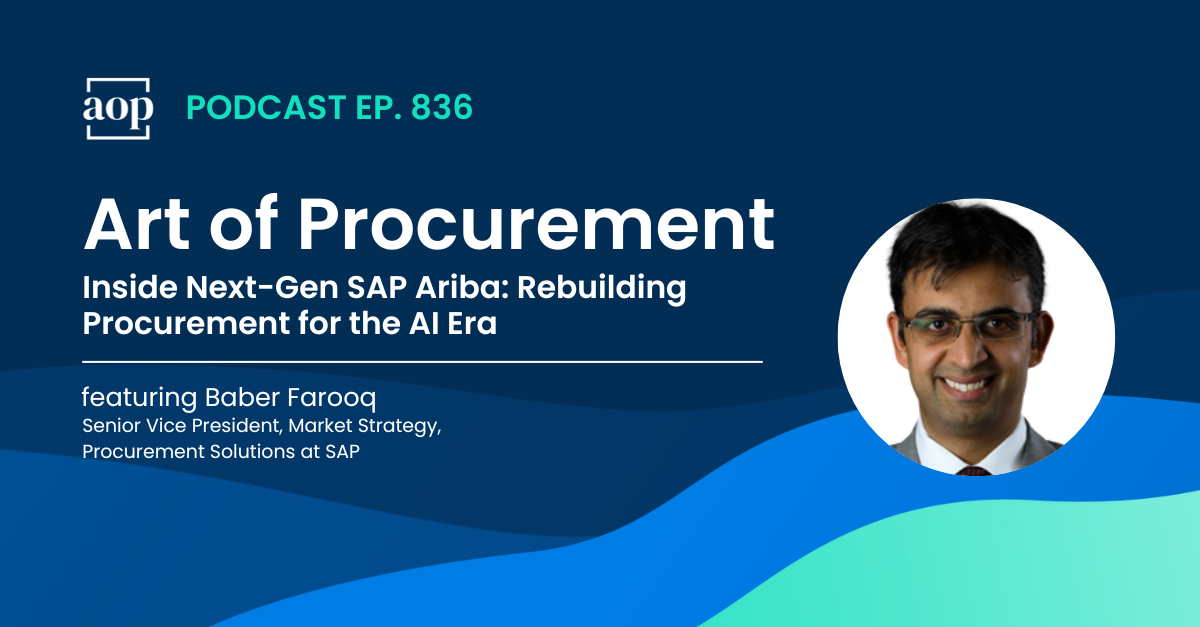
“Everyone keeps talking about AI just for the sake of AI, but, ultimately, the only thing that matters is the outcome you can achieve."- Baber Farooq,
Senior Vice President, Market Strategy, Procurement Solutions at SAP
Procurement leaders are facing the twin pressures of rising expectations and rapid technological change.
I talk to a lot of CPOs who feel their technology never caught up and isn’t keeping up, that platforms that once defined the market now struggle to deliver real productivity gains or adapt fast enough to new business realities.
That’s why SAP’s recent announcement about reimagining Ariba caught my attention. It’s not often that a legacy platform decides to rebuild itself from the ground up.
In this Art of Procurement podcast episode, Baber Farooq, Senior Vice President, Market Strategy, Procurement Solutions at SAP, shares why his team is making more than iterative upgrades. Their approach is designed for a world where AI isn’t bolted on but deeply embedded in every process.
Here, in Baber’s own words, are a few of the moments that stood out to me and why they matter for the future of procurement.
Building from the Ground Up to Harness GenAI
“We have reimagined SAP Ariba… If we were redesigning a procurement platform for the world in which generative artificial intelligence is a reality, how would that product work?... It was transformative enough for us to say, okay, let's rebuild it from the ground up to some extent.” – Baber
What struck me about this comment is that it represents a rare moment of true reinvention for our profession. Most enterprise platforms evolve through patches and integrations; few take the risk of rebuilding their foundation. This approach is challenging providers to think differently: what if we stopped layering AI on top of old processes and instead designed systems for how procurement will actually work five years from now?
Moving Beyond “AI as an Add-On”
“AI is being designed as a bit of an afterthought. It's a cool thing that's an afterthought, right? Or an add-on.” – Baber
This point gets to the heart of why so many organizations struggle to see the full impact of AI. I’ve seen teams get excited about tools that promise automation, only to realize the intelligence feels optional – a sidecar rather than the engine. Baber’s critique reminds us that effective AI isn’t about surface-level efficiency; it’s about deeply embedding intelligence so that it becomes inseparable from how work actually happens.
Transparency and Trust Built In
“We have enough confidence in the algorithms to make AI do the work and let you know what it’s done. Then you can go ahead and verify the output and make any changes that need to be made.” – Baber
This reflects a principle I believe will define the next era of digital procurement: combining automation with accountability. AI can accelerate decisions, but human judgment still anchors trust. The model Baber describes – systems that act autonomously and then invite human verification – strikes a pragmatic balance. It’s not about removing people from the loop; it’s about positioning them where they add the most value.
Data: The Real Differentiator
“We will have the best AI capability, because we do have the world's largest and most structured data set, from a business data perspective and a spend data perspective... what will make things unique is the data, what will make the AI powerful is the data that it has been trained on.” – Baber
This is an important insight from our conversation. AI innovation tends to dominate the headlines, but as Baber points out, it’s data – not just algorithms – that determines performance. In my experience, most procurement functions underestimate the strategic role of clean, structured, connected data. Without it, even the best technology will struggle to deliver insight or confidence.
From Dashboards to Autonomous Insight
“Users can expect an elevated product going forward. It will be able to communicate, “I noticed that this commodity has just been tariffed... this is what I think you should do: You should run a sourcing event, you should recontract, or you should have multiple suppliers for this commodity in multiple locations. It'll actually be telling you to do that.” – Baber
This line captures what I see as the next big leap: systems that don’t just report what happened but recommend what to do next. The idea of an application that senses, reasons, and suggests action could fundamentally shift how procurement teams operate. It moves us from dashboards and static analytics to guided, contextual decision-making – something our function has needed for a long time.
Balancing Innovation and Stability
“This rollout was the most difficult design decision on our side… We wanted to make sure that our customers are not disrupted. We do not want to disrupt them.” – Baber
When SAP decided to rebuild Ariba for the AI era, the hardest question wasn’t technical – it was human. How do you deliver a next-generation platform without forcing thousands of organizations to start over? Baber explained that his team’s top priority was ensuring continuity: customers would gain access to the new capabilities without new purchases, retraining, or business interruption.
That balance between innovation and stability resonated with me. Too often, transformation asks teams to pause their work in order to move forward. What Baber described is the opposite: a model of progress that fits seamlessly into how people already work. It’s a reminder that true innovation in procurement technology requires more than a commitment to speed or sophistication; it also means building trust through thoughtful execution.
Links: