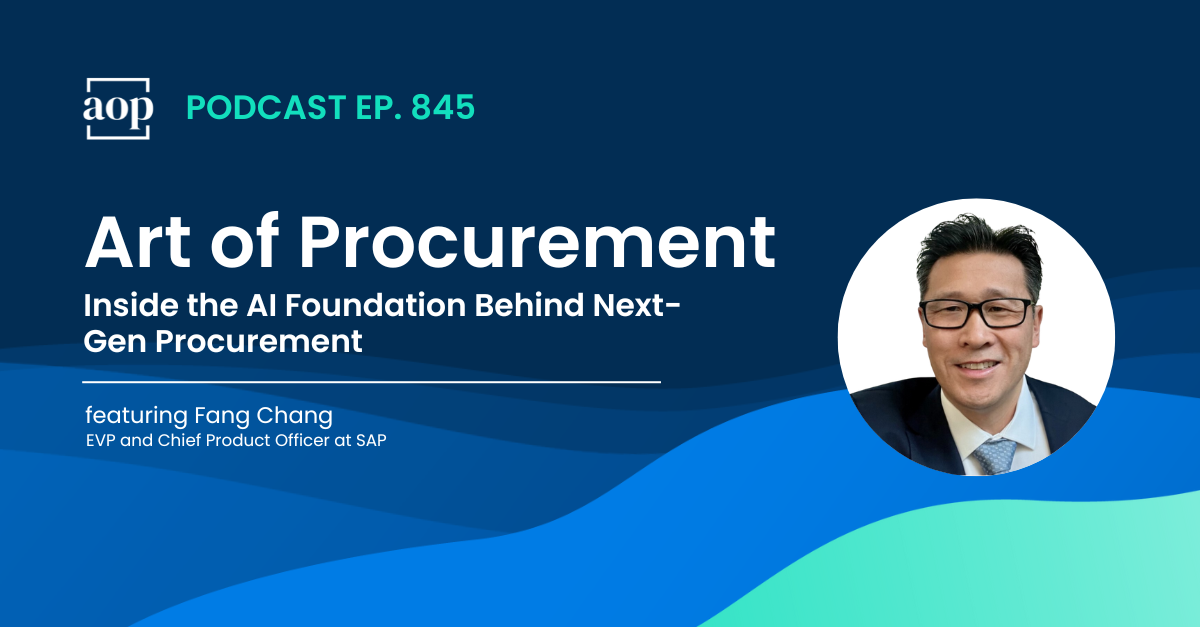
“If you don’t go on the journey, you risk being left behind. The key is to try, learn, and apply AI in a way that creates real value.”
- Fang Chang, EVP and Chief Product Officer at SAP
The world of procurement technology is undergoing a fundamental reset. More and more leaders are facing a stark choice: bolt artificial intelligence onto legacy tools, or rebuild from the ground up on an AI-native foundation.
That decision doesn’t just include tech architecture; it defines the kind of value procurement can deliver in the future.
In this podcast episode, I speak with Fang Chang, EVP and Chief Product Officer at SAP. He led a ground-up rebuild of SAP Ariba, intentionally designed with AI woven through every layer. What makes this conversation stand out is the level of transparency Fang offers about the technical and strategic decisions behind the rebuild and what it unlocks for procurement.
Here, in Fang’s own words, are a few highlights from our conversation, along with my take on what they mean for procurement’s next chapter.
Not Just Slapping AI On Top
“One option is to slap AI on top of the existing software, which I can say a lot of companies are doing, or you can weave AI through an entire platform and entire technology set. And that's what we chose to do here at SAP.”
Many teams are chasing AI features while still working inside outdated workflows, but true transformation starts by rethinking the underlying assumptions. When you build AI in from the ground up, you’re designing for a different kind of decision-making and value creation.
AI-Driven User Experience
“If you're just layering AI on top of that, you're not going to be able to reimagine those user experience workflows.”
This is where the shift becomes real and tangible for users. In our conversation, Fang explained that AI can reduce a 10-step task to just two. But that’s only possible if you re-architect the entire experience. You have to adopt smart tools in a way that creates a user journey that’s radically more intuitive, while still connected to controls, data, and governance.
Deciding Where AI Really Adds Value
“You don't want to use AI as a hammer looking for a nail. You want to apply it in ways where it makes sense.”
I appreciate Fang’s pragmatism here. The hype around AI can create pressure to apply it everywhere, but in reality, some challenges are better solved by better UX or process design. As leaders, we need to be precise about where AI is used and why, especially if we’re looking for real outcomes, not just novelty.
The Danger of Waiting for “Perfect” AI
“People have to be very careful with this notion that ‘things are changing so fast, I'm just going to wait and see before I leap in.’ And that's a very, very dangerous game… because you're missing one critical piece, which is your learning about how to apply AI, what works and what doesn't work. So if you don't go on that journey, you risk being left behind.”
I speak with many CPOs who are in ‘wait-and-see’ mode, but the reality is that experimentation is how you build readiness. The leaders who are learning by testing, failing, and adjusting are the ones who’ll be ready to move fast when the next breakthrough comes. You can’t short-circuit the learning curve.
Turning Insights Into Action
“How do you actually derive the insights in a way that's meaningful and then guide the user and organization to take action based on that information?”
The promise of AI isn’t just in more data or smarter dashboards. It’s in surfacing the right insight, at the right moment, in the right workflow so that action naturally follows. Procurement’s ability to reduce risk, drive innovation, or optimize spend depends on that leap from information to outcome. This is where the next generation of tools will be differentiated.
Human and AI: The New Workflow
“We still want to have humans in the loop because we don't want these AI agents to accidentally hallucinate… being able to integrate the human with the AI agent is super, super key.”
Even the most powerful AI needs the context, judgment, and oversight that only people can bring. The goal isn’t to completely replace human decision-making, it’s to augment and enhance it. The smartest systems are those that know when to take action and when to ask for a human’s input.