“Procurement tools traditionally look at history. To make better decisions, we need to start looking forward.”-Tomas Wiemer, Managing Director and Founder, Orbit2Transformation, LLC
Procurement has spent the better part of two decades investing in systems designed to control spend, enforce compliance, and improve operational efficiency. Those investments have created real value, but they have also shaped how procurement thinks about their role. Most tools still focus on tracking what has already happened rather than helping the business decide what should happen next.
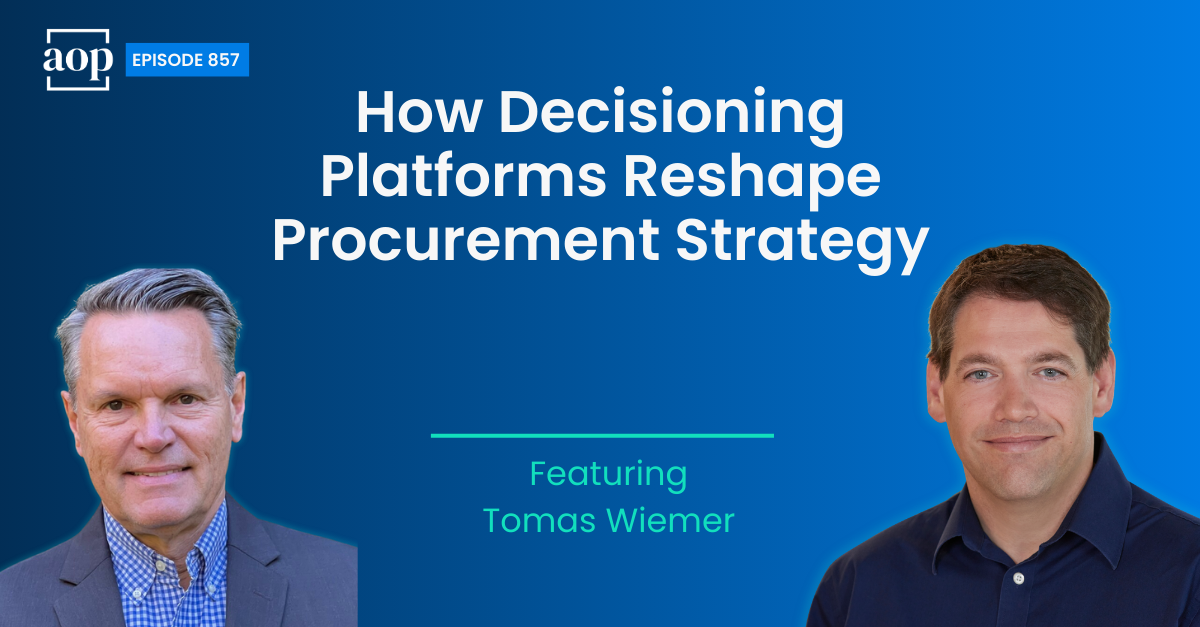
In this week’s podcast episode, I speak with Tomas Wiemer, a global procurement and digitization executive who has spent much of his career building procurement organizations and digital platforms.
Our discussion centered on how procurement can move beyond operational efficiency and start enabling better business decisions through data, visibility, and technology.
Here are a few moments from our conversation that stood out to me.
Building Procurement With a Long-Term Vision
“Organizations need an aim for where they want to go. Then you have to be able to get investments from stakeholders or from the central organization. You can invest in platforms, you can invest in suppliers, you can invest in people and training. But you need both the direction and the investment to go beyond what exists today.”
One theme that runs through Tomas’s leadership philosophy is the importance of intentional design. Procurement organizations do not evolve accidentally. They are built.
In many companies, procurement teams are asked to deliver more value while operating within structures that were originally designed for cost control or compliance. Without a clear vision for what the function should become, those teams often struggle to justify investments in technology, data, or talent.
That investment may come in different forms. Sometimes it means new digital platforms. Sometimes it means developing deeper category expertise. Often it means investing in people who can operate effectively in a more strategic environment, but none of that happens without a clearly defined destination.
The Separation Between Operational Procurement and Strategic Sourcing
“Five or ten years ago, a buyer was doing everything. They handled the negotiations, the RFPs, the auctions, the suppliers, and the stakeholders. As operational efficiency tools became more sophisticated, a separation started to happen. Shared services and operational teams take care of the transactional side, and strategic sourcing can focus on a new journey.”
This observation reflects a shift that many procurement organizations are experiencing right now.
For years, buyers were expected to manage every part of the procurement lifecycle. That model made sense when digital tools were limited, and procurement teams were relatively small. But as procure-to-pay systems and shared service models matured, the opportunity emerged to separate operational execution from strategic work.
That separation creates space for procurement professionals to focus on higher-value activities. The key question is what procurement does with that newly available capacity. Tomas believes the answer lies in enabling better decisions.
Why Volume Matters More Than Price
“My big subject lately is tracking the volume more than tracking the price. Price goes up and down all the time. The volume is the key factor.”
This comment struck me because it challenges one of the most ingrained habits in procurement.
We spend enormous amounts of time focusing on price. Negotiations often revolve around percentage reductions, cost benchmarks, and supplier margins. But in many categories, the biggest driver of spend is not price at all: demand is.
Consulting hours, software licenses, external labor, and subscription-based services are all examples of volume decisions that have a much greater impact on total spend than unit price. If the business buys more than it needs or duplicates services across departments, procurement can negotiate the best rates in the world and still miss the bigger opportunity.
This is where data visibility becomes critical. Without clear insight into how much the organization is actually consuming and where overlaps exist, procurement cannot effectively influence demand.
The Real Challenge: Data and Engagement
“The most difficult thing for any company is having structured data and making stakeholders and sourcing professionals available to really engage in these new data activities.”
Technology alone will not solve procurement’s data problem. Even the most sophisticated platforms depend on structured data, consistent processes, and active engagement from the people who generate and use that information. That requires investment not just in tools but also in discipline.
Organizations have to define the data that matters most. They have to ensure that contracts, supplier information, and usage data are captured in ways that can be analyzed effectively. And they have to encourage both procurement teams and stakeholders to participate in maintaining that data.
It is not a simple task, but it is an essential one if procurement wants to play a more strategic role in business decision-making. Procurement has already made enormous progress in operational efficiency.
The next phase of the journey will be defined by how well we enable better decisions, and that will depend less on processing transactions and more on bringing together the right data, insights, and relationships to help the business move forward with confidence.