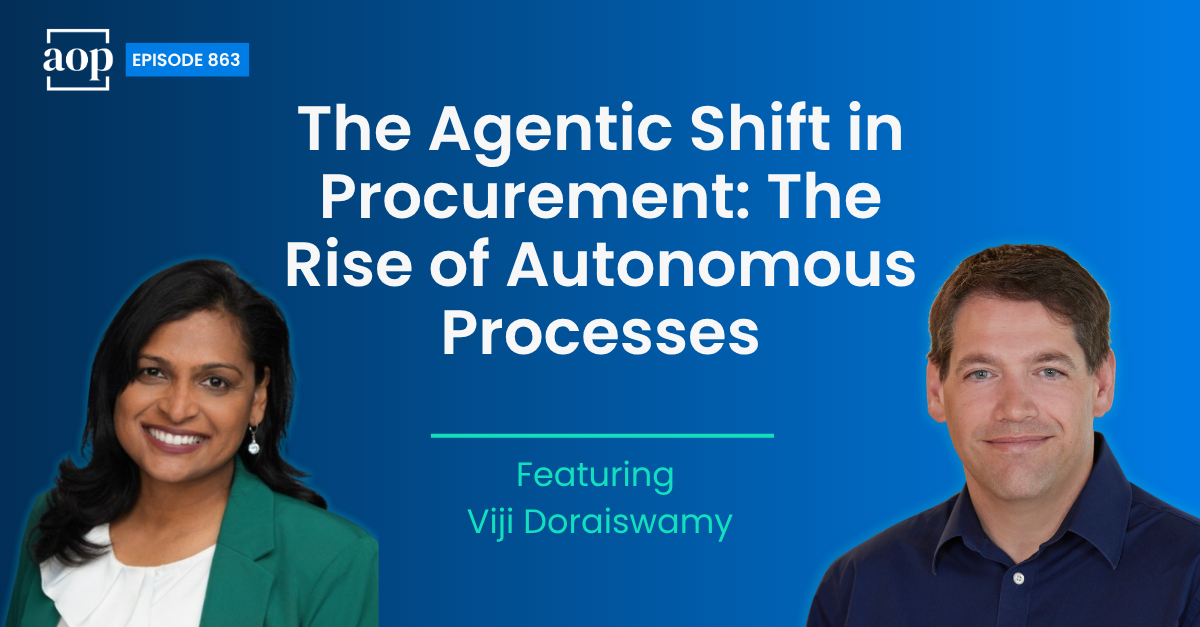
“Procurement now gets to decide where to play, who does the work, and how much of that work is done by humans versus agents.” - Viji Doraiswamy, VP Product Marketing, Coupa
Over the last decade, I’ve seen procurement technology evolve in waves. We moved from manual to digital, from fragmented to integrated, and from reactive to data-informed. What feels different now is the scale and nature of the change.
This current shift, driven by agentic AI, is more than just another step forward along the tech trajectory. It completely challenges how procurement work is defined, how decisions are made, and where value is created.
In this episode of the Art of Procurement podcast, I speak with Viji Doraiswamy, VP Product Marketing at Coupa. Her perspective is shaped by years of working at the intersection of procurement and technology. What stood out to me from the conversation was not just what is possible, but how quickly teams are moving from experimentation with agentic AI to real application.
Beyond Intake: Orchestration as Procurement’s Engine
“Intake is more of that front door. It really has made it easy for employees, for users from anywhere to submit a request… but what happens next is that underlying engine that decides what to do with that request. So without orchestration, if you're just getting an intake tool and you think you've made a transformation, your request is just stuck there without moving forward.”
I have seen many organizations invest in making it easier for stakeholders to engage with procurement. That is an important step, but it is only the beginning. What determines impact is what happens after the request is submitted.
Orchestration introduces a level of coordination and automation that changes how work flows across functions. It connects systems, embeds policies, and allows processes to move forward without waiting for manual intervention at every step. When done well, it reduces friction in a way that stakeholders notice immediately. It also creates the space for procurement teams to focus less on managing requests and more on shaping outcomes.
Shifting the Operating Model: Control and Delegation
“It’s a technology shift for sure, but I think it’s also a significant shift in the operating model because procurement has to now decide who gets to do what role… And the procurement manager decides where to spend their time at the end of the day and if the agent flags it, or if they just move forward and let the agent do it. Then they can focus their time elsewhere.”
This is where I believe the conversation becomes more interesting. Technology enables new possibilities, but the real change happens when leaders rethink how work is allocated.
Procurement has historically been built around control and visibility. Now there is an opportunity to be more deliberate about where human expertise is applied. Some decisions still require judgment, context, and stakeholder alignment. Others can be handled consistently and efficiently by agents.
The challenge for leaders is how to design an operating model that uses this technology effectively. That requires clarity on priorities and a willingness to let go of tasks that do not require direct human involvement.
Building Trust in Agent-Driven Outcomes
“It’s about how explainable the data is. Is the agent able to tell you why they chose a particular supplier because of these reasons? That explainability matters.”
What I find practical in Viji’s perspective is the emphasis on transparency and progression. Trust is often the limiting factor in adopting new technology. In procurement, where decisions can carry financial and reputational risk, that hesitation is understandable.
When systems can explain their recommendations, it becomes easier to evaluate them. When humans and agents operate in parallel, it creates a reference point for comparison. Over time, as accuracy improves and outcomes are validated, confidence builds. That progression is critical. It allows organizations to move forward without feeling like they are taking an unnecessary risk.
Making the Leap: Where to Begin
“Start with the agents that are already built because that’s been tested with multiple customers before it’s launched. Start using those low-hanging fruit agents that can give you some quick value.”
One of the most common questions I hear is, “Where do I start?”
The instinct is often to look for a comprehensive transformation plan. In practice, progress usually begins with something smaller. Starting with proven use cases allows teams to see results quickly. Those early wins are important because they demonstrate value in a tangible way. From there, it becomes easier to prioritize where to expand and how to scale.
The organizations that make the most progress are not necessarily the ones with the most ambitious plans at the outset. They are the ones that take a practical first step and build from there.