
“There are a lot of different ways to hold all of the conspirators who are involved in the effort to intentionally smuggle counterfeit goods into the U.S. and into U.S. systems accountable.”
To manage a supply chain is to accept the reality that risk will never be eliminated. Some risks are simply par for the course when doing business around the world in unpredictable conditions. In other cases, risk is caused intentionally by people and organizations willing to commit crimes to make a profit.
But learning to work with risk doesn’t mean accepting it, especially when national security is at stake.
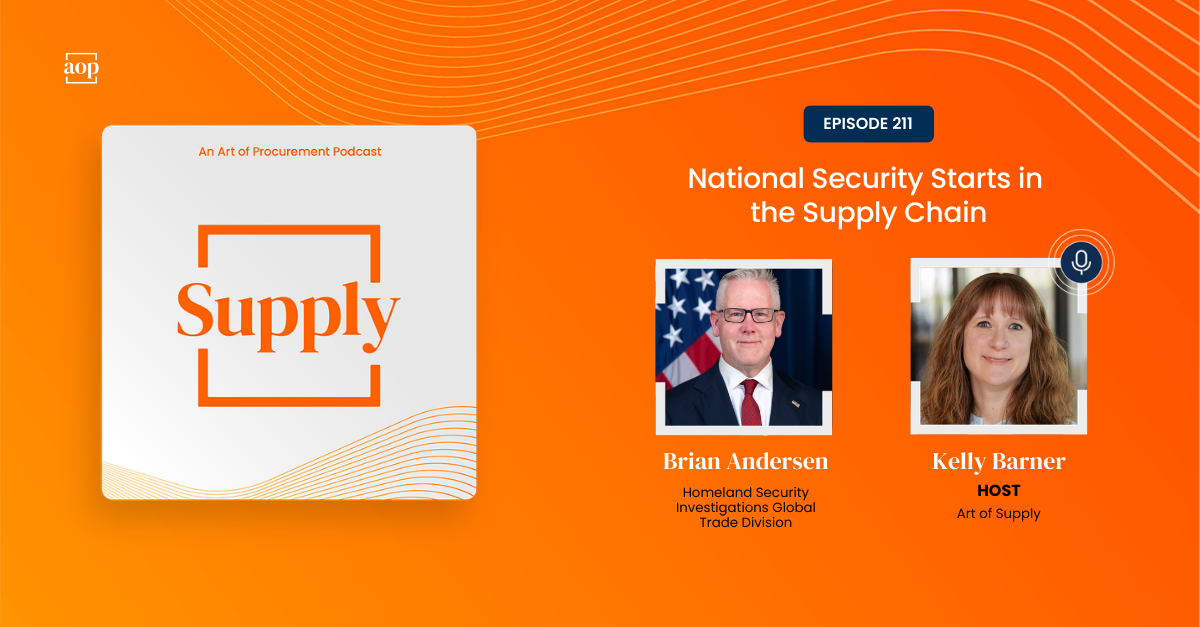
In this episode of Art of Supply, I speak with Brian Andersen. Brian is a supervisory special agent at Homeland Security Investigations Global Trade Division, part of the National Intellectual Property Rights Coordination Center, and the Government Supply Chain Investigations Unit.
The Government Supply Chain Investigations Unit (GSCIU) operates as a task force, analyzing interagency information to identify and combat threats to supply chains that feed the U.S. government.
While their ongoing investigations can’t be discussed publicly, Brian joins me to talk about some closed cases and publicly recognized ongoing efforts. He also shares red flags that all procurement and supply chain professionals should be on the lookout for in the ongoing battle against counterfeit products.
Connecting the Dots Across Agencies and Industry
The GSCIU is involved in a number of different spend categories and material needs, but their operational priorities are clear. They are focused on threats to national security, military readiness, and warfighter, veteran, and first responder safety.
“The categories of components that we spend our time focused on are typically the ones that you see being purchased by the Pentagon that have a direct impact on national security and military readiness,” Brian explained.
Examples include electronic components, body armor, optics, and any supplies feeding into the Veterans Affairs medical system, which happens to be the largest hospital network in the United States.
Information about potential crimes reaches the GSCIU through multiple channels, including partner agencies, the intelligence community, and private companies. In fact, procurement organizations often play an active role in flagging potential risks.
“Our industry partnerships are also critical,” Brian said. “Manufacturers and distributors are likely to recognize anomalies in their own distribution network before we are. And so that's the type of potential criminal intelligence that we receive from our industry partners.”
Forming a Layered Intelligence Ecosystem
With all of those sources comes data, LOTS of data.
The GSCIU operates in a “layered intelligence ecosystem” as Brian describes it. Key to this ecosystem is U.S. trade data, but international data is analyzed as well.
“So not only do we have access to U.S. trade data, but through a variety of agreements, we get access to other countries’ trade data as well,” he told me. “That's massive amounts of data potentially coming in and helping us understand it, helping us do something with it - that's why we needed the data scientists.”
In some cases, working with the intelligence community allows them to head off a problem before a counterfeit component is put into use by the military or first responders. If an incident does occur, and a counterfeit component may be involved, then the GSCIU has to trace back the supply chain to find out how many hands it passed through and where it originated from.
“Those are the types of threats that we are trying to act upon, trying to prevent,” Brian explained. “At some point, an incident will occur, and then we would need to work backwards from that incident to find out all of the people, entities that were involved in getting that counterfeit component into a system when it failed under pressure.”
Where Vigilance Makes the Difference
A lot of different products and components have government or military applications. That means that anyone working in procurement and supply chain has an opportunity to make a difference.
I asked Brian about warning signs that something has gone awry in a company’s supply chain, and he shared that there are some common signals we can watch for:
- Pricing that is significantly below market price, especially when accompanied by pressure to move quickly or to avoid established sourcing processes and channels
- Paperwork or documentation that doesn’t match, including inconsistent product labeling or gaps in a part's traceability
- Products moving through brokers or intermediaries that aren't part of the normal distribution chain
- Performance that does not match specifications, requirements, or even expectations
One example Brian shared includes encrypted radios that an allied nation purchased through the State Department for frontline law enforcement use.
“When they were inventorying the radios, they saw the same serial number for every radio in the box,” Brian shared. “And so something as simple as a serial number actually highlighted this massive infiltration of counterfeit components into a law enforcement environment.”
That is an example of a small detail that the criminals got wrong, but that someone paying close attention noticed - and picked up on in time to prevent something bad from happening.
Brian also left me with a couple of ways people who think they may have come across counterfeiting activity can report it:
The first is an email address: gsciu@hsi.dhs.gov. It belongs to the Government Supply Chain Investigations Unit within U.S. Immigration and Customs Enforcement Homeland Security Investigations.
The other is a website you can visit to learn more about or report possible IP theft. iprcenter.gov will take you to The National Intellectual Property Rights Coordination Center, which is the U.S. government's clearinghouse for investigations into counterfeiting and piracy.
In some cases, counterfeit components and materials mean wasted money, poor quality, and potential reputational damage. But with national security, the military, and first responders, lives may hang in the balance. We all have a responsibility to help address those risks.