
Despite the enthusiasm for AI and automation across nearly all areas of business, global sourcing has remained defiantly analog. The inherently messy, relationship-heavy nature of sourcing that has resisted the clean lines of traditional automation has kept things largely manual.
But that resistance may finally be cracking.
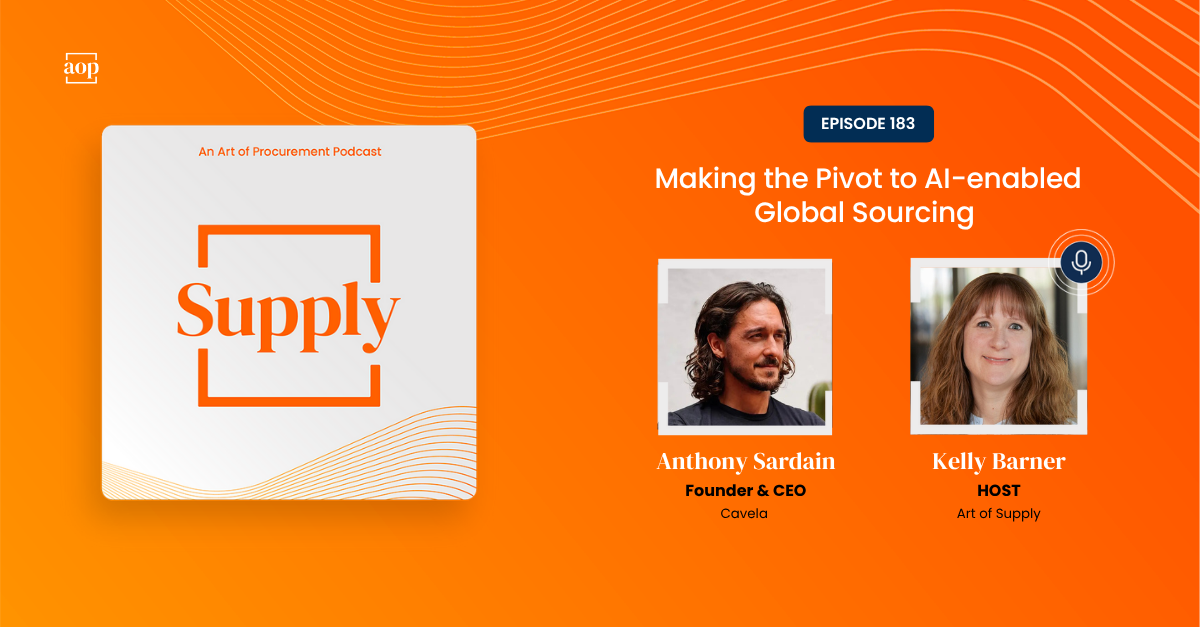
Anthony Sardain is the founder and CEO of Cavela, a company focused on automating the end-to-end sourcing process. For three generations, his family has been heavily involved in trade. It probably comes as no surprise then that during his graduate studies at McGill University, he focused on developing machine learning and AI models to predict global trade.
In this episode of the Art of Supply podcast, I speak with Anthony about the opportunities associated with (finally) automating global sourcing and how suppliers feel about this long-overdue introduction of AI into global manufacturing.
A New Business Model for Global Sourcing
The fundamental innovation behind Cavela isn't just to make sourcing faster, although that’s certainly a nice-to-have. By turning the process over to AI, they want to completely reimagine how sourcing works as a business model. Anthony describes this capability as “a virtual sourcing agent” that handles “absolutely everything from taking in your product spec to vetting suppliers, finding suppliers, doing all the coordinating with suppliers, coordinating samples, QA, all the way to ordering.”
This marks a big shift from traditional sourcing approaches that rely heavily on human capital, communication, research, and relationships.
“What we've seen with technological innovation is that it has often allowed us to go from a service world to a product world,” Anthony noted, drawing parallels to how Flexport transformed freight forwarding. As he explained, “When you thought about freight forwarding 20, 30 years ago, it meant calling up different brokers, going back and forth, getting all these quotes. And with Flexport, you kind of created this world where you can have something that feels a lot more like a click of a button.”
The implications go beyond convenience and translate to real bottom-line value creation, because when so much of the sourcing process is automated, it allows for more competitive quotes and a leaner operation overall, compared to traditional sourcing models.
Why Sourcing Stayed Manual So Long
While other areas of procurement and supply chain have seen top-to-bottom digital transformation, sourcing has remained stubbornly manual. Understanding why puts some valuable context around just how significant the current breakthrough really is.
From a technological perspective, says Anthony, “a lot of the technology that was at our disposal up until these language models became more mainstream made it such that it was very difficult to automate a lot of the work that goes into sourcing. Sourcing is inherently quite messy. It's very based on communication.”
Other business functions lend themselves much more easily to digitization. Compared to sales, for example, the contrast with sourcing is stark. “If you're selling products, your SKUs fit in very nice, neat little cells,” said Anthony. On the other hand, sourcing “is very descriptive. It's images, it's video, it's text descriptions. That didn't really lend itself to the old suite of technology.”
But AI has changed the game entirely.
Modern language models can handle the relationship-driven nature of sourcing that involves “a lot of back and forth over email, over WhatsApp, over WeChat. All of that is something that the current suite of technology is very well suited to tackle.”
Beyond technology, there's also been a shift in global trade dynamics.
Anthony points out that, “the old approach to sourcing, where it has very much like a set it and forget it type approach to building up your supply chain, is no longer appropriate and perhaps might not even be desirable.”
The current tariff environment and instability in general have created demand for a much more dynamic supply chain where companies can pivot their supply chain on a dime. AI now makes that possible for sourcing.
Small Players, Big Impact
When it comes to who is benefiting the most from AI-driven global sourcing, Anthony sees a clear pattern: “It's unquestionably small and mid-sized brands” feeling the biggest advantages, for now anyway. And the reasoning behind this is straightforward: “Large brands, large enterprises have the means to just throw money at the problem [of sourcing] to make it go away. They're hiring large dedicated procurement teams that can tackle all of the difficulties that sourcing presents. Small and mid-sized brands don't have that luxury.”
The same dynamic is emerging in physical products. Once it becomes as easy for a small group to produce products as it is to shoot a video on an iPhone or record audio to create digital content, Anthony predicts we'll see that same revolution extend from the digital product space into the physical product space.
This shift will force larger companies to adapt as smaller companies with these tools will become more nimble and, as a result, more competitive. According to Anthony, because of AI-driven sourcing, “[smaller companies] are going to push out faster products. They're going to be a lot more competitive than the large brands are able to, and that will force the hand of these larger brands to compete.”
Solving Some of Sourcings Biggest Challenges
One of the most persistent challenges in sourcing is getting product specifications right from the start. This has traditionally been one of the more manual aspects of the process that can generate a lot of time-consuming back and forth with suppliers. But having a well-structured product spec from the get-go eliminates a lot of pain (and wasted time and money) on all sides.
This is also a pain point for suppliers who, “if they receive an incomplete product spec or something that doesn't really make sense, there's all this back and forth that happens,” explained Anthony.
Cavela's AI addresses this challenge across four key areas:
- Flagging missing elements in a spec
- Identifying ambiguities, contradictions, or vague language
- Benchmarking against industry norms and standards
- Cross-checking for compliance with internal and external policies/regulations
Again, this system works in both directions.
“We apply this tooling to both what we are sending out to suppliers and what we're receiving from suppliers. So we can double-check that everything is in accordance with what both the brand wants and what the supplier wants.”
A New Era in Global Sourcing
AI and efficiency gains go hand-in-hand, but Anthony believes that AI-enabled sourcing is a catalyst for broader competitive changes beyond efficiency that will reshape how physical products compete in the marketplace.
According to this view, what has started as a resource constraint solution for smaller companies will eventually become a competitive necessity for everyone. The question isn't whether large enterprises will adopt AI-enabled sourcing, but when the competitive pressure will make it impossible to ignore.
When this happens, the future of global sourcing could look nothing like its past.