
Complexity doesn’t always announce itself, nor does it just suddenly appear out of thin air. Complexity accumulates over time and is the result of innumerable factors. What starts as a series of reasonable, individual decisions eventually creates a tangled web so intricate that even its creators struggle to understand it.
This is the reality facing supply chain leaders now. What we once called “supply chains” have evolved into something far more complex: interconnected supply networks that defy simple mapping (or management).
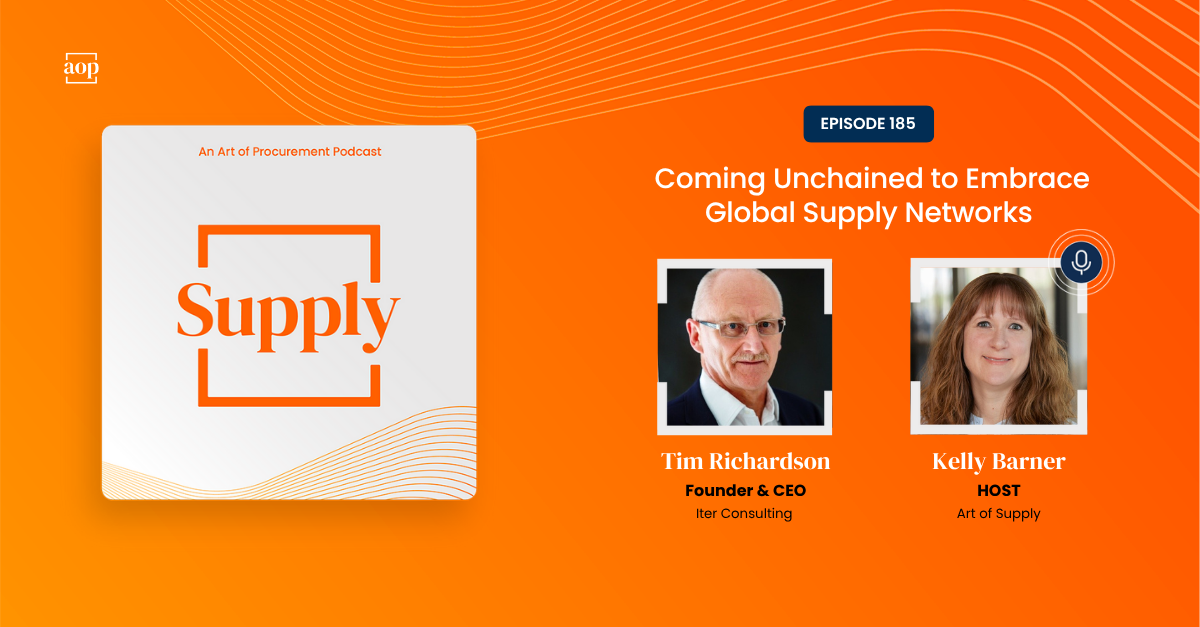
I recently had the opportunity to reconnect with Tim Richardson, Founder and CEO at Iter Consulting, to explore how this evolution is reshaping the way businesses think about their supply operations. While our previous discussion had been largely speculative, focused on what might happen as geopolitical tensions rose and trade policies shifted.
Today, we’re no longer speculating. We’re living in the reality of those changes, watching (and reacting) to them unfold in real time.
Unchained Supplies
“A chain in my mind is the link from supply through demand through supply, but just through a single chain, whereas I think networks – we are significantly past post-globalization,” Tim explained.
This shift from supply chain to supply network isn’t just a semantic distinction. It represents a fundamental reconceptualization of how goods move through the global economy.
The traditional linear chain model, where products flowed predictably from point A to point B to point C, has been replaced by something far more complex. Not surprisingly, given its well-known complexity, Tim uses the auto industry as an example: “You're looking at the automotive industry between Canada and the United States, where you've got things going across the border 10, 12 times." When you map this at a granular level, "you would end up with a real bowl of spaghetti.”
Not that it solves anything, but it’s somewhat reassuring to know that most of this complexity isn’t always intentional. As Tim puts it, “Some of it is planned, but a lot of it is accidental. You optimize each individual loop, and before you know it, the whole is not optimized.” The result is a system where most companies have “really, really poorly” mapped their actual supply networks, creating blind spots that can become significant vulnerabilities.
Re-Calculating Risk in a Supply Network
One of the biggest philosophical shifts happening in supply chain management is the move away from pure cost optimization toward what Tim called “managing for resilience at a managed cost and at an acceptable cost.” This marks a change in how many supply chain leaders approach their roles and measure success, as well as how they calculate their risk tolerance.
The challenge in a supply network is identifying where risk actually exists. In a web of complexity, it’s not always as easy as you think.
“Your risk could exist three or four tiers down in your supply chain, and you don’t really understand that, said Tim. In the electronic industry, for example, “you may have a specific electronic component that's three or four tiers down your supply chain, and yet it's only made in one factory in the world, and if that's in Taiwan, which is quite likely, you have a kind of the existential risks that's associated with that.”
Geopolitical tensions aside, this visibility problem becomes even more acute when unexpected events occur. Tim shared the example of a client with a factory in Lithuania during the Russian invasion of Ukraine: “They'd done a huge amount of preparation in case this did happen. But the one thing they hadn't thought about was the fact that most of the local drivers were Lithuanian, and they went back to fight. So suddenly you couldn't move anything.”
The Supply Talent Gap
Rising to the challenge – and especially trying to solve for it – of all this complexity requires a particular set of strategic and leadership skills. In Tim’s view, there’s a concerning gap between the strategic importance of supply chain management and the capabilities of many supply chain leaders. "If you look at the pool of talent that exists in the supply chain arena, the people that are in the senior positions have grown up in a whole diet of minimizing cost," he explained.
This creates a fundamental mismatch.
While supply chains have become strategically critical (especially during and after COVID), many senior leaders, says Tim, lack the breadth of experience needed to operate effectively at the C-suite level. “I see relatively few senior supply chain people who are able to operate at that true C-suite strategic level,” he said. “Their whole paradigm is about how you can take cost out, which absolutely is part of the job. But it's that and take the strategic view.”
AI: Promise Versus Reality
On the AI front, Tim maintains a cautiously optimistic yet realistic perspective, especially about technology’s potential to help untangle all of the complexity. The potential is there and the technology is there, he says, but it’s not always leveraged as it should be. For example, he said, “Many organizations still can't run an ERP system effectively, because the base quality data is not there. The thinking that sits behind it is not there.”
Data quality becomes quite important when considering AI implementations because, “If you use that as your basis for trying to optimize using AI, it's just not going to work because the quality of data is just really, really poor."
This raises a red flag around AI that we’ve seen in previous adoption cycles, too. “I suspect we've over-hyped the reality for the short term and underestimated its impact in the long term,” said Tim.
The organizations that will be best positioned to benefit from AI and its ability to untangle supply chain complexity will likely be those already operating effectively or efficiently (and with good data), potentially widening the gap between high- and low-performing organizations.
Volatility: Our New Normal
Tim believes we’re still in the early days of what he calls the “post-peak globalization” era, which is defined by the realization that the volatility we’ve experienced isn’t temporary… It's the new normal.
In Tim’s words, “I don’t think businesses have really got their head around the fact that this volatility is the new normal.”
Because of how global supply is evolving, Tim sees the need for a different approach to supply chain design, one that prioritizes flexibility and rapid response even over optimization. He pointed to an example of this he saw recently in a major food manufacturer that shifted their strategy to meet the (unstable) moment: “Rather than planning the short term, they’re saying their ability to cope with changes in demand is all about making sure they built the agility in their supply chain to allow it to respond to what they can’t foresee.”
More fluid supply chains (or networks, rather) will enable organizations to maintain cost control while also allowing them to pivot as quickly and as often as the market demands.
For supply chain leaders, Tim’s directives and insights can be both sobering and energizing. Even Tim admitted, “If ever there’s a time to be in my long career, this is the most interesting time to be in the supply chain – without a doubt.”
The question, then, isn’t whether supply chains will continue to evolve into ever-more-complex networks. They will. The question is whether supply chain leaders will evolve in parallel, developing new strategic approaches and prioritizing adaptability in ways that turn that “spaghetti bowl” of complexity that Tim referred to into their company’s secret sauce.