
6 min read
A purchase requisition is an internal request from an employee or budget owner to buy goods or services. It records what is needed and why, along with the expected cost and the budget that will pay for it. Once approved, procurement turns it into a purchase order, which commits the company to a supplier.
The requisition is often treated as paperwork, but it is usually the first moment procurement learns that someone in the business needs something. How easy that moment feels shapes whether stakeholders come to procurement next time or find a way around them. As I said in a recent podcast conversation with Brad Keighley, procurement often earns permission to work on the bigger activities by helping with the smaller ones and making them as painless as possible.
Key Takeaways
- A purchase requisition is an internal, non-binding request for approval to buy. A purchase order is the external document that commits the company to a supplier.
- Most requisition processes run in five steps, from identifying the need through approval and procurement review to the purchase order.
- The quality of a requisition depends on the business justification. Vague justifications slow approvals and give approvers little to decide on.
- Some procurement leaders deliberately create requisitions on behalf of stakeholders, using the conversation to build relationships and capture more spend.
- Routing requests by value and risk keeps low-risk purchases fast while giving procurement time for the purchases that matter most.
What is a purchase requisition?
A purchase requisition is an internal document an employee submits to request permission to buy goods or services before any commitment is made to a supplier. It describes what is needed and what it should cost, names the budget and the business reason, and moves through approval before becoming a purchase order.
The details vary by system. A typical requisition captures the following.
- Requester details: name and department, plus the cost center
- What is needed: description, quantity, estimated unit price, and total
- Suggested supplier: if the requester has one in mind or a contract already exists
- Timing: the date the goods or services are needed
- Business justification: why the purchase is needed and what happens without it
In most organizations the requisition lives in an ERP or procure-to-pay system, and the requisition number follows the request through approval and ordering until the supplier is paid. For a view of how those steps connect, see our article on procure-to-pay and why it stalls so often.
Purchase requisition vs. purchase order
The two documents are easy to confuse because one becomes the other. The difference is who they are for and whether they create a commitment.
|
Purchase requisition |
Purchase order
|
|
|---|---|---|
|
Audience |
Internal: approvers, budget owners, and procurement |
External: the supplier |
|
Created by |
The requester, or procurement on their behalf |
Procurement or the buying system |
|
Legal status |
Not binding |
Binding once the supplier accepts it |
|
Timing |
Before a supplier is committed |
After the requisition is approved |
|
Purpose |
Request and justify the purchase |
Confirm price, quantity, terms, and delivery |
Put simply, the requisition asks whether the company should buy something, and the purchase order tells the supplier what the company has decided to buy. Mixing the two up is how purchases get made before anyone has approved them.
How the purchase requisition process works
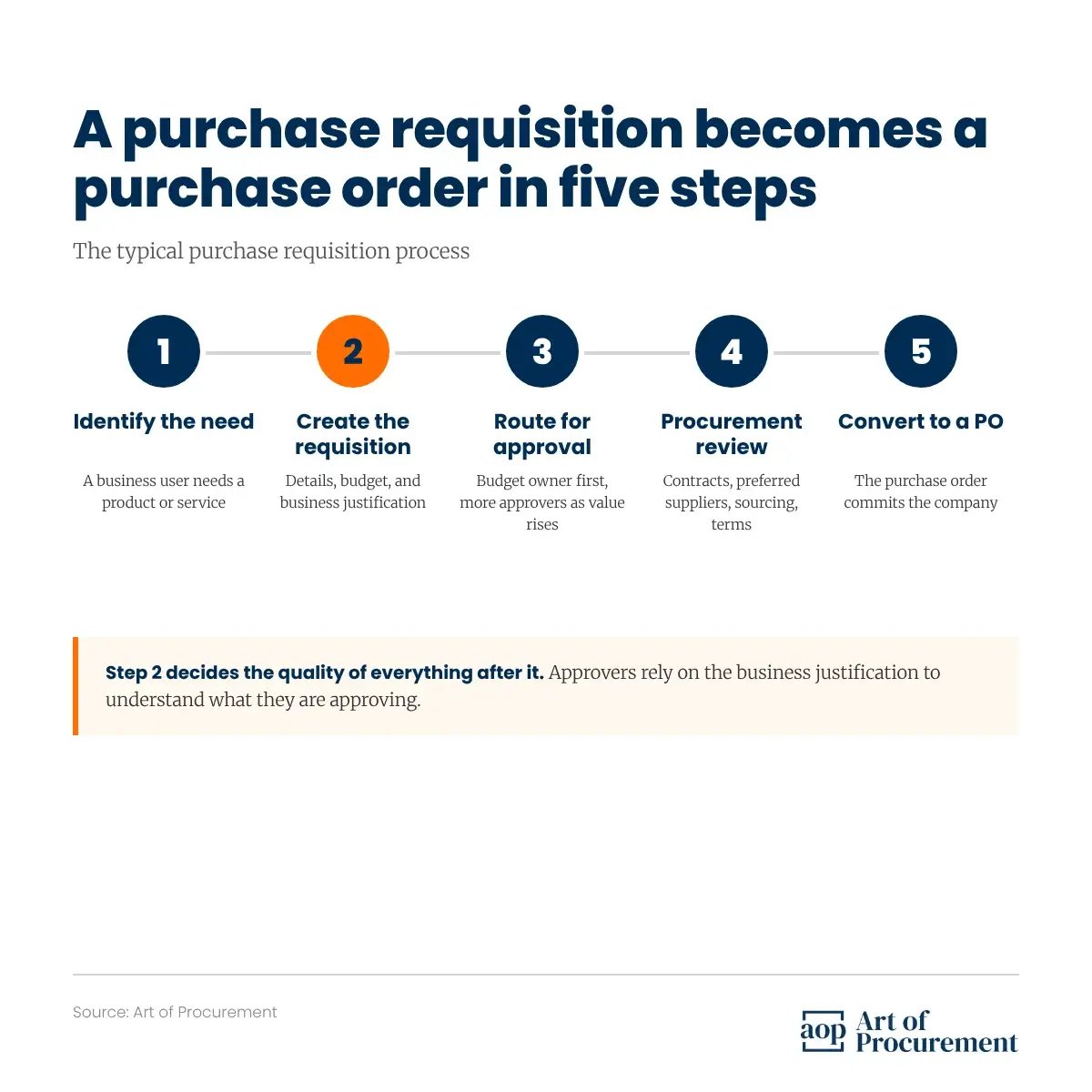
Most requisition processes follow five steps. The number of approvals and the systems involved vary by organization, but the order rarely changes.
1. Identify the need
A business user needs a product or service. In organizations with an intake-to-procure process, this step starts with an intake request that guides the user toward the right buying channel.
2. Create the requisition
The requester (or procurement, in some operating models) enters the requisition with the details above, including the business justification. This is the step where the quality of the justification is decided.
3. Route it for approval
The requisition moves through approvals set by policy, usually the budget owner first, with finance or senior leaders added as the value rises. Approvers rely on the justification field to understand what they are approving.
4. Review it in procurement
Procurement checks whether a contract or preferred supplier already exists. They also decide whether the purchase needs a sourcing event and whether the terms protect the company.
5. Convert it to a purchase order
Once approved and reviewed, the requisition becomes a purchase order that is sent to the supplier. Goods receipt and invoice matching then complete the procure-to-pay cycle.
Who should create the requisition?
Many procurement teams put the requisition in the hands of the requester, often through an intake form. Brad Keighley, a multiple-time chief procurement officer who has led procurement at companies including Dell and Meta, takes the opposite approach. His centralized requisition-to-PO team talks with the stakeholder, agrees on the justification and the suppliers to consider, and then creates and manages the requisition for them. He credits the model with capturing almost all spend.
"Procurement is a white-glove service. We make it easy. Stakeholders come to us because they see how simple we've made it for them, versus never thinking in the past that they would use procurement."
Brad Keighley, multiple-time chief procurement officer (Art of Procurement episode 848, Relationship Builder or Robot? Keeping Procurement Human in a Digital Age)
Part of Brad's reasoning is quality. When stakeholders wrote their own requisitions, he said the business justification ranged from three words ("I need it") to paragraphs that never explained the need, which left approvers guessing. A central team controls that quality, along with training and change management, and he runs the team offshore to manage the cost of the model.
Brad still uses self-service for simple, standard purchases, much as shoppers use the self-checkout lane for one or two items. The point of his model is that the requisition conversation is where procurement learns what the business is planning, often before anyone is ready to buy. If it's hard to engage with procurement, people won't.
Route requests by value and risk
Not every requisition deserves the same attention. Medtronic took a different route to the same goal, setting thresholds so that procurement concentrates on the purchases with the most risk or spend.
"There are suppliers that are higher risk, or there's a lot of dollars there, and I want my team focused on that. But then there are thousands where we could use something that's just faster: that's digital, that's the happy path, and that can allow us to move at the speed of business."
Amit Saronwala, vice president, global indirect supply management at Medtronic (Art of Procurement episode 853, From Pain Points to Progress: Medtronic's Procurement Evolution)
Below the threshold, budget owners can buy quickly without procurement negotiating every small purchase. Category leaders still see the requisitions coming through for their categories before purchase orders are issued, which gives them visibility that used to arrive only after the fact.
Common purchase requisition problems
Most requisition problems show up as delays or workarounds rather than as obvious failures. Four come up most often.
- Purchase orders raised after the fact. The supplier has already been engaged, and the requisition only records a decision procurement had no part in.
- Weak business justifications leave approvers unable to judge the request, so approvals stall or get rubber-stamped.
- Approval chains that are too long. Every extra approver adds time, and slow approvals push stakeholders toward corporate cards and other workarounds.
- Split requisitions hide the true spend when a large purchase is broken into smaller ones to stay under an approval threshold.
Each of these is a signal about the experience of buying through procurement, and fixing the experience usually fixes the compliance problem as well. That is why the improvements below start with the requester.
How to improve your purchase requisition process
Make the justification easy to write well
Replace the open text box with a few short prompts, such as what the purchase is for, what happens if it is delayed, and whether a contract already exists. Approvers get what they need, and requesters spend less time guessing what to write.
Set approval thresholds by value and risk
Match the number of approvals to the size and risk of the purchase. Low-value, low-risk requests from catalogs or existing contracts can move with a single approval, while new suppliers and large commitments get procurement's full review.
Decide where people help and where the system does
Self-service works for standard, repeatable purchases. Complex or first-time purchases benefit from a conversation with procurement before the requisition is created, whether that comes from a central team or a category manager.
Watch for requisitions created after the fact
Track how often requisitions are raised after a supplier has already started work or sent an invoice. A rising number usually means the process is too slow or too hard to find, and those are the categories to fix first.
The bottom line on purchase requisitions
Small as it is, the purchase requisition has a large effect on how the business sees procurement. Treated purely as a control, it becomes a hurdle that stakeholders learn to avoid. Designed around the person asking, with clear justifications, approvals that match the risk, and a conversation where the purchase is complex, it becomes procurement's earliest view of what the business is planning. That early view is what lets procurement act as a strategic services business within the business, helping shape decisions before they turn into purchase orders.
