“Procurement is what you make of it. It can be a bargain basement function at some firms, but it’s also becoming more strategic. We have to take a more holistic, integrated view of things and try to understand the big business problems we can help solve and then offer a business solution, not just a procurement solution.”-Amit Saronwala, VP, Global Indirect Supply Management, Medtronic
Procurement in healthcare is under growing and unprecedented pressure. A chronic need for innovation, margin expansion, and resilience is colliding with legacy processes and a bloated supplier base. It’s a constant refrain: procurement leaders are challenged to do more with less – and to do it faster.
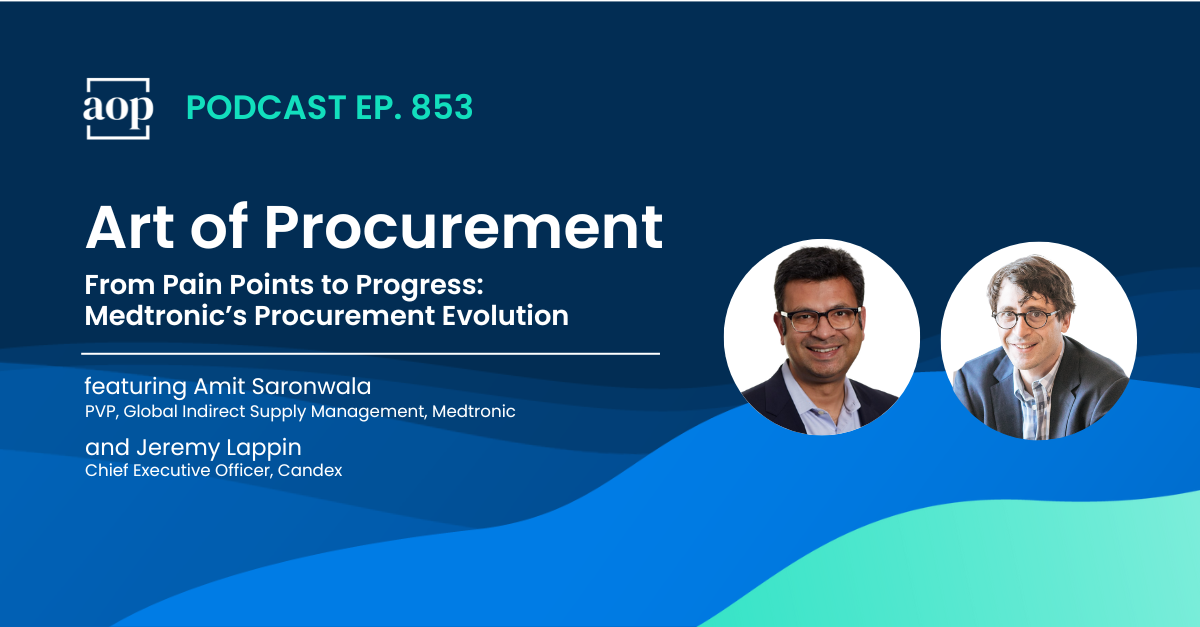
I recently spoke with Amit Saronwala, VP of Global Indirect Supply Management at Medtronic, and Jeremy Lappin, CEO of Candex. Amit brings clinical and commercial acumen to the table, while Jeremy views procurement through the lens of fintech transformation. Together, they explore how Medtronic is evolving its procurement operating model for better business outcomes.
Here, in Amit’s and Jeremy’s own words, are some stand-out moments from our conversation:
Clarity over Complexity: The Case for Segmentation
"None of us, nobody in my role has the team to manage thousands of suppliers. There are suppliers that are higher risk, or there's a lot of dollars there, and I want my team focused on that. But then there are thousands where we could use something that's just faster: that's digital, that's the happy path, and that can allow us to move at the speed of business.” – Amit Saronwala Segmenting the supply base allows leaders to prioritize strategically without sacrificing operational speed. In my experience, too many procurement teams try to manage everything but ultimately end up managing very little. Defining clear thresholds and pathways frees up resources for the relationships and categories that truly move the needle.
Speaking the Language of the Business
"A lot of procurement folks, and I've been doing this a long time, we live in this world of savings and avoidance. But very few people outside of procurement understand that language." – Amit Saronwala Procurement’s impact often gets lost in translation. If we want to be heard in the C-suite, we have to communicate in terms that align with business priorities. That means shifting from internal metrics like “cost avoidance” to language everyone understands, such as EBITDA, margin, and cost leverage.
Automation as an Enabler, Not a Threat
“I think you'll continue to see people really pushing for automation because it's very hard...You need very significant expertise to do it well. But I think those are some of the themes that I see continuing to play out from a technology perspective.” – Jeremy Lappin As leaders, we need to stop viewing automation as a threat to control and start seeing it as a foundation for scale. It’s not about replacing people. It’s about giving them better tools so they can spend their time on what matters. Done right, automation unlocks visibility, reduces friction, and strengthens governance.
Change Management Without the Overhead
“I believe the best change management is no change management. So I'm always looking for tools. I don't need a huge change management effort around it. And that's one of the big reasons why we would choose a solution is that it has little to no change management.” – Amit Saronwala Procurement transformation often stalls because we ask too much of the business. The solutions that succeed are the ones that disappear into the background – tools that work within existing systems, without requiring retraining or behavior change. That’s how you get fast adoption and lasting impact.
Procurement That Disappears
“We really pride ourselves on disappearing. We want to almost not exist.” – Jeremy Lappin
That line captures a mindset procurement leaders should pay attention to. The most effective solutions don’t demand attention, training, or constant reinforcement. They remove friction so completely that the business barely notices procurement is involved. In my experience, when tools and processes fade into the background, procurement earns trust by default. Stakeholders stop looking for workarounds and start engaging earlier, because the experience is simple and intuitive. That’s when procurement shifts from being perceived as overhead to being seen as essential infrastructure for getting work done.
Raising the Bar on Value Creation
“The procurement professional, I think it's already looking different from what we looked like five, seven years back, and I think it's going to keep evolving.” – Amit Saronwala The pace of change in procurement is accelerating. What used to be optional – data literacy, economic fluency, cross-functional communication – is now mandatory. And as the profession evolves, the gap between high-performing teams and everyone else will only widen.
Let Business Problems Lead Technology Strategy
“If it's a business solution to a business problem, that's probably the right way to do it. We start with the problem first.” – Amit Saronwala This is a mindset shift many procurement leaders are still learning to make. It’s easy to get caught up in tools and features, but tech should always follow the problem. When we ground transformation in a clear, strategic business need, adoption comes faster and the ROI becomes self-evident.