

7 min read
Procurement KPIs are the measures used to track how well procurement delivers value to the organization. Most teams start with cost savings and cost avoidance, then add measures for spend coverage and process speed. Supplier performance usually completes the set. The right set depends on what the business needs from procurement, which is why the most useful KPI frameworks reach well beyond savings.
Back in 2019, I said on the Art of Procurement podcast episode 228 that the procurement teams leading the way were "manically obsessed with aligning their performance with the actual needs of the business," and that those needs are often different from the metrics procurement is measured on. That gap has not closed. Most teams can report savings with confidence, yet far fewer can show the business how procurement helped them grow or avoid disruption.
Key Takeaways
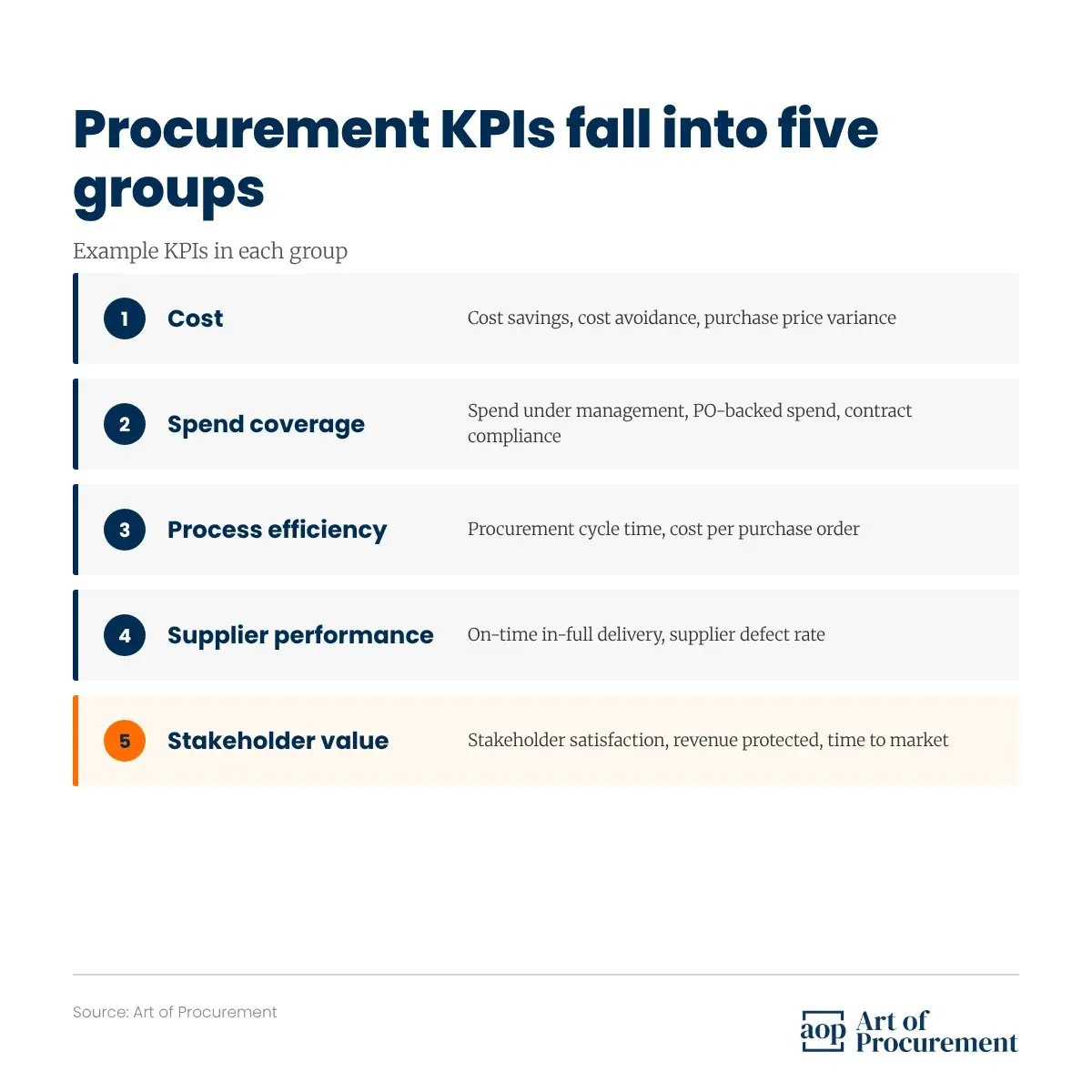
- Procurement KPIs typically fall into five groups: cost, spend coverage, process efficiency, supplier performance, and stakeholder value.
- Savings matter most in businesses where margin is the main lever. Elsewhere, savings alone can undersell procurement's contribution and even damage stakeholder relationships.
- KPIs agreed with each stakeholder group (for example revenue protected for sales, or time to market for product teams) give the business a reason to involve procurement earlier.
- Spend under management is hard to define and holds very little meaning for stakeholders. PO-backed spend and spend oversight give a clearer view of procurement's reach.
- Art of Procurement and SAP research shows that procurement teams see outcome-based KPIs as the top way to improve services spend management, yet most do not consistently measure outcomes.
What are procurement KPIs?
Procurement KPIs (key performance indicators) are a small set of measures that show whether procurement teams are meeting their objectives, such as reducing cost and controlling spend. Each KPI comes with a defined calculation and data source plus a target. Taken together, the set shows leadership what procurement contributes to the business.
KPIs work at two levels. Function-level KPIs describe procurement's overall performance and are often organized with a framework such as a balanced scorecard for procurement. Supplier-level KPIs, such as on-time delivery or defect rate, track individual suppliers and are covered in our article on supplier performance management metrics.
The core procurement KPIs and how to calculate them
The table below covers the KPIs most procurement teams track, grouped by what they measure. Few teams need all of them, and which ones to choose depends on what the business needs from procurement.
|
Group |
KPI |
What it shows |
How to calculate it
|
|---|---|---|---|
|
Cost |
Cost savings |
Reduction against a baseline price |
(Baseline price minus new price) times volume |
|
Cost |
Cost avoidance |
Increases prevented through negotiation or market timing |
(Quoted or proposed price minus negotiated price) times volume |
|
Cost |
Purchase price variance |
Difference between actual and standard price |
(Actual price minus standard price) times quantity |
|
Spend coverage |
Spend under management |
Share of spend procurement actively manages |
Managed spend divided by total addressable spend |
|
Spend coverage |
PO-backed spend |
Share of spend with an approved purchase order before the invoice |
Spend with an approved PO divided by total spend |
|
Spend coverage |
Contract compliance |
Spend placed with contracted suppliers at contracted terms |
Compliant spend divided by total category spend |
|
Process efficiency |
Procurement cycle time |
Speed from approved request to purchase order |
Average days from approved requisition to issued PO |
|
Process efficiency |
Cost per purchase order |
Administrative cost of each transaction |
Procurement operating cost divided by number of POs |
|
Supplier performance |
On-time in-full (OTIF) |
Deliveries that arrive complete and on schedule |
OTIF deliveries divided by total deliveries |
|
Supplier performance |
Supplier defect rate |
Quality of goods received |
Defective units divided by total units received |
|
Stakeholder value |
Stakeholder satisfaction |
How business units rate procurement's support |
Average survey score per business unit |
|
Stakeholder value |
Business outcome measures |
Contribution to growth, such as revenue protected or time to market |
Defined with each stakeholder group |
Procurement cycle time depends heavily on how requests enter procurement in the first place, which is why many teams now track it alongside their intake-to-procure process. Every KPI in the table also depends on clean, categorized spend data, so reliable spend analysis usually has to come first.
Why savings shouldn't be procurement's headline KPI
Savings is the KPI procurement knows best, and in a low-margin business it may genuinely be the most important one. The problem starts when savings becomes the only measure that counts. As I put it during an AOP Live session with Zip, if you go to marketing and talk about cost savings, they'll shut the door on you. Innovation-driven parts of the business care about speed and growth far more than price, and a savings number tells them very little about what procurement did for them.
Measuring the wrong thing can also hide real damage. You can exceed a savings target and still be in trouble with the business because of how those savings were achieved.
"The measure of success should not be how much glass you break in achieving the goals."
Canda Rozier, multiple-time chief procurement officer (Art of Procurement episode 318, Partnering with the Business for Mutual Success)
Canda's advice in that conversation was to keep savings on the list while procurement makes the case, with finance and other leaders, for what she called "ancillary KPIs," such as supplier risk management or speed to market. Supplier contributions to product development count too. Those wins may never reach the bottom line as a savings figure, but they are often what stakeholders remember and talk about.
Agree on KPIs stakeholder by stakeholder
Measuring procurement stakeholder by stakeholder is harder than reporting one number, but it is a more sophisticated approach, and it tends to bring more spend to procurement because the business can see procurement is on their side. In the same AOP Live session, I mentioned a head of procurement whose main metric was revenue preservation: by securing supply, procurement protected the revenue the business depended on. That is a measure a CEO cares about, and it changes the conversation from expense management to growth.

Spend under management vs. spend oversight
Few procurement metrics cause as much debate as spend under management. Stakeholders feel it as friction, finance questions what it really measures, and procurement often struggles to define it consistently. In an AOP Live session on procurement strategy in a post-spend under management world, Kelly Barner and I made the case for replacing it with 100 percent spend oversight, where procurement has visibility into all external spend even when they are not running every purchase.
PO-backed spend is one practical way to measure that reach.
"Five years ago, I would have said a no-PO, no-pay policy was extremely draconian, and you probably hate your stakeholders if you implement it. Now, seeing what I've seen and what we've been able to accomplish with POs, it is, to me, a little bit of the holy grail... because then you have complete visibility."
Colin Glazier, then vice president of solutions consulting at Zip (Art of Procurement AOP Live session, Procurement Strategy in a Post-Spend Under Management World)
Colin's condition for implementing a no-PO, no-pay policy matters as much as the conclusion that it can be impactful. PO-backed spend only works as a KPI when raising a purchase order is easy for the business and there is a clear policy for which purchases go on a PO and which go on a virtual card. Without that, a no-PO, no-pay rule simply moves the friction somewhere else.
What Art of Procurement's research shows about KPIs for services
Services spend is where the gap between intention and measurement is most visible. In the 2026 Art of Procurement and SAP research report Twin Paradoxes of Services Spend Management, based on a survey of 173 procurement leaders, respondents named increased use of outcome-focused KPIs as their top planned way to improve services spend management, ahead of AI and process consistency.
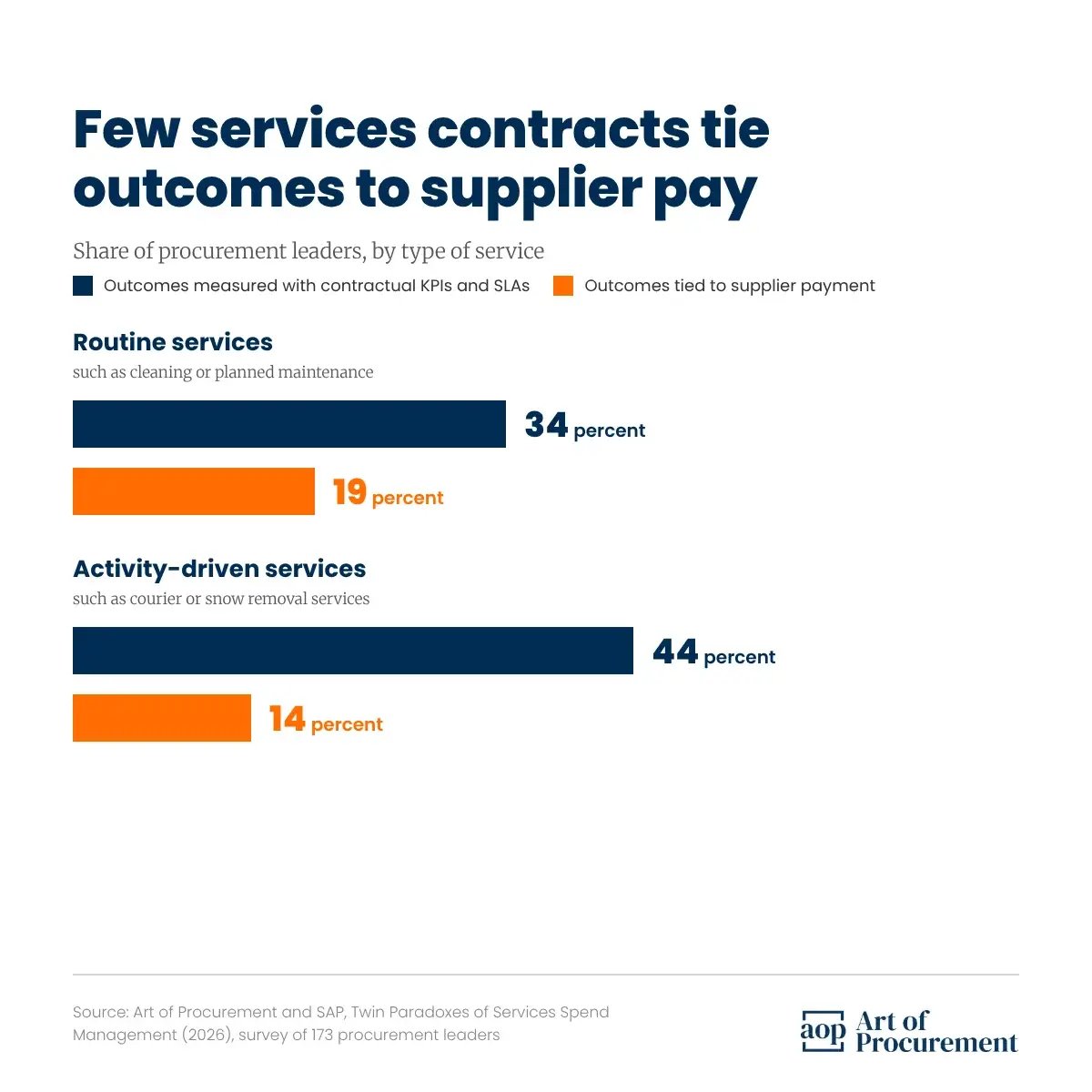
The same respondents often do not measure outcomes formally. Only 34 percent measure routine service outcomes (such as cleaning or planned maintenance) with contractually agreed KPIs and SLAs, and 44 percent do so for activity-driven services (such as courier or snow removal services). Fewer still tie supplier payment to those measures: 19 percent use bonus or penalty mechanisms for routine services and 14 percent for activity-driven services.
The report's recommendation is practical. Audit KPI and SLA coverage across services contracts, then check whether each KPI being tracked is connected to how the supplier gets paid. Where it is not, contract redesign is a faster fix than new technology.
How to choose procurement KPIs that fit your business
Keep the KPI set small enough to manage and specific enough to drive decisions. These steps help keep it that way.
1. Start from the outcomes the business needs
Ask each major stakeholder group what they are trying to achieve this year, whether that is margin or growth, a launch date or resilience. Choose KPIs that show procurement's contribution to those outcomes, and only then add the measures procurement needs to run itself.
2. Keep a short core set and add stakeholder-specific measures
Five to eight function-level KPIs is a manageable core for most teams. Stakeholder-specific KPIs sit underneath them and are reported to the relevant business leader instead of to everyone.
3. Define each KPI before reporting it
Write down how each one is calculated and where the data comes from. Name an owner and set a target. "Savings" in particular needs an agreed baseline, and finance should sign off on the method before results are reported.
4. Connect KPIs to supplier contracts
A KPI that suppliers never see has little influence on how they perform. Build the most important measures into contracts and, where it makes sense, into how suppliers are paid.
5. Add a KPI when procurement starts creating a new kind of value
The KPI list itself says something about procurement's role.
"If you get yourself to the point where you actually have to add a KPI or a metric to the list to capture what's being delivered, now you know you've jumped beyond productivity and you've actually started to broaden the forms of value that procurement is creating."
Kelly Barner, Art of Procurement (Art of Procurement episode 883, The CPO Agenda: Scaling AI Beyond the Pilot)
It may be useful to run Kelly's test once a year. If the KPI list looks the same as it did three years ago, procurement may simply be doing the same work faster. A new measure, such as revenue enabled or time to market, is evidence that the role itself is growing.
The bottom line on procurement KPIs
The best procurement KPIs show the business what procurement contributes in terms the business already cares about. Keep the cost and coverage measures that hold procurement accountable and define them carefully; the most important ones belong in supplier contracts. Then add measures agreed with each stakeholder group, so that each business leader sees procurement's impact on their own goals. Done well, the KPI set describes procurement as a strategic services business within the business, one whose value grows as the list of measures grows.
