
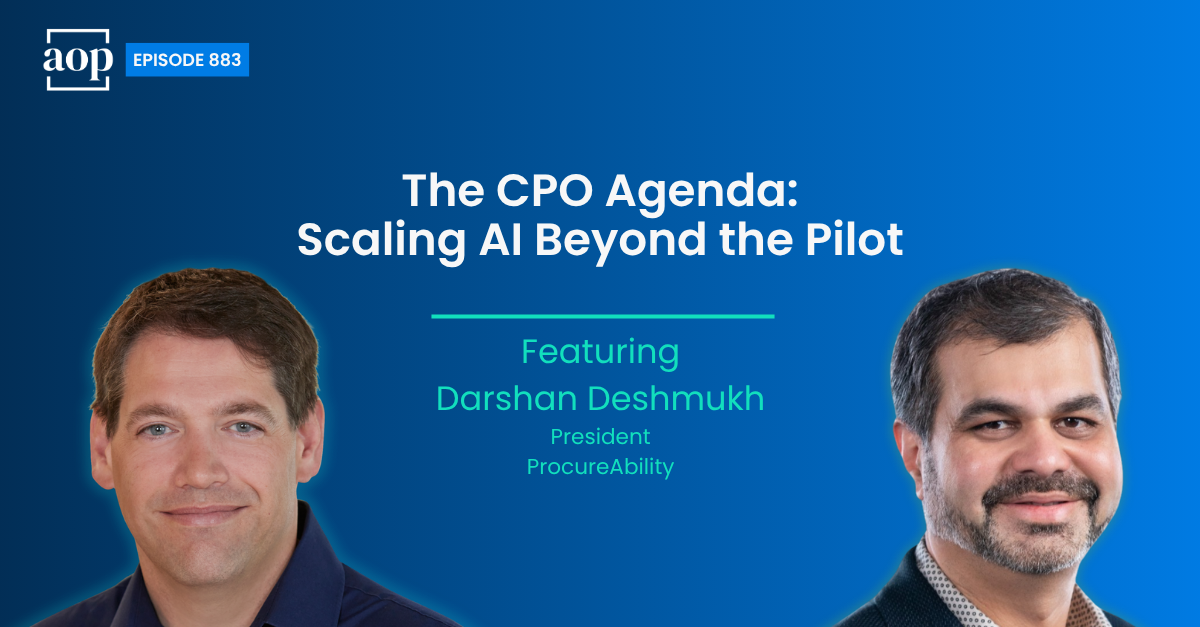
“It’s all about building that momentum, creating the value, testing the hypothesis, and then continuing to challenge us to take it to that next level.” - Darshan Deshmukh, President at ProcureAbility
Procurement has reached an interesting point in their relationship with AI. The question of whether procurement should use AI has been settled, and most teams have moved well beyond the experimentation phase.
Now, the more difficult questions are starting to surface: What are we trying to accomplish with it? How will we know when it is creating meaningful value? And at what point does doing the same work faster become something we can genuinely call transformation?
In this episode of the podcast, based on an AOP Live session, Kelly Barner explores those questions with Darshan Deshmukh, President at ProcureAbility. Their conversation ranges from risk and agentic AI to revenue enablement and organizational culture, but one idea keeps resurfacing: technology alone can only take procurement so far.
AI won’t eliminate uncertainty, but it can change our response to it
“The uncertainty doesn't go away. But the most important benefit of AI is the speed with which we are able to identify and then couple that with our decision-making and the synthesis of the information.”
For all the predictive capabilities associated with AI, procurement still can’t foretell the future. Geopolitical events will still surprise us, suppliers will still struggle, and markets will still move in unexpected directions.
What may change is the amount of time between signal and action. Procurement has access to more information than we could ever manually process, and that abundance creates its own kind of risk. Separating meaningful signals from noise quickly enough will make a difference. If AI can compress the time spent gathering, sorting, and synthesizing information, procurement will have more time to consider the implications and decide what to do about them.
A thousand pilots still don’t add up to transformation
“We keep on making that mistake again and again, but we lead with the technology instead of focusing on the outcome. And all of a sudden, we are kind of unhappy about the outcome.”
Darshan uses the phrase “death by a thousand pilots” during the conversation, and it captures a problem that feels increasingly familiar for procurement teams. There is so much pressure to demonstrate progress with AI that organizations can end up with an impressive collection of experiments without a particularly clear transformation story.
This is where CPOs have to maintain some discipline amid the excitement. A compelling platform or use case can be a source of inspiration, but it cannot define the destination. The business problem and the outcome have to do that.
The real opportunity starts beyond efficiency
“It's important to start with the mindset of the problem statement, what you're trying to solve and what transformation you want to drive versus starting with individual use cases.”
Efficiency is attractive because it is easy to understand and relatively easy to measure. If something takes less time, requires fewer manual steps, or costs less to complete, we can point to progress. But there is a ceiling on how transformational efficiency can be if procurement continues delivering exactly the same forms of value.
One of the most interesting parts of this conversation is the possibility of AI helping procurement broaden that value proposition. Darshan talks about innovation, time to market, and revenue enablement alongside the more familiar responsibilities of cost, risk, and resilience. Instead of only asking how AI can improve procurement’s existing work, where can these capabilities allow procurement to contribute something the business was not receiving from us before?
Trust in AI may actually be a data problem
“If you don't fix the basics of the data as part of your transformation, you're going to continue to increase the trust issues within the process.”
It is easy to treat trust in AI as a technology issue. Can we rely on the model? Is the recommendation accurate? How much autonomy should we allow? But AI is working with something, and the quality of that something matters enormously.
Poor data does not become better simply because a more sophisticated technology is interpreting it. In fact, AI may make underlying data weaknesses more visible because organizations are suddenly trying to use that information at greater speed and scale.
For CPOs, this puts some decidedly unglamorous work back at the center of the AI conversation. Data hygiene, common data models, governance, and transparency may not generate the same excitement as autonomous agents, but they have a direct bearing on whether people will ultimately trust the outputs those agents produce.
Transformation needs room for failure
“You're not going to get penalized for trying out something new if you fail, right? We should keep on driving that innovation culture within the organization.”
Procurement is accustomed to managing risk, enforcing controls, and protecting the organization from undesirable outcomes. Those instincts are valuable, but they can also make experimentation uncomfortable. AI is developing too quickly for every initiative to come with certainty about the outcome.
Leaders have to create enough governance to keep experimentation responsible while leaving enough room for people to try something that may not work.
Maintaining that balance is important. If every failed experiment is treated as evidence that someone made a bad decision, people will quickly learn to make safer decisions. And safe decisions are unlikely to reveal the genuinely new capabilities that procurement is looking for.
Links: