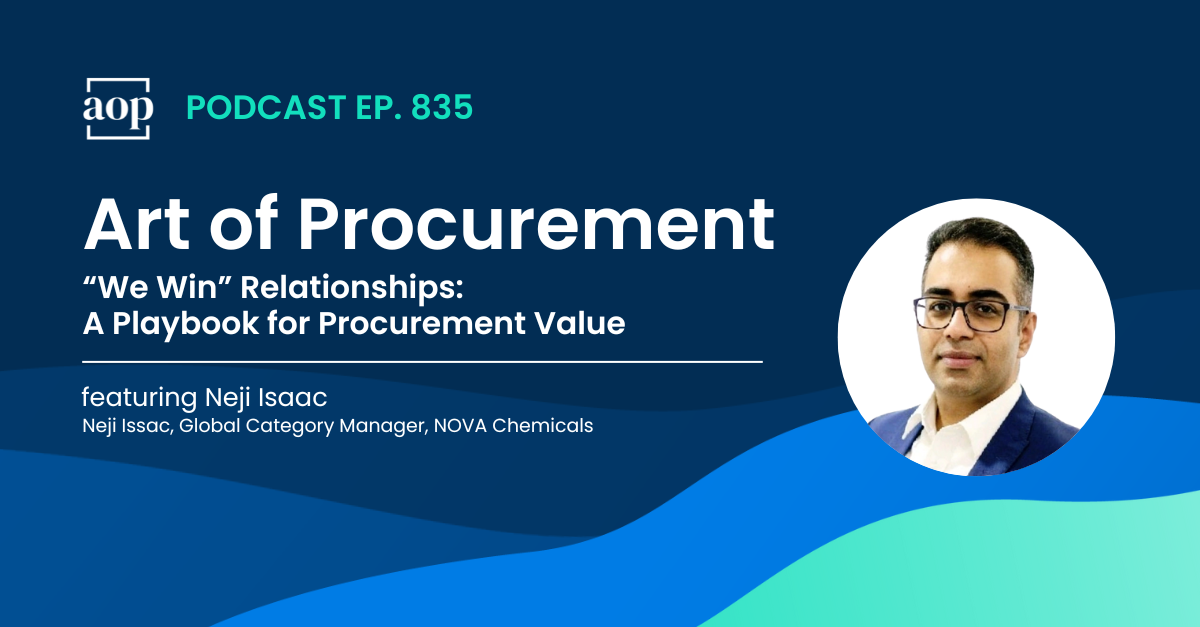
“There is no stagnancy in a supply relationship. Continuous improvement is the basis for that."
- Neji Isaac, Global Category Manager, NOVA Chemicals
Procurement leaders face an ongoing challenge: extracting new value from categories and suppliers when traditional levers run dry. As organizations tighten budgets and competition grows, thinking differently about supplier relationships isn’t just nice to have; it’s a requirement for continued relevance and impact.
In this episode of Art of Procurement, I speak with Neji Isaac, Global Category Manager at NOVA Chemicals, about lessons learned from his doctoral research and a standout case study on unlocking value in a so-called “stagnant” category.
Neji reveals how global experience shapes his approach and why reframing the conversation with suppliers leads to shared wins, not just smaller margins.
Here, in Neji’s own words, are some stand-out moments from our conversation:.
Every Region Reads the Contract Differently
"Not everything that is written on a contract is interpreted the same way. There are countries where a handshake is everything. You don’t necessarily need to see it on the paper to believe it. One of the biggest takeaways for me was my humbling experience of having gone through different countries."
Neji’s comment is a powerful reminder that supplier engagement is not just a policy exercise; it is a cultural one. If you’re working globally, assuming everyone interprets your contract terms the same way is a recipe for missed expectations. Listening and adapting to local norms is not soft—it's strategic.
Turning Real Estate Into a Strategic Lever
"When we analyzed the spend, 33 percent of it was mobilization and demobilization. That’s quite a significant chunk. We proposed a solution: let the crane company store heavily used cranes on-site. We eliminated the mobilization cost and increased their profitability at the same time."
This case study is a masterclass in creative problem-solving. The team turned unused land into a strategic lever that improved cost, service levels, and supplier goodwill. The lesson? Don't overlook what’s right in front of you. Often, the answer isn't a new supplier… It's a new lens.
Adopting a "We Win" Mindset
"I’m not so much of a win-win person. I’m a ‘we win’ person, because in a win-win, one party wins first. In a ‘we win,’ we win together."
Procurement doesn’t always control the power dynamic, but they do influence the framing. Neji’s "we win" approach is about creating integrated value, not just compromise. When suppliers see themselves as true partners, they bring more to the table.
Don't Assume Price Is All That Matters
"You don't know if you don't ask. Don't make assumptions about what’s important to the supplier. If you go in thinking price is all that matters, you end up in zero-sum battles, and nobody wins those."
Many suppliers care more about opportunity, flexibility, or regional access than shaving a few points off your pricing. But unless you ask – and really listen – you’ll never know where the untapped value lies.
Innovation Happens on Both Sides
"Innovation is not the monopoly of the owner-operator. If you beat down a supplier, they innovate too, just not in ways you’re invited to be part of."
That line stayed with me. Procurement has to choose: do we want to co-innovate or push suppliers to protect themselves from us? Collaborative partnerships create long-term value. Adversarial ones lead to short-term wins and long-term value erosion.
Find Your Change Agents
"You always need to find someone who’s going to stand by your side. Not someone who says, ‘Change is good. You go first.’"
Whether it’s unlocking new supplier models or getting internal buy-in for a creative idea, change doesn’t happen alone. Neji’s advice is practical: identify your allies early and bring them into the process.
Cost-Cutting Isn’t a Strategy
"There’s a place and time for aggressive cost-cutting, but if that’s all you focus on, when external challenges happen, that’s when you really feel the pinch."
As we’ve all learned over the past few years, resilience can’t be retrofitted. If procurement only focuses on short-term savings, it risks long-term vulnerability. Balance is essential. Optimize costs, yes, but invest in relationships that endure disruption.
Neji’s story is a strong reminder that procurement innovation doesn’t always come from new tools or tech. Sometimes, it starts with a conversation, a reframed assumption, a shift in perspective, or a creative look at assets you already have. The most transformative ideas often come from simply seeing the familiar in a new way… and then having the courage to act on it.


.png)