
3 min read
The AI Performance Gap: What Procurement Leaders Are Doing Differently
Philip Ideson : Updated on October 5, 2026
“It has to start with the business outcomes that we want. This becomes an operating model decision. Technology has to support the operating model that we're designing.” - Christopher Sawchuk, Principal and Global Procurement Advisory Practice Leader at The Hackett Group
We’ve reached a point where saying your procurement team is “using AI” doesn’t tell us very much.
Most organizations are using AI in some form. People are summarizing documents, drafting emails, analyzing information, and experimenting with new tools. Those applications can save time, and there is real value in that, but I’ve become increasingly convinced that productivity gains alone aren’t going to define the organizations that get the most from AI.
The more interesting question is what happens when we stop inserting AI into the way procurement works today and start reconsidering the work itself.
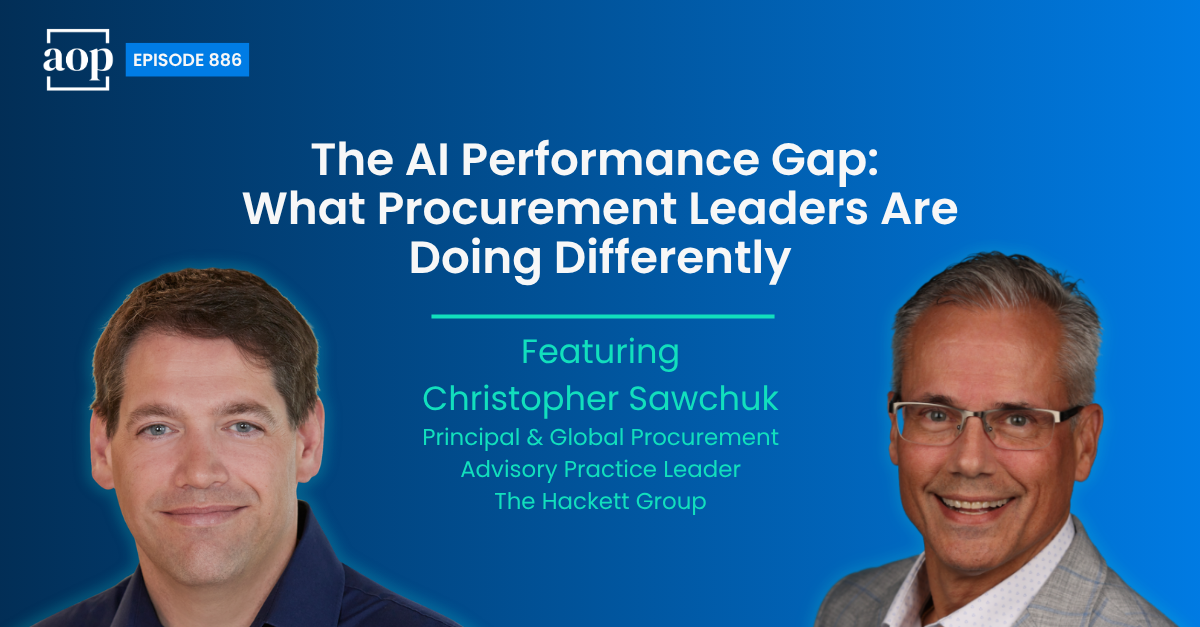
That idea was at the center of my recent conversation with Chris Sawchuk, Principal and Global Procurement Advisory Practice Leader at The Hackett Group. Chris joined me to discuss findings from The Hackett Group’s AI World Class Procurement research and the performance gap beginning to emerge between organizations experimenting with AI and those using it to reshape their operating models.
Our conversation reinforced something I think procurement leaders need to think: the technology is moving quickly, but our ability to redesign the function around what it makes possible may ultimately determine how much value we create from it.
Adoption is becoming a poor measure of AI maturity
“It is not really around the adoption of AI. Most organizations are adopting it. It's how they're redesigning their model that's really what's causing this gap to occur.”
For the last couple of years, it made sense to ask whether procurement was using AI. Adoption itself represented progress because teams needed opportunities to experiment, understand the capabilities, and build confidence.
I think we’re quickly reaching the point where that question has lost its usefulness.
Two procurement organizations can both say they are using AI while doing fundamentally different things with it. One may be making existing tasks a little faster. The other may be reconsidering who performs the work, how decisions are made, where people spend their time, and what the function can deliver to the business.
Incremental productivity has a ceiling. If we continue to run the same processes, with the same roles and the same expectations, but add AI at individual points along the way, we may become more efficient without becoming materially more capable.
Pilots need to lead somewhere
“The way success was being measured was based on the number of use cases being deployed rather than what I'll call the business outcomes that are being achieved.”
There has been enormous pressure on procurement leaders to demonstrate that their teams are doing something with AI, and pilots have been an understandable response. They give people a relatively safe environment to learn what works before committing to something bigger. The danger comes when activity becomes the measure of progress.
Ten AI use cases don’t necessarily create ten times the value of one. A successful proof of concept doesn’t automatically tell us whether we’ve solved an important problem. Eventually, we have to connect experimentation back to outcomes and ask whether what we’re building changes procurement’s contribution to the business.
Freed capacity needs somewhere to go
“The conversation shouldn't be about how many people we can remove. What the conversation needs to be is how much more value can we extract from that same team and how much more value can that team create?”
This may be one of the most consequential questions procurement leaders will face as AI adoption accelerates. We have spent decades saying we want procurement professionals to spend less time on transactional activity and more time on strategic work. AI may finally give us an opportunity to create that capacity at a scale we haven’t experienced before.
But capacity by itself is not a strategy. If we automate a significant amount of work without being clear about what people should do instead, we shouldn’t be surprised when the resulting conversation becomes one about headcount. Leaders need to define the higher-value work before the capacity arrives and make sure their teams have the skills to take it on.
The operating model should lead the technology
“It has to start with the outcomes, the business outcomes that we want. The operating model can't be forced to fit the technology.”
Every few months, there is another capability that changes our understanding of what might be possible. That creates understandable pressure to evaluate tools and figure out where they fit. But procurement transformation has suffered from technology-first thinking before. We buy a platform, implement it, and then adapt the organization around what the technology allows us to do.
Instead, we can start with the outcomes we want, reconsider how work and decisions should flow, determine where human judgment creates the greatest value, and then use technology to enable that model. We may not know every detail of the future state, particularly given how quickly AI capabilities are changing, but we can still be deliberate about the direction we want to travel.
I don’t think any of us can describe with confidence exactly what an AI-enabled procurement organization will look like five years from now. Chris acknowledged just how difficult that has become when the capabilities themselves are changing so quickly. But uncertainty about the destination doesn’t mean we have to stand still.
We can start redesigning the work now. And if we do that thoughtfully, AI becomes more than another productivity tool. It gives us an opportunity to reconsider what procurement is capable of delivering in the first place.