“Catalyst is really a unicorn. You walk in the room, check your ego at the door, and everybody is there to learn” - Christine Moore, Managing Partner, RAUS Global
Procurement leaders are navigating a period where AI, operating model redesign, and rising business expectations are colliding.
That is one of the reasons we created the Catalyst event series. We wanted to build an environment where procurement leaders could move beyond surface-level conversations and openly share with trusted peers what is actually working, where organizations are getting stuck, and what practical next steps look like.
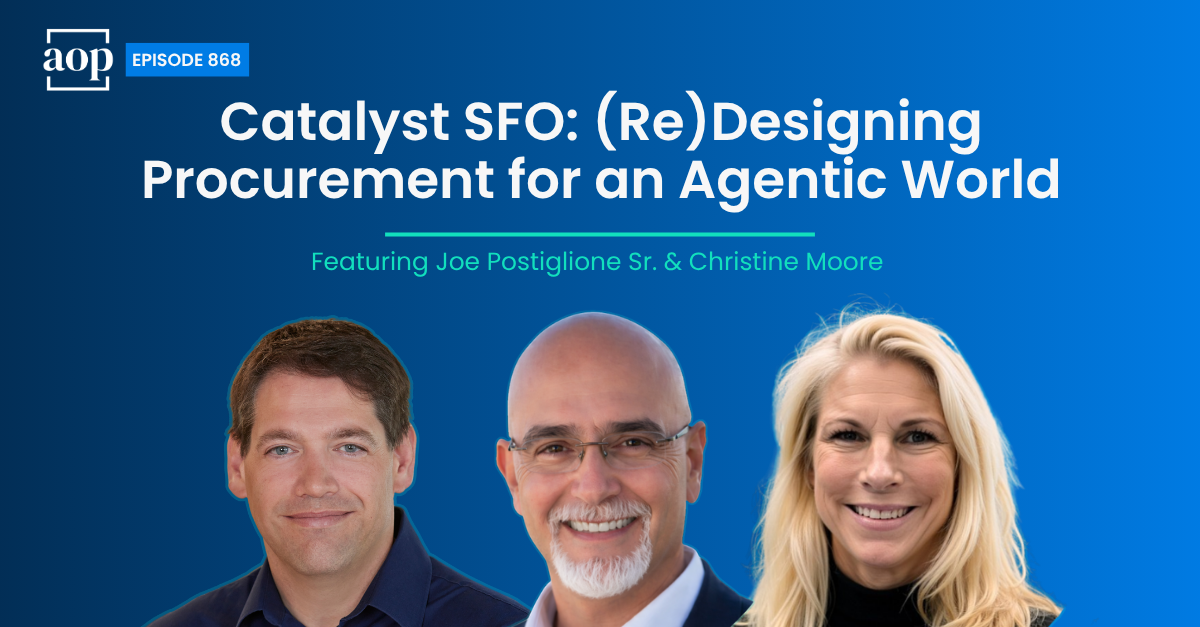
After Catalyst San Francisco in May, I had the opportunity to reconnect with attendees Christine Moore, Managing Partner at RAUS Global, and Joe Postiglione Sr., author of the upcoming book Achieve Results with AI and Avoid the CFO Hot Seat, to reflect on the themes that emerged throughout the day.
What stood out most to me in the conversation was how quickly the procurement community is moving from curiosity about AI toward implementation, governance, and organizational redesign. There was far less discussion about whether AI matters (that’s just stating the obvious) and much more focus on how to make it work in practice.
Creating Space for Real Conversations
“What happens in San Francisco stays in San Francisco because it’s a group of trusted individuals sharing with other trusted individuals.” — Christine Moore
Procurement leaders are under enormous pressure right now, and traditional conferences unintentionally reinforce the idea that leaders need to have all the answers. In reality, the most productive conversations happen when people feel intellectually safe enough to admit uncertainty, share experiences honestly, and learn from a trusted set of peers and colleagues.
What I noticed throughout the day was how quickly people moved past titles and company names and into genuine dialogue. That changes the quality of conversation entirely. Instead of polished presentations about completed success stories, the room focused on practical implementation questions, concerns, and lessons learned in real time.
AI Depends on Strong Operational Foundations
“The blocking and tackling has never gone away. Optimize the business process, pick the right technology stack, and make sure you have the right human in the loop.” - Joe Postiglione Sr.
There is a tendency right now to treat AI as a replacement for operational discipline. In reality, the organizations getting the most value from AI are often the ones that already understand their processes, governance models, and decision points extremely well.
I appreciate Joe’s emphasis on the “human in the loop.” At Catalyst SFO, there was a lot of discussion around where AI can operate autonomously and where procurement leaders still need human-driven judgment and accountability. The answer is rarely absolute. The challenge for procurement is figuring where human involvement will create the most value so we can design workflows accordingly.
Change Management Has Become a Core Leadership Capability
“Change management doesn't become something that you need to be really good at. You need to own it. You need to drive it. You need to really have everybody on the bus.” - Christine Moore
Procurement has always been involved in change management to some degree, but AI introduces a different level of organizational disruption because the existing way of working often still remains available.
As Christine pointed out during our discussion, when organizations implemented systems like ERPs in the past, the old system eventually disappeared. With AI, people can continue working the way they always have if they choose to. That changes the challenge significantly. Adoption becomes less about system implementation and much more about leadership, trust, communication, and behavior change.
The Cost of AI Is Becoming a Procurement Conversation
“You don't know how much (AI) you're consuming. I don't think it hit anybody except the people that are now being charged with subscription models where it is based on usage.” - Christine Moore
AI is introducing entirely new categories of spend for management. Most organizations are still focused primarily on capability and experimentation with AI, but procurement also has an opportunity to help the business understand something that is often overlooked: the economics behind AI consumption.
Whether it is compute costs, token usage, model selection, or subscription structures, organizations are beginning to realize that AI spending behaves very differently from traditional software investments. Visibility into consumption patterns and forecasting future usage will become increasingly important.
AI Needs to Be Outcome-Driven
“Everyone runs to intake and orchestration first instead of giving more attention to what it is I’m actually trying to develop and then having AI monitor it as it goes through the workflows.” - Joe Postiglione Sr.
Many organizations begin AI initiatives by focusing on workflows, intake tools, and automation layers before fully defining the business outcome they are trying to achieve. What Joe advocates for is a much more outcome-oriented approach. Start with the objective. Define the expected result clearly. Then determine where AI can monitor, guide, or improve the process in real time.
That perspective shifts AI from being a technology exercise into a business performance exercise. It also creates a much stronger connection between AI investment and measurable organizational value, which will become increasingly important as executive scrutiny around ROI grows.


.png)