“Play the long game, avoid myopic thinking and approaches to solve immediate problems as much as you can, and treat your suppliers as your customers or client.”
- Darshan Deshmukh, President at ProcureAbility
Today’s procurement leaders face a world where headlines shift quickly and new risks emerge overnight. Supply chains, once focused on cost and efficiency, now must prioritize resilience and adaptability.
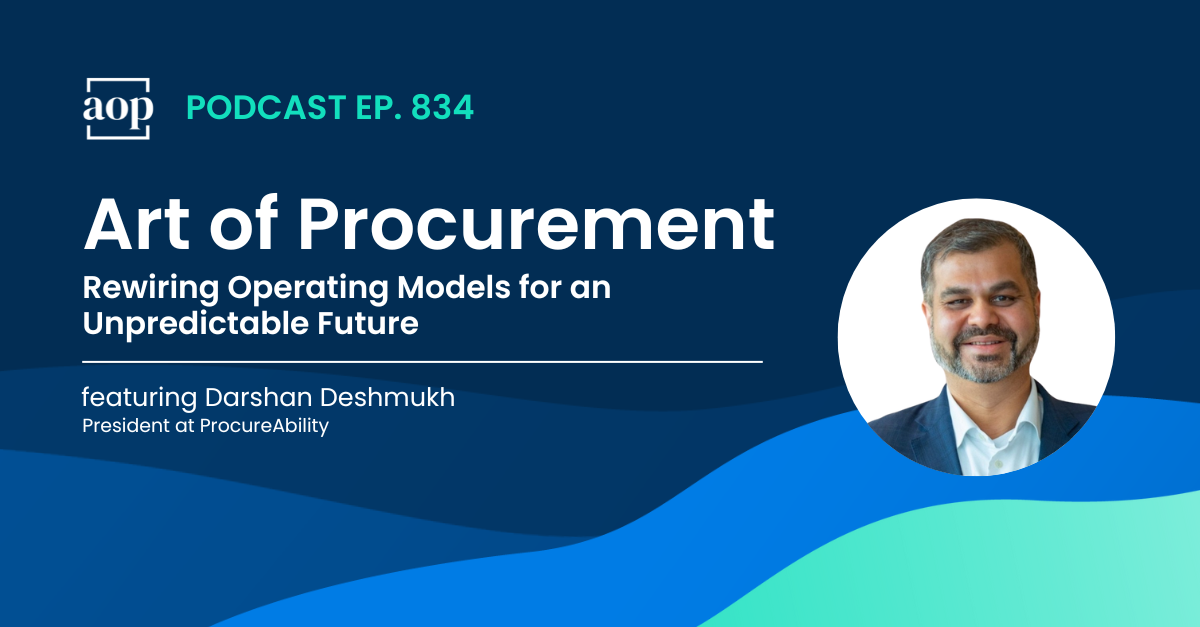
That’s exactly why Kelly Barner and I wanted to explore this topic in depth. We were joined by Darshan Deshmukh, President of ProcureAbility, for a candid and timely conversation about what it takes to build geopolitical agility and future-proof procurement strategies in the face of ongoing disruption.
Darshan brings a unique global perspective and deep operational expertise. Here are a few of his most impactful takeaways from our conversation, along with my reflections on what they mean for procurement leaders right now:
Procurement Fatigue and the Challenge of Uncertainty
“There’s a general feeling of uncertainty. Many organizations are experiencing the anxiety of the unknown and also the change fatigue of these cycles. Leaders and teams are starting to zone out on risk anticipation because they just can't anticipate anymore.” – Darshan Deshmukh
Procurement teams are operating in a state of chronic disruption, and it’s wearing them down. With geopolitical events, regulatory shifts, and economic volatility all hitting at once, the constant state of alert is leading to emotional and operational fatigue. Leaders need to proactively monitor for signs of burnout – not just in their teams, but also in the broader organizational appetite for change – and shift the conversation from reactive risk response to intentional, structured planning.
Regional Differences in Risk Perception
“In Asia, countries that are part of the China Plus One strategy are seeing a chance to grow their economies a little faster. But at the same time, they’re also facing a lot of tariff-related and other conversations as well. Within China, for sure, there is a lot of anxiety. How do you stay ready for global growth, while also tackling the issues that come with trade balance uncertainty?” – Darshan Deshmukh
Every region views risk through a different lens, shaped by their local economic realities and regulatory environments. For procurement leaders managing a global footprint, this means a one-size-fits-all risk approach simply won’t work. Instead, we need localized strategies that reflect on-the-ground sentiment and blend macroeconomic insight with firsthand knowledge from regional teams and supply partners.
The Need for True Optionality
“When the variables are changing so fast, having optionality, and the ability to talk about those options gets difficult. Building something like a China Plus One manufacturing strategy is going to take years. It’s not going to happen overnight.” – Darshan Deshmukh
Optionality isn't just a buzzword; it’s a long-term strategic commitment. Building redundancy and resilience into the supply base, developing alternate sourcing paths, and investing in supplier diversification all take time, capital, and stakeholder alignment. Leaders need to resist the pressure to look for instant ROI and instead champion options that will pay off when the next shock inevitably arrives.
From Transactions to Collaboration
“It’s not about doing the busy work as fast as I can and squeezing the value out of it. What we’re seeing is that everybody’s starting to think differently – spending more energy on upfront relationship building and acting as a true decision support system.” – Darshan Deshmukh
Procurement is stepping into a new era—one where influence matters more than execution. The most forward-looking teams are focusing less on transaction volume and more on becoming trusted partners to the business. That shift means investing in cross-functional relationships, bringing strategic insight to the table early, and creating clarity around procurement’s role as a proactive value creator.
Risk Evaluation: Cutting Through the Noise
“There’s a need to assess real risk versus perceived risk when the risk is introduced. You have to look at all of the dimensions, but also take both a short-term view and a long-term view.” – Darshan Deshmukh
Effective risk management starts with clarity. In today’s climate, it’s easy to overreact to headlines or miss slow-building risks beneath the surface. That’s why mature procurement functions are building more structured frameworks for evaluating risk, drawing on internal data, external intelligence, and scenario planning to assess not just impact, but also timing, probability, and alignment with business priorities.
Sustaining the Long Game
“It might feel difficult in the current environment, sometimes even impossible. But the organizations that decide to part ways with that [sustainability] agenda will be at a disadvantage, in my opinion.” – Darshan Deshmukh
There’s no doubt that sustainability has become harder to prioritize amid economic headwinds. But long-term competitiveness requires staying the course. Whether it’s Scope 3 emissions, supplier diversity, or circularity goals, organizations that stay committed now will be better positioned to meet stakeholder expectations, regulatory demands, and investor scrutiny in the years ahead.


.png)