
4 min read
Owning Transformation: How to Successfully Lead Procurement Through Change
Philip Ideson : August 30, 2026
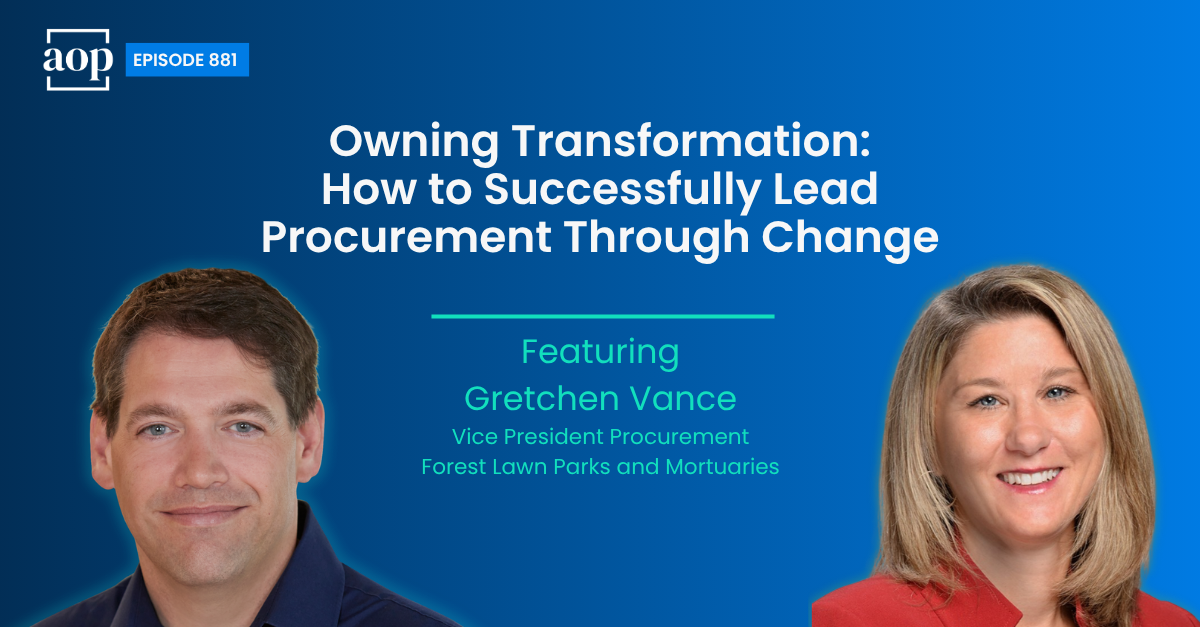
“Don’t ask AI to do something that you don’t know how to do yourself.” - Gretchen Vance, Vice President Procurement at Forest Lawn Parks and Mortuaries
There are some procurement careers that follow a fairly predictable path. Gretchen Vance’s isn’t one of them.
Gretchen started her professional career later in life after raising four children. She joined Forest Lawn Parks and Mortuaries as a secretary in the sales department, moved into purchasing, continued her education along the way, and today serves as Vice President of Procurement. Eighteen years after joining the organization, she’s still learning. In fact, she’s currently working toward her MBA one class at a time.
I found her story interesting because it illustrates something important: procurement gives curious people an enormous amount of room to grow. You can develop commercial skills, become deeply involved in operations, lead technology transformation, build supplier relationships, and solve problems that touch almost every corner of the business.
Gretchen has done all of those things, and she has done so in an environment where procurement’s decisions can have a very immediate human impact. Forest Lawn serves families during some of the hardest moments of their lives, and that sense of purpose shapes how Gretchen thinks about suppliers, technology, risk, and ultimately procurement’s role in the organization.
Your suppliers become an extension of your organization
“It’s really important that I communicate the message that our suppliers are an extension of us in serving our families.”
I talk frequently about moving supplier management beyond the transactional, but Gretchen’s environment puts that idea into particularly sharp focus.
When a supplier’s employees may interact directly with a family at an incredibly difficult time, price and contractual performance can only tell you so much. Culture, behavior, judgment, and a genuine understanding of the organization’s purpose become part of supplier qualification.
There’s a broader lesson here for procurement, regardless of industry. We often talk about strategic suppliers as extensions of our organizations, but how often do we actually select and manage them that way? If a supplier’s actions ultimately shape the experience of our customers, employees, or other stakeholders, cultural alignment deserves more attention alongside the traditional commercial criteria.
Procurement should be viewed as problem-solvers for the business
“I see us as being a creative group that solves problems.”
Procurement has spent years trying to move upstream. We want stakeholders to involve us before a supplier has been chosen or a commercial decision has effectively been made. One of the best ways to earn that earlier involvement is to become known as the team people bring problems to, rather than the team they bring purchase requests to.
That requires curiosity. When a stakeholder says they need a particular product or supplier, there’s usually a business problem sitting underneath that request. Understanding that problem opens up far more possibilities for procurement to create value.
AI still requires someone who knows what good looks like
“You should always look at what it does first because A.I. is not going to be perfect. But it’s to help you. It’s to save time.”
Gretchen shared an example of someone bringing her an AI-generated report that she could tell almost immediately contained incorrect numbers. That story gets to one of the most important skills procurement needs as AI becomes embedded in their everyday work: human judgment.
AI can accelerate contract comparisons, organize information, analyze RFQs, and dramatically reduce the time required for tasks that used to take hours. Gretchen’s team is already using it for exactly those kinds of things. But faster output has very little value if the person receiving it can’t recognize when something is wrong.
Owning procure-to-pay changes the supplier relationship
“To be able to have end-to-end with the supplier, from initiating the relationship to paying the bill, is very powerful.”
So often, we treat payment issues as something for AP to resolve. Procurement negotiates the agreement and manages the commercial relationship, then an invoice gets stuck somewhere and suddenly we’re telling a frustrated supplier that payment isn’t really our responsibility. From the supplier’s perspective, that distinction is meaningless.
Taking responsibility for AP gave Gretchen visibility into the entire supplier experience, including what happens after the sourcing and contracting work is finished. It also changed how she thinks about decisions like payment terms because she now sees the operational consequences on the other side.
Even if procurement and AP remain separate functions in your organization, there’s real value in understanding that complete journey.
Sometimes leadership requires putting something on the line
“I had two pieces of paper, and they were turned upside down on his desk. And I said, under this piece of paper is the e-procurement tool and the quote for that. And under this is my resignation. I’d like you to pick one.”
I’ve heard plenty of stories about procurement leaders fighting for transformation investment. I’m not sure I’ve heard many quite like this one. I certainly wouldn’t suggest that every CPO walk into the CFO’s office tomorrow and put their resignation next to a technology business case. But there’s something important about Gretchen’s story. She had done the work. She had researched the market, run the RFQ, understood what the organization needed, and reached the point where she was willing to put her own credibility behind the recommendation. Once her CFO chose the technology, she also understood that she had taken responsibility for making it work.
That willingness to own an outcome is a meaningful part of leadership. Transformation always carries risk, and there are moments when waiting for universal agreement simply preserves the status quo.
Gretchen’s bet paid off. Forest Lawn digitized purchasing in 2018, long before anyone knew how important those capabilities would become during COVID. Her team has since expanded that foundation across procure-to-pay and is now working within a broader company-wide digitization effort that includes AI.
Gretchen said early in our conversation that she believes “leading is learning.” Her career is a pretty compelling example of what that looks like in practice.
Links: