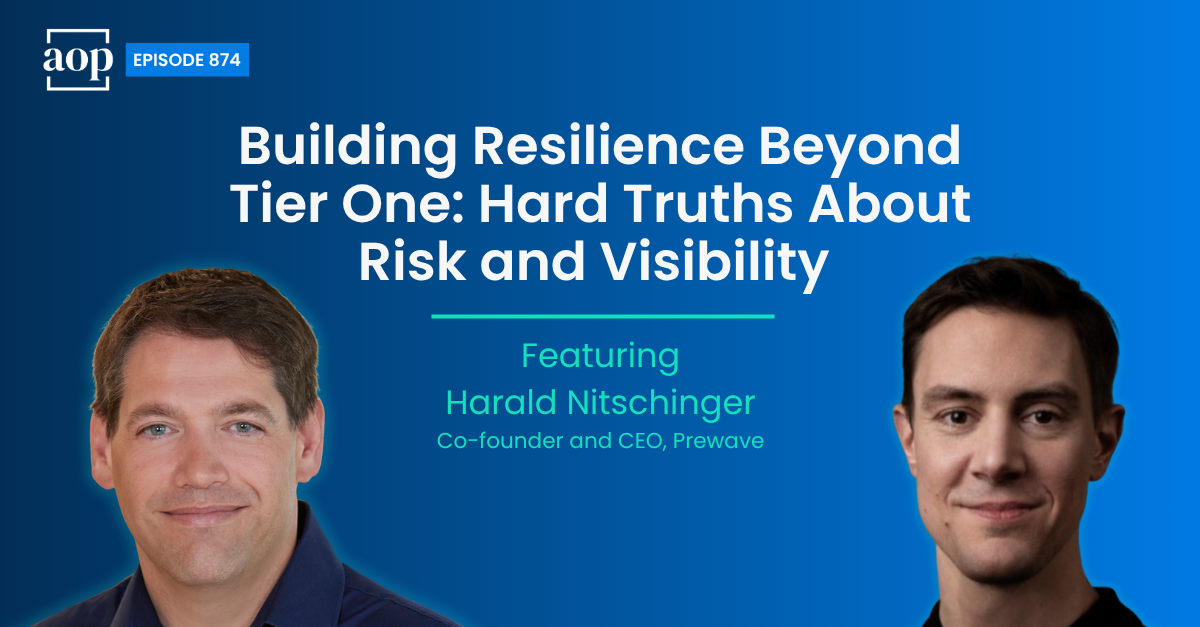
“Resilience doesn't mean a supply chain that doesn't see risk. That's impossible. It means setting yourself up to withstand shocks and disruptions.” - Harald Nitschinger, Co-founder and CEO, Prewave
Supply chain resilience has become one of procurement's top priorities. Almost every organization has invested in better data, more monitoring, or new technology to improve visibility across its supplier base. But visibility, by itself, doesn't make a supply chain more resilient.
That was one of the biggest takeaways from this conversation with Harald Nitschinger, Co-founder and CEO of Prewave. Harald works with some of the world's largest manufacturers, helping them map complex, multi-tier supply chains and identify risks long before they disrupt production. He challenges some of the assumptions organizations still make about risk management, particularly the idea that collecting more information automatically leads to better decisions.
Harald argues that resilience comes from understanding which risks actually matter, knowing how they affect the business, and putting processes in place to act before disruption occurs.
The Biggest Risks Often Sit Beyond Tier One
"You need that public data view to get a first indication of where you're exposed and what your deepest supply chain actually looks like."
For years, supplier visibility largely stopped at tier one. That made sense because that's where procurement had relationships and contracts. The problem is that many of today's biggest vulnerabilities exist several layers deeper. Whether it's semiconductors, critical minerals, or specialty chemicals, concentration risk often exists with suppliers most organizations never interact with directly.
Harald isn't suggesting that organizations can achieve perfect visibility overnight. He describes a practical way to begin understanding where those hidden dependencies exist so procurement can focus their attention where it will have the greatest impact.
Visibility Is Only the Starting Point
"Transparency and visibility are an important foundation, but they're not a solution in and of themselves. The solution is knowing what the biggest problem is and what the real problem is that I actually need to tackle."
Procurement has more information available today than at any point in its history. AI can surface risks faster, mapping tools can reveal hidden supplier relationships, and external data sources provide insight into what's happening across global supply chains – insight we didn’t have before.
None of that data and insight creates value unless someone can decide what deserves attention. One of procurement's most important responsibilities is helping the business distinguish between noise and genuine business risk. More visibility needs to lead to better prioritization, not simply more dashboards.
Invest Where It Matters Most
"The most advanced approach is when you can have that ROI view. What does it cost to bring a second source here, and what am I gaining from it? That's where you can really have a clear steering on the supply chain and start building cases for investing in resilience."
One of the biggest challenges with resilience has always been proving its value before a disruption occurs. Procurement leaders know the cost of inaction can be enormous, but that isn't always enough to secure investment.
Harald reframes resilience as a business decision rather than an insurance policy. Instead of asking whether a second source or additional inventory costs more, he's encouraging organizations to evaluate what those investments protect. When procurement can quantify the trade-offs and connect them to business outcomes, resilience becomes a strategic investment rather than an operational expense. That's the kind of conversation executive teams are far more prepared to have.
Risk Management Is a Journey
"We don't recommend bringing transparency to all 10,000 suppliers up until tier five. That's just an overwhelming amount of data. It actually doesn't help you."
One of the reasons organizations struggle with supply chain visibility is that they try to solve everything at once. Harald advocates for a much more practical approach: start with the categories that carry the greatest exposure, learn from that process, and expand over time.
I think that's an important reminder because transformation rarely happens in one large step. Procurement organizations need to build capability gradually, proving value as they go. Whatever your objective is, meaningful progress usually comes from solving the next important problem rather than trying to solve every problem simultaneously.