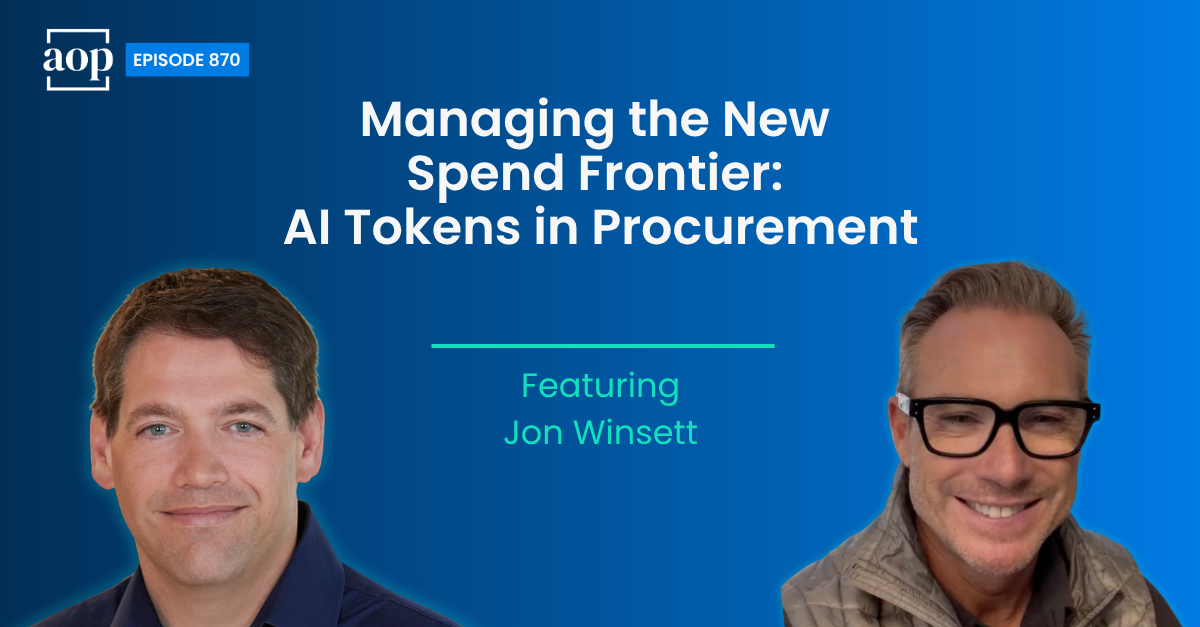
“You need to get visibility into the AI tokens, what workloads they are being used for, which users are using them, and what department they’re coming out of. Most organizations don't have that visibility yet. They just get the bill.” - Jon Winsett, CEO, NPI
A year ago, most procurement leaders weren't talking about AI tokens. Now, many organizations are spending millions of dollars on them.
What's remarkable is not just the speed of adoption but how quickly token consumption has become a genuine spend management challenge. Budgets are being exhausted months ahead of schedule, while new governance models are still emerging. Finance teams are scrambling to understand these new invoices, and all the while, procurement is being asked to help manage a category that barely existed when their annual planning cycles were finalized.
That is why I wanted to have this conversation with Jon Winsett, CEO of NPI. Jon and his team work with many of the world's largest enterprises, helping them manage technology spend, and they are seeing firsthand how AI consumption is reshaping enterprise budgets.
What struck me most from our discussion was that the challenge is not AI itself, but the underlying visibility, governance, and understanding of how to manage a rapidly growing consumption-based spend category before it spirals out of control.
Token Consumption Is Growing at an Extraordinary Pace
“If you look at a graph starting in January of 2025, AI tokens have grown 13-fold in less than a year and a half. It's a hockey stick, and you rarely see that steep of a hockey stick in business.”
We've spent years talking about digital transformation, cloud adoption, and SaaS expansion. Most of those changes happened gradually enough for procurement and the rest of the business to adapt their governance models along the way.
What Jon describes is different. The acceleration of token consumption is being fueled by agentic workflows that repeatedly interact with large language models throughout a process, quickly increasing cost and consumption. Many organizations are discovering that the assumptions they made about AI spend six months ago no longer hold true today.
Most Organizations Still Lack Visibility
"Most organizations don't have that visibility [into AI tokens] yet. They just get that bill and they're like, ‘how do I even dispute this? I don't even know. It's not broken out.’"
You can’t manage what you can’t see.
For decades, procurement has worked to improve spend visibility across categories ranging from contingent labor to software licensing. Token consumption introduces a new layer of complexity because the usage is often happening deep inside applications, workflows, and AI-enabled services that stakeholders use every day.
When visibility is limited, governance becomes reactive. Organizations find themselves responding to invoices rather than proactively managing consumption. That is rarely a position procurement wants to be in.
The ROI Conversation Is Just Beginning
"We've got to be able to map cost to outcomes, cost to benefit, and measure ROI."
Many organizations are still operating in a phase where investment decisions are heavily influenced by urgency and competitive pressure. Nobody wants to be left behind.
Eventually, however, every emerging technology reaches the same point. Leaders start asking harder questions, like: What are we spending? What are we getting in return? How does our performance compare to peers? Which use cases create measurable value?
Those questions are not signs of skepticism. They are signs of maturity and are necessary if you want to turn AI from an experiment into a sustainable business capability.
The Future Will Require New Procurement Capabilities
"You've got to benchmark aggressively. You've got to understand how your pricing stacks up to similar size deals and similar size environments."
What makes AI token spend so interesting is that it sits at the intersection of procurement, technology, finance, and business strategy. Managing it effectively requires skills that span all four domains.
Procurement teams will need to become comfortable discussing model routing, consumption economics, governance structures, portability rights, pricing mechanisms, and business outcomes. Those are not traditional sourcing conversations, but they are rapidly becoming procurement conversations.