
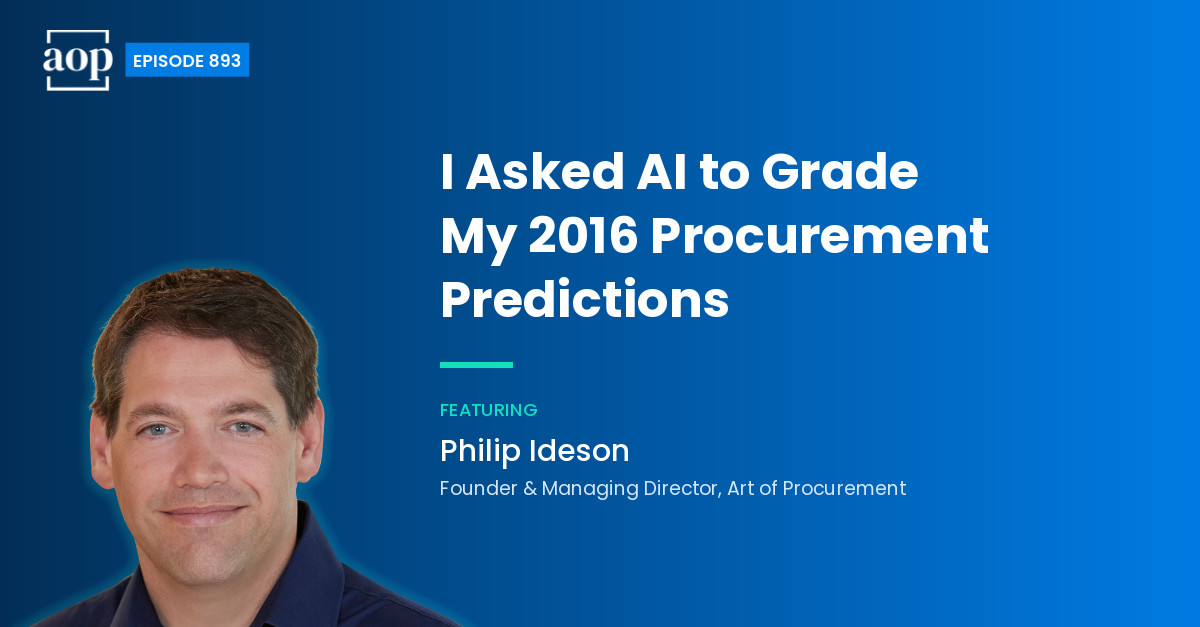
“I don't think the last 10 years are going to tell us very much about the next 10.” - Philip Ideson
In 2016, two CEOs said back-office functions like procurement might not exist within a decade. I disagreed on the show and laid out how I thought our mission, our ways of working, and our roles would change.
That decade is now up. With AI agents changing how buying gets done, it feels like the right moment to check my work.
For this Thanksgiving week episode, which also marks 11 years since our first show went out on November 4, 2015, I gave Claude the transcripts of my 2016 episodes and asked it to grade each prediction against what guests said on Art of Procurement in 2025 and 2026.
The Architect Was the Best Call
"I've recorded some episodes over the last couple of weeks where I returned to that theme of the procurement procurement professional as an architect, and I strongly believe that's truly the biggest role for us going forward."
Claude gives this prediction an A and describes it as my best call. In 2016 I argued that best-in-class would become situational, and that someone would need to design a delivery model from a growing set of options.
Today that person is designing orchestration layers that sit above legacy systems. If you lead a team, ask who owns that design work and whether they have the time to do it well.
Data Is Still the Bottleneck
"Ten years on, data is still the reason a lot of these investments and good ideas never really get off the ground. It's something we haven't really solved for."
Claude gives this prediction a B+. Data does run through everything now, but I assumed the data problem would get solved along the way. It didn't.
Patrick Reymann of IDC put it plainly: AI doesn't fix bad data, it scales and exposes it. Before you fund the next AI pilot, check whether your supplier and spend data can carry it.
Value Talk Has Outrun Value Measurement
"We've changed how we talk about value much faster than we've changed how anybody measures it."
Claude gives my prediction about our mission a B-. The language of revenue, margin, and risk took hold, yet scorecards still lean on cost savings, and we are still recording episodes about fake savings.
A few weeks ago I facilitated a conversation at the ProcureTEX conference in Amsterdam with a finance leader who said savings aren't what they want from procurement. We build business cases on that assumption, so find out what your CFO actually wants first.
The Leader's Agenda Changes, the Role Doesn't
"The agenda might change every few years. It's savings, then it's risk, then it's ESG, now it's AI. But the role itself, in my opinion, doesn't change."
This is where I disagree with Claude, which gives my prediction that the leader would change least a D. Its evidence is that a CPO now decides what work goes to agents.
To me, that is the 2026 version of deciding what goes to an outsourcer or a shared service center. I made those calls when I helped lead an outsourcing and offshoring center of excellence and a shared service operation in Chennai. Leaders absolutely need a much firmer grasp of technology than they did 10 years ago.
Judgment Over Category Depth
"I think that if AI can give you the market knowledge for almost any category in seconds, then deep category expertise is the part that's becoming a little bit more commoditized. And what's harder to find is judgment."
In 2016 I told generalists to specialize. I was one myself, buying childcare one day, travel the next, and audit services the day after.
Today I might give the opposite advice. Category knowledge still matters, but the advantage comes from what you do with it. That means knowing what the business needs and when to trust the answer you get back.
Will You Design the Future Office of the CPO?
"I think the office of the CPO as we know it today, the org chart, the headcount, the sourcing team, perhaps doesn't survive the next 10 years in most companies, but the job does."
Claude's overall grade is a B-. I got the shape of the function right and the workforce wrong, expecting outsourcers and freelancers where it's turning out to be software.
When I ask whether an office of the CPO exists in 10 years, Claude says it bets on a longer clock. My view is that more value will come from outside the company, through AI models, data, contract manufacturers, and specialist partners.
Someone has to own the rules for that and be accountable to boards and regulators. Back in December 2016, Pierre Mitchell floated the idea of a Chief Externalization Officer, and that may finally be the job. The question for every CPO is whether you design that function yourself or wait for someone else to do it.
Links: