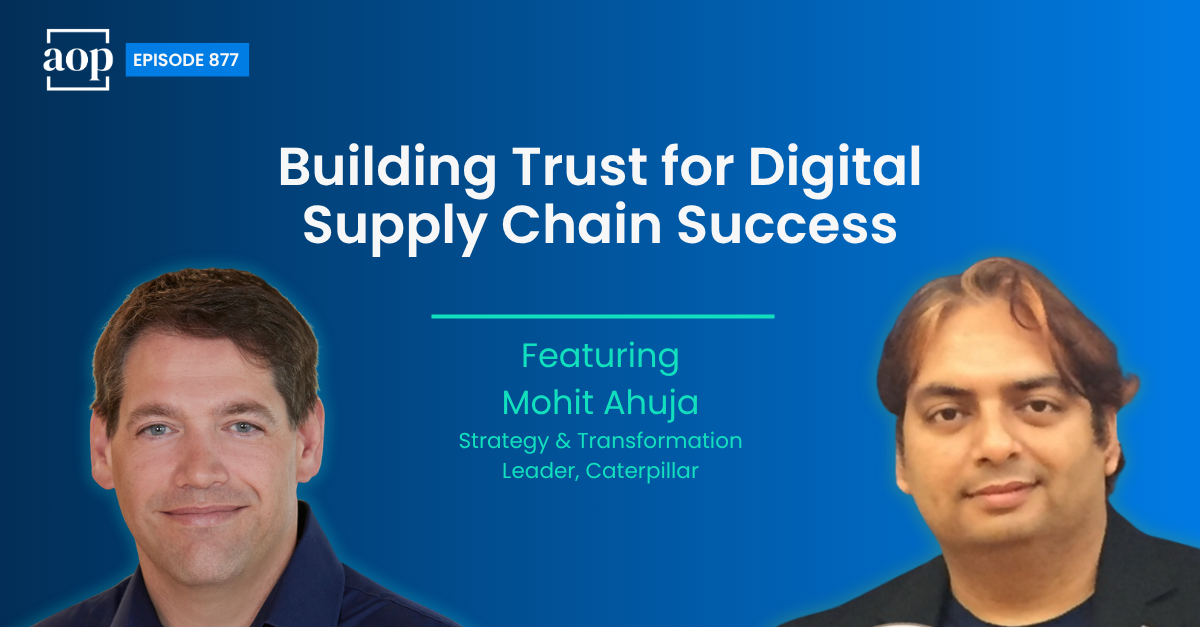
“Visibility is not the end goal. The end goal is how does that visibility enable me to make a quick decision.” - Mohit Ahuja, Strategy & Transformation Leader, Caterpillar
Most procurement transformations are less about technology and more about changing how decisions get made and how different parts of the business come together around a common goal.
That idea came through clearly in my conversation with Mohit Ahuja, a strategy and transformation leader at Caterpillar. With a background in engineering, operations, and supply chain transformation, Mohit brings a perspective that bridges functions that don't always see eye to eye. Our discussion explores everything from digital transformation in manufacturing to procurement's role in product development, risk management, and cross-functional collaboration.
Digital transformation should enable faster decisions, not just better visibility
“With AI agents coming in, seeing that visibility, making quick decisions on our behalf, and providing recommendations to have a human intervention... that's a true reality now."
For years, we've measured digital maturity by the amount of information we can put in front of people. Dashboards, alerts, and analytics all have their place, but they don't create value on their own. Better information is only valuable when it enables organizations to make better decisions more quickly. As AI and intelligent agents become more capable, procurement leaders have an opportunity to shift their focus from simply improving visibility to improving the quality and speed of decision making.
Manufacturing transformation succeeds when people trust the process
"The biggest challenge is the workforce on the ground... develop a trust with their employees before they hop on to the journey and keep them as a partner throughout the journey so that it doesn't feel like they're about to experience a change that's either going to kick them out the door or would require them to completely change the way they work."
Technology projects often fail for reasons that have very little to do with the technology itself. In manufacturing environments especially, people have spent decades developing expertise that can't simply be replaced overnight. Mohit's perspective is an important reminder that transformation is as much a leadership challenge as it is a technical one. Bringing employees into the process, communicating openly, and creating confidence throughout the journey ultimately determines whether change is embraced or resisted.
Procurement creates more value when they’re involved from the beginning
"Procurement should be part of your team from day one so that they can understand why a decision for a certain material, for a certain technology, for a certain manufacturing process is being taken. The clear expectation is coming in early into the process."
Many organizations still involve procurement too late in product development, asking teams to reduce costs after critical decisions have already been made. Early collaboration allows procurement to contribute market intelligence, supplier capability, and commercial insight before designs become fixed. Instead of becoming the function that says "no," procurement becomes a partner helping the business make smarter decisions from the outset.
Resilience deserves as much attention as cost
"Start thinking in terms of risk intelligence. What matters to operations is having the right material at the right time at the right location to ensure the continuity of flow. Think about how it would enhance your resiliency for the operations rather than just being cost competitive."
The last several years have changed how procurement leaders think about value. Cost will always matter, but resilience has become just as important. Supplier relationships, sourcing strategies, and network design all influence whether an organization can continue operating when disruption occurs.
Cross-functional collaboration starts with understanding each other's priorities
"Those early conversations have definitely helped keep engineering in check. That has only been possible now with early engagements and raising the voice when it's needed."
One of my favorite parts of this conversation was hearing both the engineering and procurement perspectives on a challenge that's existed for decades. Engineers want to build the best possible solution. Procurement wants to ensure that solution can be sourced, manufactured, and delivered profitably. Neither perspective is wrong. The disconnect comes when those conversations happen too late. Bringing teams together earlier helps everyone understand the trade-offs before they become problems, creating better outcomes for the business and ultimately for the customer.