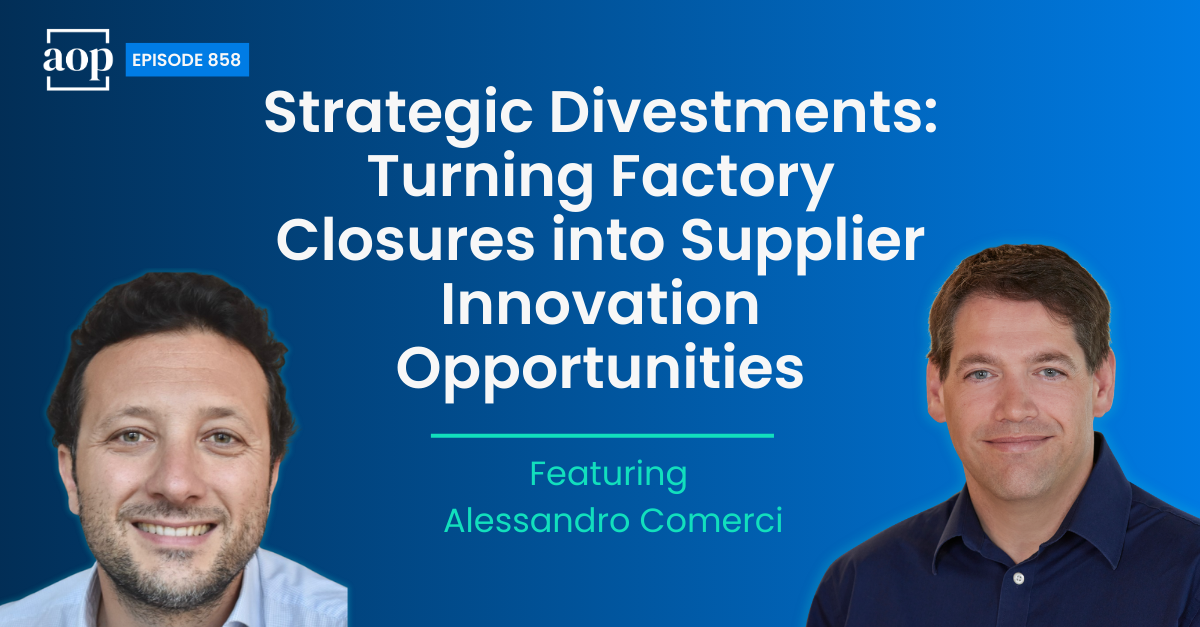
“The strategic rationale of selling is not really to make money. It’s about preserving 200-plus jobs and making sure your colleagues have continuity in their lives.” - Alessandro Comerci
Procurement leaders rarely expect to find themselves on the selling side of the table. Most of our careers are spent negotiating purchases, building supplier relationships, and managing cost and value. But as organizations reshape portfolios and rethink their footprint, procurement is increasingly pulled into other projects, like strategic divestments.
That shift forces us to apply our commercial instincts in a completely different context.
It also introduces a set of human and organizational dynamics that most procurement leaders are not used to dealing with in day-to-day sourcing.
I recently had the chance to explore this topic with Alessandro Comerci, a procurement executive who led major factory divestitures during his time at Procter & Gamble. His experience offered a powerful reminder that the most complex negotiations we face are rarely just about numbers.
Here are a few moments from our conversation that stood out to me.
Trust Can Collapse Overnight
“The moment you announce you're divesting an asset, it's like a divorce in a house. Nobody talks to each other anymore.”
That line stopped me for a moment during our conversation because it captures a reality that many procurement leaders haven’t experienced.
Inside organizations, procurement professionals often operate with a baseline level of trust. We work alongside stakeholders and employees who see us as colleagues, partners, and problem solvers.
The moment a divestment is announced, that dynamic can change instantly.
Employees who trusted leadership may suddenly see corporate representatives as outsiders. Factory leadership can feel caught between two worlds. Unions and employee groups naturally shift into defensive mode.
From Alessandro’s perspective, the biggest challenge in the process was not structuring the transaction. It was rebuilding trust after that initial shock.
This is an important reminder that relationships inside our own organizations can be just as fragile as supplier relationships. Communication, transparency, and presence become critical when navigating transitions that affect people’s livelihoods.
Commercial logic alone will not carry the day.
Know When You Need Expertise
“You've got to trust the process, and you've got to trust the external relations experts. And knowing that at the end, you'll see the light, but you've got to trust it from the beginning.”
Alessandro described stepping into territory that was completely outside his prior experience. Labor laws, union engagement, employee consultation processes, and regulatory requirements created a level of complexity that procurement professionals rarely encounter.
In his case, that meant bringing in deep experts and trusting their guidance through the divestiture process.
Strategic leadership does not mean having all the answers. It means assembling the right team of experts when the stakes demand it.
Buying and Selling Require the Same Strategic Mindset
“We look at ourselves as being procurement people are over here and sales people are over there, and we're kind of worlds apart from each other… but essentially they're very similar jobs with very similar skills.”
Many of us grew up in environments where procurement and sales were positioned as adversaries. One side pushes for margin, the other pushes for cost reductions. The narrative reinforces a natural tension.
But when you step back and look at complex negotiations, the similarities are striking.
Both roles require building trust with the other party. Both involve identifying value beyond the immediate transaction. Both require understanding long-term strategic objectives and aligning incentives.
Alessandro’s experience on both sides of the table reinforces something I have observed throughout my own career. The most effective procurement leaders think like business partners rather than tactical negotiators.
They understand how the other side creates value. They recognize where interests align. And they look for outcomes that sustain relationships rather than extract short-term gains.
The Real Value Often Appears Years Later
“Later on, the supplier that ended up buying one of our factories became one of our most innovative suppliers, giving us very fast access to market with their technology. And I actually know, because it’s a small industry and you talk, that after that deal, a few years later, P&G benefited a lot from having an expert partner who could really drive innovation that they weren’t previously focused on.
So you see, there’s always someone down the road who finds value. It’s not a silver lining in a bad situation. It’s really about asking: what is the longer-term value that we can bring?”
One of the most fascinating parts of Alessandro’s story is what happened after the deal closed.
A supplier that acquired one of the divested factories eventually became one of the company’s most innovative partners. The relationship evolved far beyond the original transaction.
This outcome reinforces a principle that experienced procurement leaders already know but sometimes forget in the pressure of negotiations: relationships outlive deals.
Every transaction shapes the foundation for future collaboration. When we prioritize trust, fairness, and long-term thinking, we create conditions where new forms of value can emerge over time.
Alessandro’s experience offers a powerful reminder for procurement: The skills that define great procurement leaders, strategic thinking, relationship building, and long-term perspective, apply just as strongly when we are selling as when we are buying.
And sometimes, the most valuable outcome of a deal is the one you only discover years down the road.