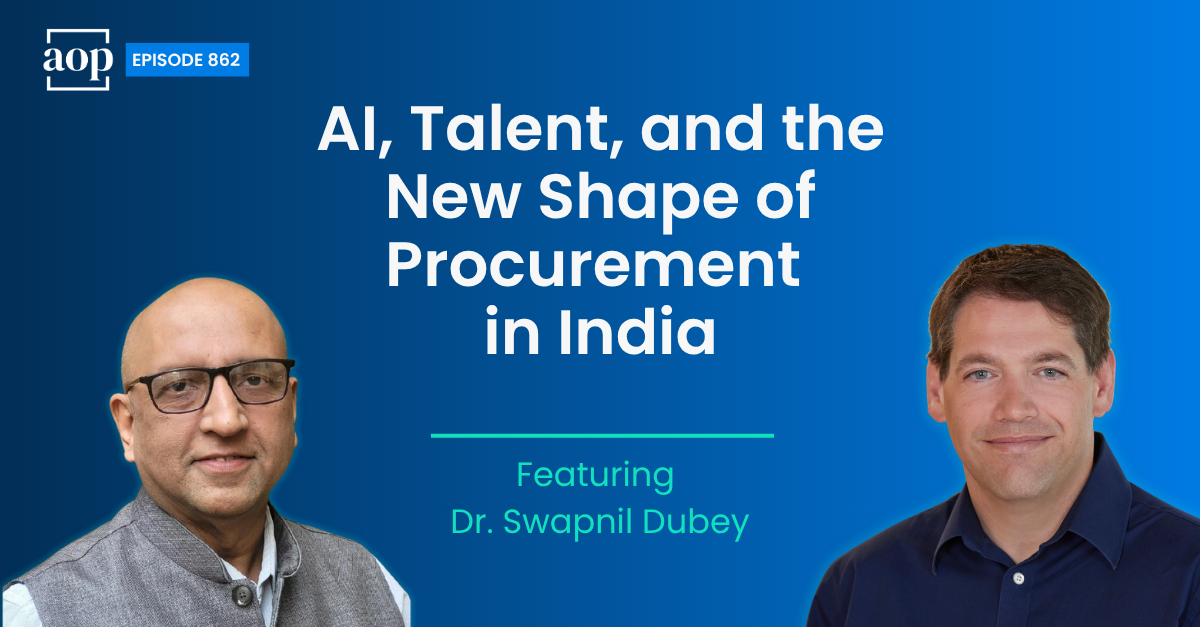
“In the AI regime, things are going to be disrupted. So be ready to be disrupted.” - Swapnil Dubey
India’s procurement landscape has evolved significantly over the past two decades. What was once seen primarily as a transactional function has steadily moved closer to the center of business strategy. That shift has not happened uniformly, and it is still playing out across different organizations and sectors.
What I found particularly interesting in my conversation with Dr. Swapnil Dubey, who joined me for this episode of the Art of Procurement podcast, is how much of this evolution is not just about capability, but about context. The maturity of procurement in India today reflects a combination of talent, organizational readiness, and increasing executive interest in what procurement can deliver.
Swapnil brings nearly four decades of experience in building procurement capability, and his perspective offers a grounded view of what has changed, what still needs to change, and where the real opportunities lie.
Executive Attention Is Fueling Procurement’s Leap
"Over the last five years, I would say that there is a lot of interest in the CEO level and the CXO level about how procurement and supply chain can add value to the organization.” This shift in executive attention is one of the most important developments for the function. When procurement is viewed through a strategic lens, the conversation naturally changes. It moves beyond savings targets and into how procurement can support growth, resilience, and competitive advantage.
What I see in many organizations is that this attention creates both an opportunity and a responsibility. Procurement leaders are being invited into more strategic discussions, but they also need to demonstrate how their decisions connect directly to business outcomes. That requires a deeper understanding of the organization’s priorities and a willingness to engage earlier in the decision-making process.
Shared Service Roots, but Local Talent Was Always Ready
“The procurement team members here in India were definitely capable of handling the kind of complexity that was required and the mindset that was required to handle such kinds of roles.” There has sometimes been a perception that procurement capability in India developed primarily through shared service models. What Swapnil highlights is that the underlying talent was always there. What changed was the introduction of frameworks, exposure, and integration with global operating models. That combination helped unlock the potential that already existed.
Tech Maturity Hinges on Process, Not Tools
“It’s not only about tools and technologies. It’s about the process maturity, and the technology must enable the process maturity.” This is a point that comes up consistently, regardless of geography. There is often a strong appetite to invest in new tools, particularly as digital solutions become more accessible.
However, without clear and consistent processes, technology can struggle to deliver the expected value. What stood out to me in this discussion is how closely process and technology need to evolve together. When organizations focus on process clarity first, technology becomes an enabler of scale and consistency. When that sequence is reversed, it can lead to frustration and underutilized systems.
AI Will Transform White-Collar Work
“The blue-collar workers are not going to get impacted so soon. It is the white-collar jobs that are going to be really impacted. And that is where the educated class and the systems of education, the entire ecosystem, is going to change over the next five, six, ten years.” The conversation around AI often focuses on efficiency, but Swapnil’s perspective highlights a broader impact. The changes are likely to be most visible in knowledge-based roles, including many within procurement. That creates a need for a different approach to skills development.
From my standpoint, this is where adaptability becomes a defining characteristic. Procurement professionals who are willing to learn, experiment, and adjust their approach will be better positioned to navigate these changes. At the same time, organizations need to think more intentionally about how they will support that transition, particularly in terms of training and capability development.
The New Career Path: Diverse and Transformation-Driven
“I've also seen some people who have worked on procurement transformation projects, and they have led the procurement transformation successfully. And… those are the people who have also gone up the ladder, and they have taken up CPO roles.” One of the more interesting shifts we discussed is how the path to procurement leadership is becoming less defined. Historically, many leaders progressed through category management or sourcing roles. While that path still exists, there is now a greater emphasis on transformation experience.
Leading change initiatives, whether they involve operating model redesign, process improvement, or technology adoption, is becoming a key differentiator. What this suggests to me is that future CPOs will need a broader skill set. Technical procurement expertise remains important, but it is increasingly complemented by the ability to lead change across the organization.
What ties all of these themes together is the idea that procurement in India, and more broadly, is moving toward a more integrated role within the business. The expectations are higher, the scope is broader, and the environment is more dynamic. For leaders, that creates a need to continuously evolve how the function operates, how it engages, and how it delivers value.


.png)