
4 min read
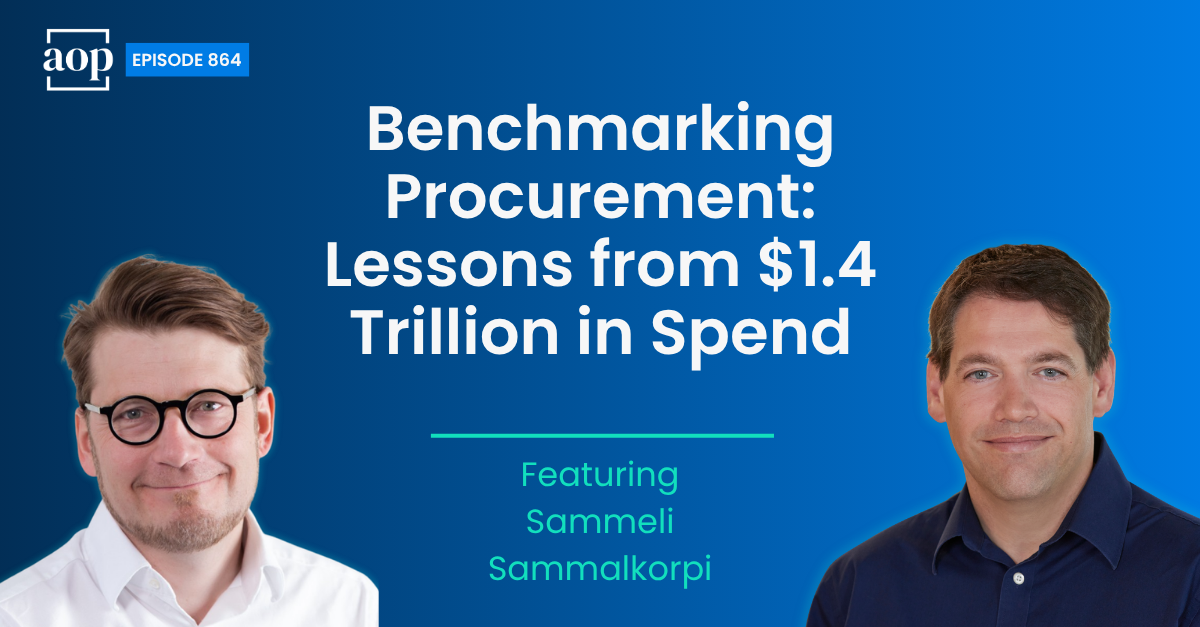
Benchmarking Procurement: Lessons from $1.4 Trillion in Spend
Philip Ideson : Updated on May 3, 2026
“Don’t speak about category savings because that’s procurement lingo. We need to speak about gross margin expansion at the end-product level.” - Sammeli Sammalkorpi, Co-Founder and CEO, Sievo
Today’s CPOs are operating in an environment where expectations continue to rise. Transparency is no longer optional. The ability to make informed decisions quickly is critical. And, perhaps most importantly, procurement is being asked to demonstrate a clear connection to business performance.
What makes this even more complex is that most organizations are still looking at their data in isolation. Without an external benchmark, it is difficult to know whether performance is strong, average, or lagging behind peers.
That is why I was particularly interested in the 2025 State of Spend report from Sievo. With insights drawn from $1.4 trillion in enterprise procurement data, it offers a perspective that very few organizations can access on their own.
In this podcast episode, I am joined by Sammeli Sammalkorpi, Co-Founder and CEO of Sievo, and Kelly Barner to explore what the data reveals and how procurement leaders can use those insights to take more effective action.
Even the Best Organizations Miss Opportunities
“Mature organizations feel that they've already done everything. That is true for a lot of the categories, a lot of the regions, and category combinations, but there's always going to be this 20-30% where you still have a lot of opportunity. So I think it's this revelation that even though you've invested a lot and you have a mature procurement organization, there's going to be a lot of opportunities on the table. And even quite simple ones, like payment terms, that's kind of an evergreen focus.”
This is a point that I see come up repeatedly when working with procurement leaders. There is a natural tendency to assume that maturity equates to optimization. The reality is more nuanced.
Even the most advanced organizations tend to have areas that have not received the same level of focus, often because attention has been directed toward more visible or strategic categories. What Sammeli highlights here is the importance of continuing to challenge that assumption.
Benchmarking at a more granular level helps uncover those pockets of opportunity that would otherwise remain hidden. In many cases, the opportunities are not complex. They are simply overlooked.
Spend Spikes Signal Deeper Issues
“Actually, to be honest, I was a bit surprised to see that Q4 spend spikes were so visible in the data. It's more of a budget holder accountability question than a procurement behavior question. But, seeing those numbers, I definitely would compare my pattern to the industry pattern and see if I'm as bad as everybody else, or even worse, or perhaps better off.”
The Q4 spending spike is something most of us have experienced, but seeing it so clearly in aggregated data reinforces just how widespread the behavior is. What I find particularly important is Sammeli’s framing of this as a broader business issue rather than purely a procurement one. That creates an opportunity.
Procurement is well-positioned to bring this insight to the business and help reframe how budgets are managed and deployed. When approached in the right way, this becomes less about enforcing process and more about enabling better financial outcomes. It also opens the door for procurement to engage more directly with finance and budget owners in shaping behavior, rather than simply reacting to it.
Payment Terms Are a Missed Lever
“If I were in procurement at a large enterprise, I definitely would look at how I can create a business case of investing in ‘X’ by freeing up some working capital. And that's very easy math to get positive cash flow very quickly.”
Working capital is an area where procurement can have a very direct and measurable impact, yet it is often underutilized. Payment terms tend to be viewed as a negotiation point within individual supplier relationships, rather than as part of a broader financial strategy. What Sammeli is pointing to here is the opportunity to elevate that conversation. When procurement can quantify the impact of payment terms on cash flow, it becomes much easier to build a compelling business case. This is one of those areas where relatively small adjustments, when applied at scale, can create significant value.
PO Policies: Not One Size Fits All
“I have a controversial opinion here. I know there are these ‘no PO, no pay’ policies, and that's seen as what procurement should go for. For me, you want to optimize for cost, for speed, for the risk, and POs are one way of doing that. I see a lot of people just do POs because a PO needs to be done. We decided to include it because the common wisdom is that you need to have a ‘no PO, no pay’ policy. But at the end of the day, I think that's in some ways quite a crude metric in terms of procurement performance.”
This is an area where procurement has traditionally focused on control as a proxy for performance. The assumption has been that more control leads to better outcomes. What Sammeli challenges here is the idea that control should always be the primary objective.
Different categories, different risk profiles, and different business contexts require different approaches. From my perspective, this reinforces the need for procurement leaders to be more deliberate in how policies are applied. Rather than defaulting to a one-size-fits-all model, there is an opportunity to align processes more closely with the outcomes that matter most for each category.
Clean Data Drives All Outcomes
“The value is in the great data that can be used by humans and by AI. From Sievo's point of view, I'm super bullish. Our capability to create a clean data set is more valuable than ever before to help people make decisions faster and eventually help agentic AI make decisions faster. And that will unlock a lot of value, but still, the basic requirement of a clean data foundation is there.”
The conversation around AI often focuses on what the technology can do. What tends to get less attention is the quality of the data that underpins those capabilities.
Without a strong data foundation, even the most advanced tools will struggle to deliver reliable outcomes. What stood out to me here is the emphasis on data as an enabler of speed and decision-making. As procurement teams look to adopt more advanced technologies, the focus on data quality becomes even more critical. It is not a separate initiative. It is foundational to everything else.
When I step back and reflect on this conversation, what stands out is the role procurement can play in bringing insight to the business. The ability to connect internal data with external benchmarks creates a level of visibility that can inform better decisions across the organization and increase procurement’s influence on how the business operates.
Links:
.png)