
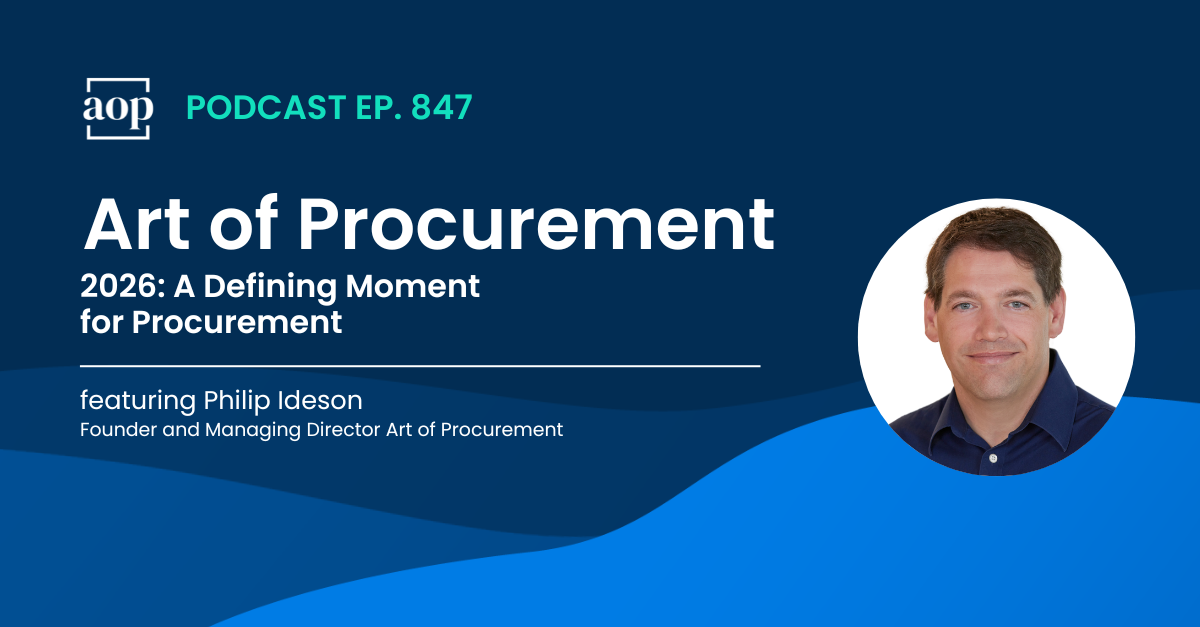
“Efficiency should fund the future, not erase the people needed to deliver it."“- Philip Ideson, Founder and Managing Director of Art of Procurement
First of all, let me welcome you to 2026. I hope you had a relaxing end to 2025 and are reinvigorated and ready to take advantage of all that the new year has to offer.
2026 marks year 11 for Art of Procurement, and what a journey it has been! 2025 was a big year for us on many fronts, and I’ve never been clearer about our role in supporting the procurement profession.
Every year since 2018, I’ve written an annual letter that shares some perspectives on the year ahead. Those perspectives are shaped by the hundreds of conversations we have every year with procurement leaders, providers, subject matter experts, and people both inside and outside the world of procurement.
In previous letters, I’ve talked about the purpose of procurement and the widening gap between teams that embrace change and those that take a conservative approach. Last year, I discussed the rise of agentic AI and the pressure to do more with less. We are still at the very beginning of that story.
A Defining Moment for Procurement
At the start of 2026, we are in a fascinating moment for procurement. For better or worse, almost every conversation I have is rooted in AI. When I talk to CPOs, the concerns I hear are consistent:
- “My boss has asked for my AI strategy.”
- “I need to do even more with less than ever before.”
- “How do I separate hype from reality?”
- “I’m struggling to get the investment I need.”
- “Will my team have the skills to evolve?”
There is an acknowledgement that procurement is likely to change beyond recognition—and yes, teams will get smaller. But there is also a lot of confusion about where to start.
Digitization: Which Path to Take?
When organizations decide to digitize or further digitize procurement, there are really only two paths they can take. Most teams don’t explicitly choose between them.
Path one is the path of least resistance, and frankly, it’s the trap most of us fall into. We take what we do today (the intake, the approvals, the sourcing events) and we just layer technology on top of it. We pave the cow path.
Sure, it makes things faster. But if that process was broken or painful for the stakeholder to begin with, you’ve just automated the friction. You haven’t solved the problem; you’ve just made a bad process run at light speed.
This creates a hidden risk. Once you hard-code these legacy assumptions into your technology, you lock them in. It becomes much harder to step back and ask bigger questions about your role and scope because the operating model becomes something you have to work around, rather than something you actively design.
The Second Path: Operating Model First
The second path is harder because it forces us to look in the mirror. Instead of asking, “Which tool can digitize this workflow?”, we have to ask, “Should this workflow even exist?”
This is about intent. It’s about designing an operating model where technology isn’t just a faster horse, it’s a car. We have to be willing to ask: What decisions do we actually need to influence? And honestly, what work should we just stop doing entirely so the tech can take over?
That is a scary conversation, but it’s the only one that leads to real transformation. When you start here, technology becomes truly enabling. It allows you to unlock something that wasn’t possible before, whether that is fewer sourcing events but better commercial outcomes, or spending more time orchestrating suppliers and less time running workflows.
Organizational Readiness: The Elephant in the Room
Now, let’s talk about the elephant in the room: readiness.
We love to talk about tech. We love the features, the demos, the shiny new AI agents. But in all the conversations I had in 2025, the teams that struggled weren’t failing because the tech didn’t work. They were failing because the culture rejected it.
Readiness isn’t about whether your laptop can run the software. It’s about whether your team feels safe enough to use it. Do they see it as a superpower, or do they see it as their replacement? When organizations aren’t ready, resistance emerges—not because people oppose change, but because they don’t feel ownership of the outcome.
A Note on Curiosity
I pick up on a quiet tension in a lot of my conversations with CPOs. When we’re speaking off the record, they tell me: “Phil, my boss wants an AI strategy, but if I’m honest, I don’t even fully understand how the LLM works.”
And you know what? That is okay. You weren’t hired to be a prompt engineer. You were hired to make judgment calls.
But in 2026, curiosity is no longer a “nice to have.” You don’t need to have all the answers, but you do need to be brave enough to ask the questions. Without curiosity, you don’t have experiments. And when experimentation stops, change happens to you instead of with you.
Start With the End in Mind
This is the most critical point I want to land today. We all know the mandate is “do more with less.”
If you use AI to free up 20 percent of your team’s time, but you haven’t explicitly defined where that time goes, that capacity will disappear. The business is very good at removing what it can’t see. If you don’t say, “We are using these hours to drive supplier innovation,” the CFO will say, “Great, we can reduce headcount.”
You have to define the destination before you start the engine, or you’ll just end up right back where you started: doing more work with fewer people. This isn’t a future scenario; it is already happening. The only way out of this loop is to decide what procurement becomes before the automation fully delivers.
Efficiency should fund the future, not erase the people needed to deliver it.
AI and automation are not the story. They are the catalyst. The real question isn’t whether procurement will become more efficient. It will. The question is whether that efficiency is used intentionally, or whether it quietly erodes the function.
The AOP Evolution
At Art of Procurement, we have looked deeply at our own operating model over the past 12 months. We grew the business by over 50 percent this year, and while we started the year as a digital media business, we invested significantly to add new capabilities and experiences:
- Events: We launched our Catalyst event series, hosting executive events in Hollywood and at Carnegie Hall. In 2026, we’ll be in San Francisco, Detroit, and New York City. These are places where leaders come prepared to work on their operating model.
- Intelligence: We acquired the ProcureTech100 and Founders’ Circle programs. They give us a strong foundation to build a comprehensive procuretech intelligence program. (You can find the 2025/26 winners at artofprocurement.com/procuretech).
- Advisory: In November, we launched our Digitization Enablement practice, led by Jyothi Hartley, to help organizations tackle tech stack strategy, organizational readiness, and process redesign.
Today, we are launching the next iteration of AOP: Real-World Intelligence for Procurement Executives.
This means that every insight we share, whether it’s on the podcast, at a Catalyst event, or through our advisory practice, is rooted in the reality of what is happening on the ground, right now. It is the synthesis of our four pillars:
- Media: The breadth of perspective from thousands of conversations.
- Events: The depth of off-the-record truths.
- Data: Validation that strips away the hype.
- Advisory: The execution "how-to" for complex change.
The Pragmatist’s Path
At AOP, we embrace the role of the Pragmatist. We believe that the “Art of the Possible” has to be tethered to the “Art of the Probable.” We are stripping away the “Function” mindset and embracing the “Business” mindset as we first explored in Procurement, Inc 5 years ago. In 2026, the goal isn’t to be a better support function. It is to be a better business operator.
2026 is going to be another year of volatility. But it will also be a year of immense opportunity for the Pragmatists in the room, the ones who are willing to do the work to build the future, rather than just waiting for it to arrive.
Links: