
5 min read
As procurement professionals, we spend time categorizing and managing our suppliers. But here's what we often miss: how do suppliers see us?
In balanced relationships, the supplier experience matters. When you understand how suppliers view and categorize you, good things happen. Supplier negotiations become more effective. Relationships grow stronger. Both sides win more often.
This is where the supplier preferencing model comes in. Let's explore what it is and how procurement professionals can use it to their advantage.
What is the supplier preferencing model?
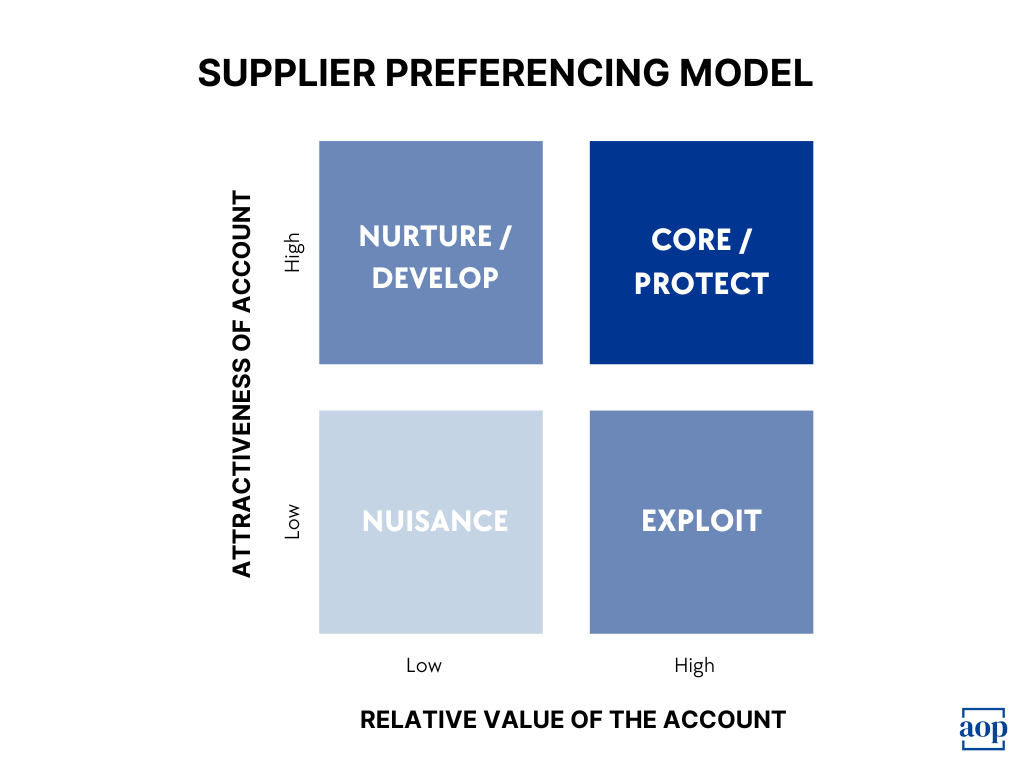
The supplier preferencing model is a four-quadrant chart that shows how suppliers view your buying organization. Some people call it the supplier perception matrix.
Paul Steel and Brian Court created this model in 1996. They wrote about it in their book "Profitable Purchasing Strategies".
Think of it as the opposite of a Kraljic matrix. The Kraljic matrix shows how you view your suppliers. The supplier preferencing model flips this around. It shows how suppliers view their customers, including you.
How the supplier preferencing model is used
The main goal of the supplier preferencing model is to see yourself through each supplier's eyes. When you understand where you stand in a supplier's portfolio, you gain real advantages:
- Predict supplier behavior and pricing strategies
- Adjust your negotiation approach for better results
- Spot opportunities to build stronger partnerships
- Use your resources more wisely across all suppliers
Where to apply the supplier preferencing model?
Strategic sourcing teams use this model regularly. In fact, it's a key part of my 7-step strategic sourcing process. The supplier-preferencing model helps build stronger category profiles.
How the supplier preferencing model works
The supplier preferencing model is built on two fundamental axes, creating a four quadrant view of the attractiveness of the buyer’s account and the relative value of the customer’s business to the supplier.
Attractiveness of account
This axis measures how appealing a customer (or account) is to a supplier. Factors influencing attractiveness include:
- Profitability: The margin a supplier can achieve on sales to the customer
- Growth potential: Opportunities for increased business volume
- Innovation collaboration: Potential for joint product or process development
- Payment terms and behavior: Reliability and speed of payment
- Operational efficiency: Ease of doing business, including order processes and communication
One factor on this list deserves more attention than it usually gets. Payment behavior is asymmetric. Paying suppliers on time does not make you a customer of choice; it is the baseline expectation. Paying late, however, actively reduces how effectively you will be able to partner with your supplier base. Procurement teams that treat on-time payment as a competitive differentiator misunderstand the dynamic. Reliable payment is the price of entry. Late payment is what costs you the relationship.
“It doesn’t necessarily make you more attractive to pay on time. It makes you less attractive if you pay late.”
— Gordon Donovan, on Art of Procurement Episode 753: Can Procurement Save the World?
The practical takeaway for category managers and supplier relationship managers is that becoming a ‘customer of choice’ rarely starts with the dramatic moves (joint innovation programs, longer-term contracts, executive sponsorship). It often starts with cleaning up the basics. Pay on time, communicate predictably, make ordering easy, and stop treating routine commercial hygiene as a discretionary act. The dramatic moves work better when you have already earned the right to make them.
Relative value of business
This axis assesses the importance of the customer’s business to the supplier. Some considerations here can include:
- Share of supplier’s revenue: The percentage of total sales the customer represents
- Volume stability: Consistency and predictability of order volumes
- Strategic alignment: How well the customer fits with the supplier’s long-term goals
- Market access: The customer’s ability to open doors to new markets or segments
- Knowledge transfer: Opportunities for learning and capability development

Limitations of the supplier preferencing model
The supplier preferencing model can give you a valuable snapshot into the perceptions of your suppliers, but its strategic role depends on how and when you use it.
Some of the common limitations of supplier preferencing models include:
- Data accuracy. It’s not easy to get reliable information about the perceptions of suppliers.
- Subjectivity. Even when you get data from your suppliers, categorizing accounts by “attractiveness” and “relative value” involves subjective judgements.
- Static snapshot of a dynamic environment. Buyer-supplier relationships can quickly change based on market conditions and changes to business strategies.
- Limited scope and complexity. By looking at supplier perceptions too narrowly, you may fail to see broader supply network interdependencies.
Bottom line on the supplier preferencing model
As procurement professionals, we need to have a balanced view of supplier relationships. The supplier preferencing model is one simple tool that can help us see things from the unique viewpoint of our suppliers.
You can use the supplier preferencing model as part of a strategic sourcing initiative, or as a way to strengthen your understanding of key suppliers.
Remember not to overthink this exercise. If you want to know how your suppliers perceive you, sometimes the best thing to do is ask them directly. While they may not always categorize your account neatly into a quadrant view, open reflections on attractiveness and value of relationship are one way to ensure transparency and alignment.