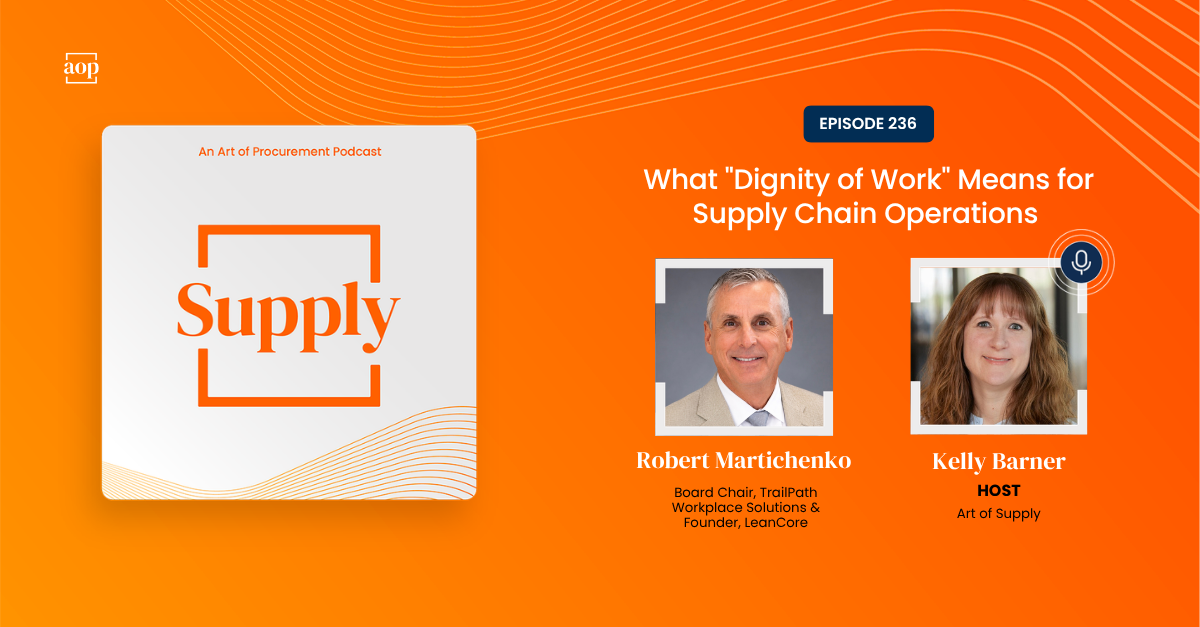
Robert Martichenko has spent over three decades in supply chain operations.
After earning a mathematics degree in the early 1990s, he took a job at Challenger Motor Freight in Cambridge, Ontario, which led him into logistics. In 1998 he moved to Evansville, Indiana, and was introduced to the Toyota Production System and lean thinking.
In 2005, he founded LeanCore, a training, consulting, and managed logistics company that he ran hands-on until it sold in 2020. He's now board chair of TrailPath Workplace Solutions, a workplace strategy company he co-founded that helps organizations improve frontline employee retention and participation.
In this episode of Art of Supply, I speak with Robert Martichenko about dignity of work: what it means, why it's different from the "respect for people" language common in lean and operational-excellence circles, and why it's relevant to procurement and supply chain leaders specifically, not just HR.
Respect vs. Dignity: What's the Difference?
Robert draws a specific distinction between two terms that are often used interchangeably.
"Respect for people" is a well-established phrase in the lean and continuous-improvement world, and Robert doesn't dispute its value, but he does argue that it is incomplete. From his perspective, respect is a decision: a leader chooses to respect someone based on their accomplishments or a personal connection.
Dignity is not a decision. It is the obligation to treat every person as a human being regardless of whether a leader chooses to or not. As Robert put it in our conversation, a leader doesn't "get to decide whether you should be treated with humanity or not."
The Four States: Declining, Surviving, Growing, Thriving
TrailPath's research places employees into one of four categories based on how they experience their workplace day to day:
Declining: Actively disengaged and likely to leave, whether abruptly or with notice
Surviving: Staying for financial or practical reasons without deriving satisfaction from the work
Growing: Cautiously optimistic that the job is working out
Thriving: Highly engaged and unable to imagine working anywhere else
Across the thousands of employees TrailPath has measured, close to 50 percent fall into the declining or surviving categories. Robert argues that the standard tools for measuring this (annual or biannual employee engagement surveys) are run too infrequently to be useful, since day-to-day experience at work fluctuates far more often than that.
The Real Cost of Turnover
Robert estimates that fully loaded turnover costs, including recruiting, onboarding, and training a replacement, run between $5,000 and $20,000 per employee, depending on tenure.
He also points out that this is only the visible cost. Unlike inventory, which at least appears somewhere on a balance sheet, turnover-related costs like safety incidents or lost customers caused by disengaged employees are difficult to trace back to their root cause, making the true cost of a disengaged workforce hard to quantify.
Why This Applies to Supply Chain, Not Just HR
Robert connects the dignity conversation directly to procurement and sourcing decisions. He describes the multi-decade shift toward global sourcing as fundamentally a cost-reduction strategy since purchased materials often represent 60 percent or more of cost of goods sold, even modest unit-cost reductions produce large savings.
That shift, however, extended replenishment cycles (from a matter of days to a matter of months in some cases), increased forecast variability, and reduced the direct relationships between buyers and suppliers that once helped absorb day-to-day disruptions. Robert argues that when the people doing the work no longer understand the purpose behind it (what's in the box, or why it matters to the person receiving it) that erosion of connection is itself a loss of dignity in the work.
He also applies a physics metaphor to organizational processes: citing the second law of thermodynamics, he argues that processes naturally drift toward disorder over time unless energy, in the form of leadership, participation, and intentional culture-building, is continually applied to counteract that drift.