

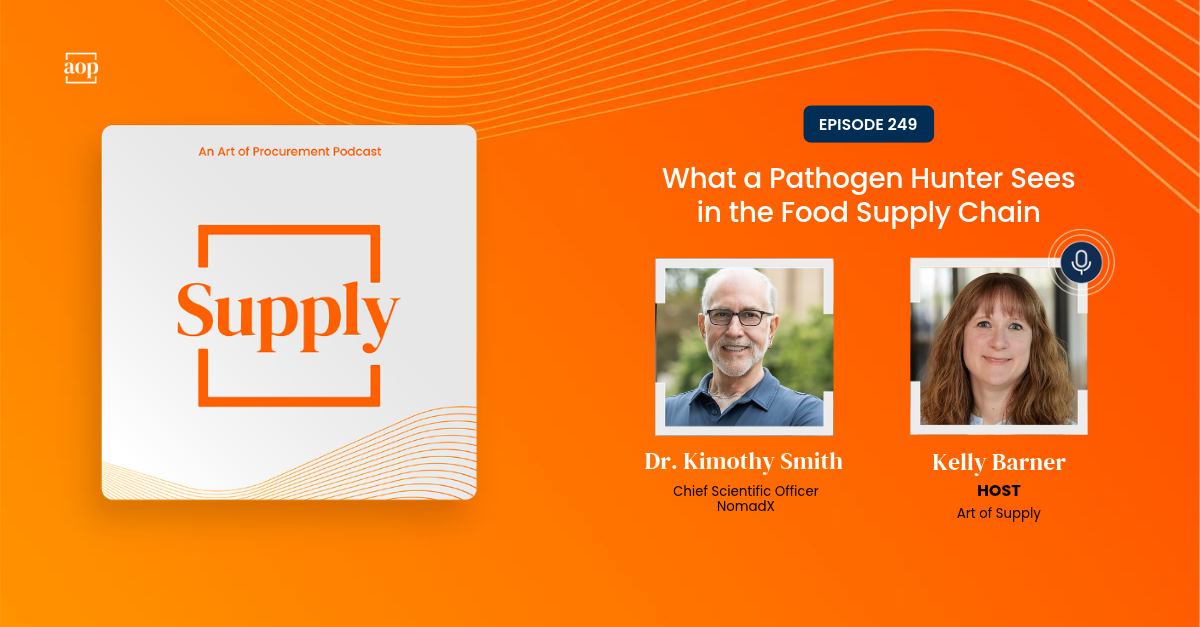
When a food recall makes the news, the coverage usually starts at the end of the story: a product pulled from shelves, a brand apologizing, and with consumers checking their refrigerators. The work that decides whether contaminated food reaches anyone at all happens much earlier, on farms and in packing facilities, processing plants and testing labs.
In this episode of Art of Supply, I speak with Dr. Kimothy Smith, Chief Scientific Officer at NomadX, about what that work involves and why it is harder than most people realize.
How does contamination move through the food supply?
Kimothy holds a doctorate of veterinary medicine and a PhD in molecular epidemiology. Before his research career, he practiced as a veterinarian for almost ten years and farmed as part of his family's operation in southwest Oklahoma.
"I did large animals, small animals, some exotics. I also farmed myself in southwest Oklahoma. I had irrigated cotton, winter wheat, ran a few cattle."
His doctoral research focused on Bacillus anthracis, the bacterium that causes anthrax. That work became urgent after the 2001 anthrax letter attacks, which killed five people and sickened 17 others. Kimothy's lab was part of the investigation.
He went on to work at Lawrence Livermore National Laboratory and the Department of Homeland Security. Since leaving government, he has worked with NomadX, applying methods for detecting pathogens in difficult environmental samples to the food safety industry.
Kimothy describes food production as a progression from more contaminated to less contaminated, with points along the way to intervene, monitor, and test.
"Things go from more contaminated, hopefully, and then to less contaminated as we go from harvest and it starts actually pre-harvest. We begin thinking about contamination, pre-harvest, harvest, and we want to begin eliminating not just all microbes and pathogens. We want to be very mindful of some key pathogens that cause issues."
In the U.S., three pathogens get the most attention: Listeria, Salmonella and pathogenic E. coli. Each finds its own ways into a product, so the right controls depend on the food, the pathogen and the stage of production.
Some routes are hard to predict. Kimothy pointed to the 2011 Listeria outbreak that the CDC traced to whole cantaloupe grown at Jensen Farms in Colorado. The FDA isolated outbreak strains of the bacteria from equipment and cantaloupe in the farm's packing facility. Kimothy remembers it as a route of contamination that had not been reported for melons before.
What does "zero tolerance" mean for testing?
Testing sounds simple: take a sample, send it to a lab, get a result. Kimothy explained why food makes each of those steps difficult.
"Food's hard. You know, the bugs get in there, they don't want to get out. It's organic material largely, and that organic material tends to defeat those things that we want to get the cells, bacterial cells, away from them."
Sampling raises its own questions: where to take the sample, how much material to collect, and how to do it quickly without adding cost. Kimothy described today's methods as adequate, and said that improving collection and concentration is one of the three pillars of NomadX's work.
Some food safety standards allow no detectable amount of a pathogen. Under the USDA Food Safety and Inspection Service's zero-tolerance standard, any amount of Listeria monocytogenes in a ready-to-eat meat or poultry product renders it adulterated. Kimothy explained what that standard means in the lab:
"That means if you want to detect it in any reasonable sample size, you have to enrich, you have to be able to grow it and multiply it because our sampling techniques currently cannot pull those single bacteria out of a large sample when we're talking actual zero, zero tolerance here. I'm not criticizing the standard or the regulation. I'm just saying it presents difficulties and challenges for not just producers, but testers, processors, the people doing the testing. It takes time."
That time matters because product waiting on a result has to be stored somewhere, and for perishable goods the wait comes out of shelf life. The goal is testing that delivers accurate results within a single production shift.
Where does innovation in food safety testing come from?
Regulators set the baseline, and Kimothy was quick to credit the scientists who build it. He sees the private sector as the place where most new testing methods will come from.
"Let's give the government scientists their due. They work really hard and they develop a lot of protocols that are applicable for a broad range of people and plants... Most of the cutting edge innovation is going to happen more appropriately in the private sector, you know, in the commercial side where maybe if they're doing well and the commodity they're dealing with is worth enough, then they can spend some on R&D."
He also noted that a regulatory requirement is a minimum, and that some producers may want to test more often than the rule requires.
"Sometimes I believe that perhaps the prescribed regulatory requirement is either vague or non-prescriptive or not frequent enough. And perhaps a producer should weigh, you know, with help, should they be doing more frequent testing for things?"
Food safety is decided long before a recall, at every step where a product is handled, stored, sampled or moved, and those steps belong to the supply chain as much as to the lab. Time spent waiting on a test result works like any other lead time, using up storage capacity and shelf life, so it deserves a place in network and inventory planning.
A processor’s testing approach, including how often it tests and how quickly results come back, is worth understanding alongside price and capacity, especially where regulatory minimums may not match the risk of a particular product. And for everyone responsible for moving goods, it helps to remember that contamination can travel with packaging and other inputs, not only with the food itself.