
3 min read
The Supply Planning Paradox: Why Bigger Budgets Don't Buy Better Outcomes
Kelly Barner : June 18, 2026
“Demand planning is the thing which everybody seems to focus on, because it's kind of theoretical. You come up with a forecast and it doesn't really influence anything. It's when you look at the supply side, that's when it becomes real.”
Every year, large enterprises pour significant capital into supply chain transformation. They implement new platforms, systems integrators, and data infrastructure. And every year, the results seem to disappoint.
This isn’t because the technology is wrong or the implementations are lacking. It is because the money is being aimed at the wrong problem.
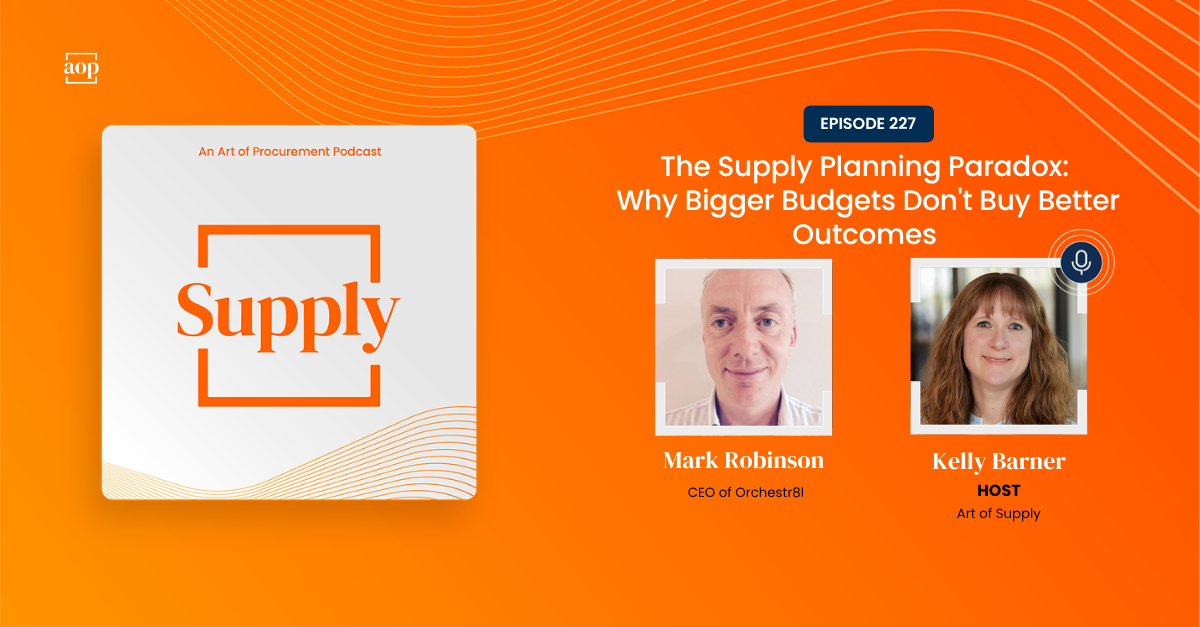
I recently had a conversation with Mark Robinson, CEO of Orchestr8, an enterprise supply chain planning platform.
Mark has more than 20 years of experience developing supply chain planning software for large global enterprises. His work has focused on helping organizations bridge the gap between planning models and operational reality, with a recent emphasis on applying machine learning and AI to supply planning challenges.
Supply planning is one of the most misunderstood disciplines in business, not just by practitioners in the trenches, but by the executives writing the checks.
The Gap Nobody Talks About
Most companies have some version of the following setup: a demand planning tool, some form of sales and operations planning, and an MRP system that produces a supply plan. On paper, it works. In practice, something else often happens.
"The fourth box that people don't really understand is where the planning sort of goes on,” Mark explained. “That's where people fire up their spreadsheet. That's where they fix the supply plan that was so perfect when it came out of the computer. And that's the bit that really interests me. And that's the bit that kind of goes on between the gaps in the system. So you can invest in your nice new shiny software tool and not really fix anything."
That fourth box, the one filled with spreadsheets, manual overrides, and tribal knowledge, is where supply planning happens. It is where the carefully calculated system output gets reworked by human hands, and it is almost entirely invisible to leadership.
Senior executives tend to believe that investing in software addresses the core issue, but if the core issue is a process that was never properly understood in the first place, no amount of software investment will fix it.
Supply Planning Is Not a Background Task
Supply chain planning sits in an uncomfortable place on most org charts. It is critical to operational performance, but rarely represented at the executive level. That distance from leadership has real consequences.
"Most senior management is not interested in understanding what the core issue is,” Mark told me. “Supply chain planning is rarely a board level position. It's seen as something that goes on in the background. But this is not a background task; it fundamentally affects the performance of the business."
For any company that makes, moves, or buys something (isn’t that most companies?) supply planning is as fundamental to performance as finance or sales. The cost of getting it wrong doesn't disappear just because no one is measuring it. Poor supply planning shows up in excess inventory, missed service levels, reactive purchasing, and margin erosion.
The Hidden Cost of Relocating the Problem
One of the trends Mark has observed is the move to shift supply planning activity to lower-cost geographies. On the surface, it looks like sound cost management. In practice, it often makes the underlying problem worse.
"Yes, your labour is less expensive, but you don't cost in things like poor service, or too much inventory. All of those things are a result of the fact that you've lost the skills, you've lost the local knowledge, all of those things that were there that you didn't recognize," Mark explained.
Offshoring a broken process doesn't fix that process, it just moves it somewhere cheaper while stripping out the institutional knowledge that was quietly holding things together. The visible labor cost goes down while the invisible costs go up.
Mark was clear that the answer isn't to keep doing what you've been doing. It's to fundamentally change the approach. Use better tools to solve the structural problems, and deploy human expertise where it can genuinely add value: on the exceptions, the edge cases, the decisions that require judgment.
What 'Getting It Right' Actually Looks Like
Companies that are making meaningful progress with supply planning tend to share a few common characteristics. They have identified specific, bounded problems within their supply chain, built focused solutions around those problems, and resisted the temptation to try to solve everything at once.
"Find a problem in your supply chain that you desperately want to solve…” Mark suggested. “Pick something that you can build a model around, and actually draw a box around with inputs and outputs, you can say what success looks like. If you can do that, you can build a supply chain machine learning model to solve that."
This is the opposite of the big-bang transformation approach that so many organizations default to. The companies seeing real returns are running targeted plays, not enterprise-wide rollouts. They're solving specific, measurable problems and then moving to the next one.
We should stop looking for solutions that can solve everything, and start looking for the thing that's costing the business the most. Define what success looks like. Build toward it. Then repeat.
The supply planning paradox, where more money doesn't produce better outcomes, isn't actually a paradox at all. It is what happens when investments follow assumptions instead of evidence. The organizations breaking that pattern aren't doing it with bigger budgets. They're doing it with better questions.