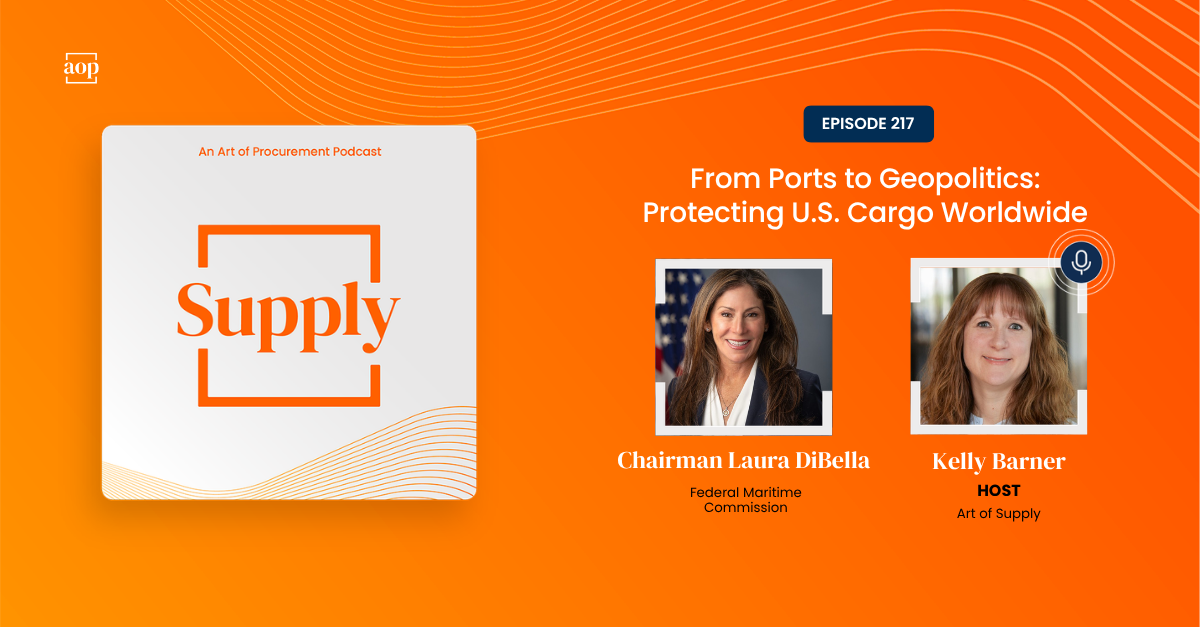
“What happens clear across the world has a very, very big impact, potentially, to U.S. cargo. We’ve had to take a wider lens look at all of the risks.” - FMC Chairman Laura DiBella
The Federal Maritime Commission is an independent agency of the Federal government. Although the organization was officially founded in August of 1961, they can trace their roots back to World War I and the United States Shipping Board.
The Board initially existed to help private companies navigate the maritime disruption resulting from the war. In 1920, their charge was expanded to include foreign laws, regulations, or practices that created unfavorable shipping and trade conditions. From the 1930s to 1960, the modern-day FMC’s scope was part of the U.S. Maritime Commission, until the responsibility for international shipping was separated off in 1961 by President John F. Kennedy.
Today, the FMC is led by a bipartisan group of commissioners, with Laura DiBella serving as Chairman. In this episode of Art of Supply, I had the opportunity to ask Chairman DiBella about the FMC’s focus and priorities, ongoing investigations, as well as her vision for the future direction of the Commission.
“We are entirely focused on U.S. cargo,” as Chairman DiBella explained. “And we are agnostic as to where that cargo is and what type of vessel it is on. So wherever that cargo is in the world (and of that, wherever, whatever intersects with that) is what we focus on.”
In 2026, that “wherever, whenever” scope is likely to include some pretty risky conditions and locations, creating an active opportunity for the FMC to get involved on behalf of U.S. container ships.
Addressing Potential Shocks to the System
Given the amount and rate of change we see in global supply chains and geopolitical conditions, it comes as no surprise that organizations like the FMC have to constantly reevaluate their direction.
“For the longest time, the FMC was dealing with regulatory activities here in our backyard, here in the United States’ backyard,” Chairman DiBella explained. “We regulate shipping lines. We regulate maritime terminal operators.”
As the risk to maritime cargo has increased over the last couple of years, the FMC found that it needed to broaden its scope.
“I think everybody understands that what happens clear across the world has a very, very big impact, potentially, to U.S. cargo. We've had to take a wider lens look at all of the risks inherent, kind of following where the puck is going, in a sense, to address any future shocks to the system.”
Some of the regulations the FMC team is using today date back to the 1980s. One example of this is the Foreign Shipping Practices Act, passed in 1988. The Act authorizes the FMC to investigate and take steps to counteract laws or practices by foreign governments that are considered restrictive, discriminatory, or unfair.
According to Chairman DiBella, FMC attorneys and economists are using the Foreign Shipping Practices Act to address laws that put U.S.-flagged carriers at a disadvantage globally.
Ensuring the Safe, Efficient, Competitive Movement of U.S. Cargo
In the interview, Chairman DiBella and I dig into three specific investigations: global chokepoints, flags of convenience, and allegations that Spain denied U.S. vessels access to ports on their way to Israel. It struck me that the FMC’s challenge is less about what to do with their authority, and more about what to prioritize.
“They're all a priority in their own right,” Chairman DiBella explained. “Probably the best part is that they're all interrelated. We can't necessarily be working on one without addressing the other. Flags of convenience, chokepoints, and the investigation on Spain are all interrelated in some way; they're very complementary in a sense.”
Private sector supply chain professionals know that there is an enormous apparatus within the Federal government working to help us globally, but it isn’t necessarily easy to keep the different pieces and how they work together straight.
I asked Chairman DiBella what she wanted listeners to take away from the conversation, how we should think about the FMC and the value they represent:
“I would love your listeners to know that we are there for them. We exist solely for them; no issue is too small,” she answered.
“All we care about is the cargo and the safe and efficient and competitive movement of that cargo. We want to ensure that business is done and it's not prohibited in any sort of way that shouldn't exist. So call us, reach out to us. We are very, very, very available. And I am in particular, so I'm not hard to find on LinkedIn or anywhere on our website. We have a very, very responsive crew that is ready to serve.”
For more information on the Federal Maritime Commission and their ongoing investigations, visit fmc.gov.


.png)