
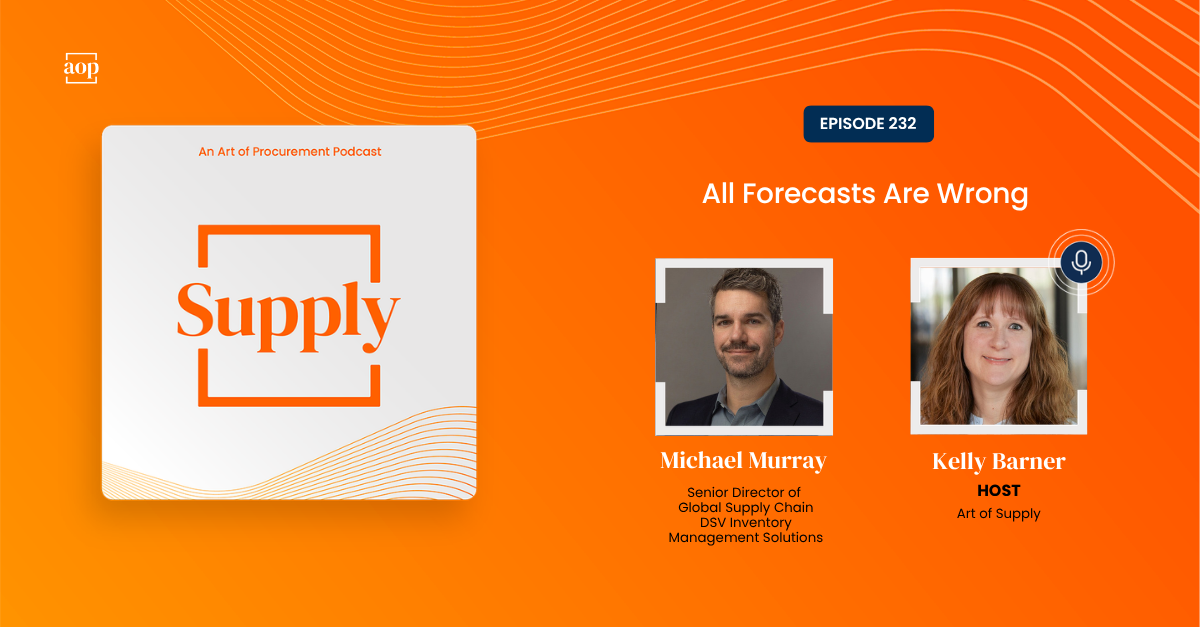
“Just-in-time inventory is great when it's working, but when it stops working, it's a huge disaster because you don't have material staged and you don't have strategic reserves.” — Michael Murray, Senior Director of Global Supply Chain, DSV Inventory Management Solutions
Just-in-time (JIT) inventory means ordering and receiving materials as close as possible to when they're needed, minimizing the amount of stock a company holds.
For most of the 2000s, lean, just-in-time principles were the dominant model in manufacturing. That shifted after a string of disruptions: a pandemic-driven toilet paper panic, the Suez Canal blockage, and a global semiconductor shortage that was estimated to cost the auto industry $210 billion in revenue in 2021 alone. This pushed many manufacturers toward holding more just-in-case buffer stock than they had before.
Michael Murray is Senior Director of Global Supply Chain for DSV Inventory Management Solutions. He joins me for this episode of Art of Supply to walk through how manufacturers are approaching inventory strategy today: the ongoing tension between just-in-time and just-in-case inventory, how trade policy is reshaping decision-making, and how third-party inventory management programs work in practice.
How Is Trade Policy Changing Inventory Strategy?
Trade policy and tariffs are increasingly the biggest driver of inventory strategy changes, according to Michael. Unlike the pandemic, which arrived with no warning, trade policy changes come with lead time. "There's a little bit of warning time so companies can adopt their strategy in advance," he said. That lead time gives manufacturers room to time their orders, use free trade zones or bonded warehousing, or position inventory in locations with more favorable trade terms before a policy change takes effect.
How Are Companies Segmenting Critical vs. Non-Critical Inventory?
Michael described a clearer case for direct, high-value components: a cloud networking company, for example, can reasonably stockpile servers and switches because they hold their value and are unlikely to go unused. Cabling and racks offer more flexibility and don't need the same treatment.
Indirect inventory (like spare parts supporting factory equipment) is harder to segment. Michael described customer networks with lists of 10,000 spare parts supporting a single tool, where nearly every part could reasonably be called factory-critical. Sorting out which parts are true stoppers versus which ones a company can operate without for a period of time is, in his words, "really difficult."
What Problem Is Third-Party Inventory Management Solving?
Michael pointed to two main drivers behind companies bringing in outside help. The first is financial: holding inventory ties up working capital and sits on the balance sheet without necessarily being a productive investment. The second is capability. Very few companies are simultaneously expert manufacturers and expert supply chain operators across transportation, storage, procurement, and demand planning. Bringing in a partner with that expertise natively is often more practical than building it in-house.
How Does a Consolidated VMI Program Work?
The most common third-party arrangement is traditional vendor-managed inventory (VMI), where an equipment manufacturer manages its own supply chain at the customer's site and folds the cost of holding spares into its pricing. "We're not an equipment manufacturer," Michael explained. Instead, the VMI provider sits between the OEM and its tier-one and tier-two suppliers, handling procurement execution across all of a customer's major suppliers. That structure makes it possible to show a customer exactly what they are spending on equipment, spares, storage, and carrying costs as separate, transparent line items, rather than bundled into a supplier's tooling price.
What Makes These Programs Difficult to Implement?
Change management is a factor on both sides of the transaction. On the buy side, companies without existing procurement-outsourcing experience often need to build new processes and shift their procurement team from tactical purchasing toward strategic supplier relationship management.
On the supply side, technical integration is usually the easy part. The harder part is commercial trust: suppliers may initially see a consolidated VMI provider as a competitor or distributor. Michael said that concern tends to ease when the conversation happens with a supplier's COO or CFO rather than only their sales or customer service contacts, especially when it includes faster payment terms than a supplier would otherwise negotiate directly with the end customer.
How Far Upstream Should Manufacturers Be Looking?
Most companies have visibility into their tier-one suppliers but not much further. Automotive is something of an exception, but Michael noted that this visibility has historically served technical and quality control rather than demand forecasting. Extending real forecast visibility three tiers upstream, he said, is something "I don't think anyone's really doing... to any major degree" right now, partly because many companies don't have a clear picture of who their tier-three suppliers even are.
What Advice Does Michael Offer for Balancing Cost, Resilience, and Supplier Relationships?
Michael's advice centers on transparency as an ongoing practice rather than a one-time disclosure.
● The choice between just-in-time and just-in-case isn't permanent. Expect the right answer to keep shifting as new disruptions and cost pressures emerge.
● Trade policy provides more lead time than pandemic-level disruptions did. Use that window to plan sourcing, timing, and inventory positioning in advance rather than reacting after the fact.
● Segmenting critical from non-critical inventory gets harder the further you move from finished-goods components into indirect and spare-parts categories.
● Third-party inventory management can reduce working capital and add capabilities many manufacturers don't have in-house, but it requires real change management on both the buy side and the supply side.
● Consolidated VMI programs tend to gain supplier buy-in faster when the pitch reaches a supplier's COO or CFO rather than only their sales or account team.
● Very few companies have forecast-level visibility into tier-two or tier-three suppliers. Closing that gap is an emerging opportunity for building a more resilient supply chain.
● Regular, transparent supplier forums, where companies share plans and act on supplier feedback, were cited as one of the most effective relationship-building practices for a resilient inventory strategy.
Michael noted that just-in-time "will always be really attractive, especially from a financial perspective," because holding inventory "takes a lot of work and capital" and carries the risk of obsolescence if a forecast turns out to be wrong.
Several years removed from the height of pandemic-era disruption, he sees companies cautiously moving back toward leaner inventory models… but with more nuance about where and how much buffer stock to hold.